
A tool for checking quantum chips found a new use in magnetism
A shortcut developed to test quantum circuits can estimate the energy of a model magnet on an ordinary processor. Rearranging the same 100 spins changes the comparison.
Reading tools for text size, copying, printing and your reading list
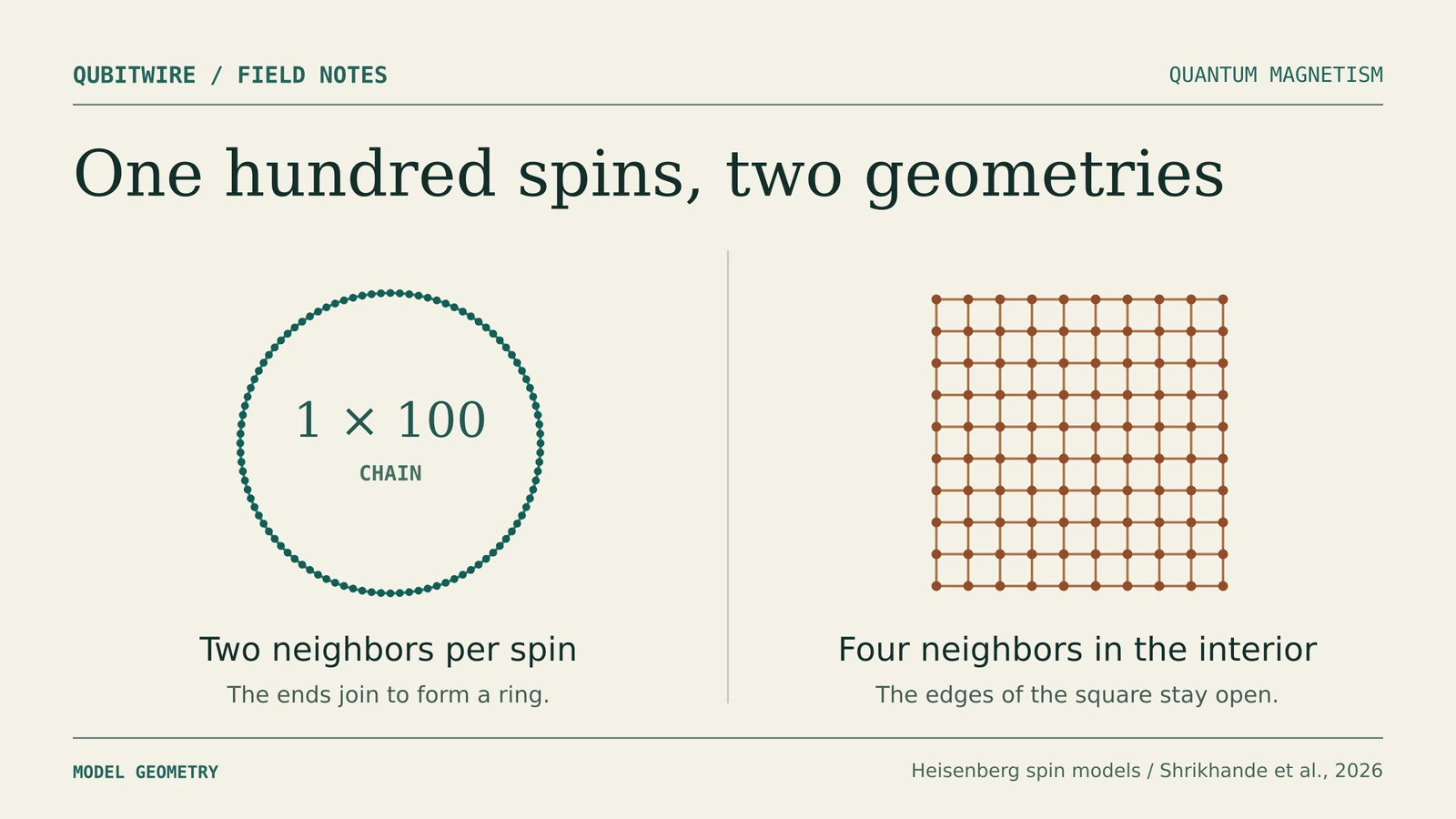
The shape of the magnet matters
Take 100 magnetic spins and join them in a loop. Now take the same 100 spins and arrange them on a square grid. An interior spin has twice as many neighbors in the square. A calculation that works beautifully on the loop can suddenly become expensive, even though the number of spins has stayed exactly the same.[2][4]
Chinmay Shrikhande and colleagues at Indiana University and Virginia Tech used a tool developed to check quantum processors to ask a familiar physics question: what is the lowest energy those interacting spins can have? Their peer-reviewed study appeared in PRX Quantum on November 2. Every calculation in the comparison ran on classical hardware.[1][2]
How to calculate one thing about many spins
Writing down every possible configuration would be a costly way to answer a question about just one quantity. Pauli propagation offers another route. It rewrites the quantity to be measured as a sum of simpler pieces and tracks what happens to those pieces when the calculation changes. Here, the quantity is the energy.[4][5]
How much time buys a closer estimate?
Four runs, one model magnet. Each run used one CPU thread to estimate the lowest energy per spin on a 10 × 10 square. A smaller cutoff keeps more terms in the calculation.
| Cutoff | Time (min) | Difference from reference |
|---|---|---|
| 0.001 | 2.5 | 0.158% |
| 0.0001 | 18.2 | 0.189% |
| 0.00005 | 39.4 | 0.141% |
| 0.00001 | 249.8 | 0.045% |
What counts as a reference?
The team ran a separate method, DMRG, on 64 CPU threads for 3,213.9 minutes. Its extrapolated energy per spin was −0.628693 in units of the interaction strength. The last column gives each run’s percentage difference from that reference. The reference is itself an estimate.
The team’s algorithm chooses changes that lower the estimated energy. It discards small terms along the way and uses the trend in the remaining estimates to predict where the energy will settle. A competing classical method called DMRG packages the connections between parts of the system differently. Chains suit that approach especially well.[1][4]
The square took 2.5 minutes under one setting
For the square, the published table reports 2.5 minutes on one CPU thread when the cutoff for small terms was 0.001. The energy per spin differed by 0.158% from the team’s extrapolated DMRG reference. Computing that reference took 3,213.9 minutes on 64 threads. The reference supplied the yardstick. These timings alone do not compare two methods at identical accuracy.[2]
This is the detail that gets lost when the result travels. The journal’s popular summary describes roughly a minute for 100-particle lattices. In the table, the chain took 1.1 minutes and the square took 2.5 at the same cutoff. The November 2025 manuscript had reported roughly ten minutes for the square; the September 2026 revision already contained the updated result. The published table lets a reader name the shape, setting and accuracy together.[1][2][3][4]
The shortcut also shows what it leaves out
On the chain, the authors asked a second question: how strongly is the orientation of one spin linked to the orientation of another far away? The reference calculation still saw correlations across the chain. The shortcut made them fade too quickly. It could come close on energy while missing a feature of how that energy was organized.[2][4]
That distinction matters when choosing a tool for a real problem. Someone screening models for a promising energy can use a quick estimate. Someone investigating long-range magnetic order needs to test the correlations themselves. The same demand belongs in a future quantum-computing benchmark: specify the property that matters, then ask how accurately the best available tools can recover it.[2][5]