
A crystal quantum memory got more than 90% of its light back
The laboratory device recovered 90.2% of the light in a test with very faint pulses. A separate measurement asked how faithfully the memory preserved a qubit.
Reading tools for text size, copying, printing and your reading list
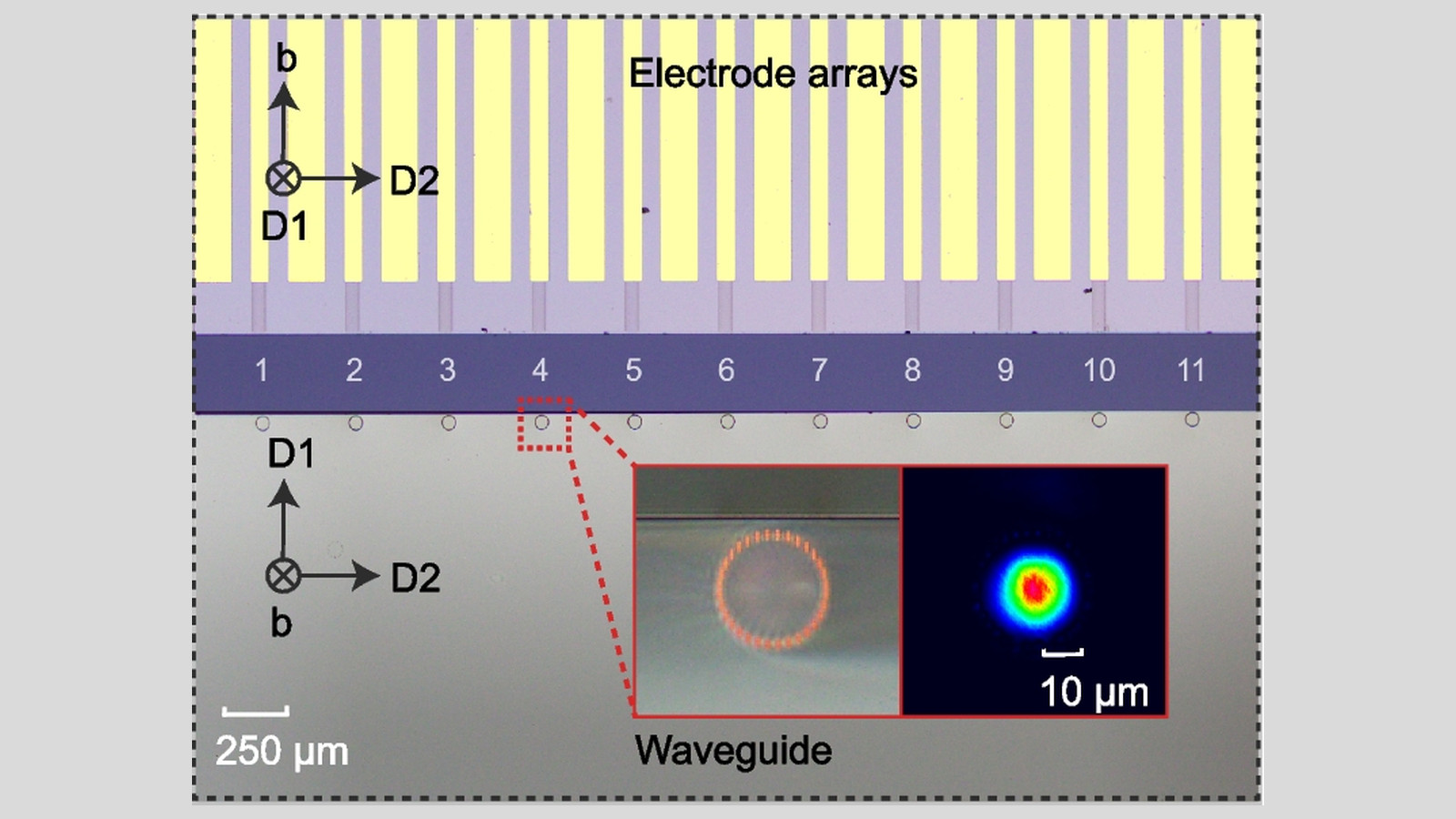
A quantum network may need to hold information on one link while it waits for another link to catch up. That only works if the memory can give the information back. In a paper published November 25 in Physical Review Letters, Pei-Xi Liu and colleagues reported that a memory built into a crystal retrieved 90.2% of the incident light in a test with weak pulses at the single-photon level. The team reported an uncertainty of 0.4 percentage points. That is a laboratory measurement of the memory, not the fraction of signals delivered through a network.[1][2][5]
Using the crystal as a light trap
The device is made from yttrium orthosilicate, a crystal containing a small amount of the rare-earth element praseodymium. Light travels down a tiny channel in the crystal, called a waveguide. The channel acts as part of an optical cavity, where light can pass the praseodymium ions more than once. The ions absorb the light, temporarily taking on the information it carried. The challenge is getting the signal back out without losing too much light along the way.[1][3]
The researchers reduced losses in the waveguide and used light to prepare the ions so that other transitions would be less likely to absorb the signal. They also adjusted the shape of the incoming pulse using a simple idea: take the pulse the memory gives back and reverse its shape in time to get a better input. The American Physical Society’s account says the team repeated that process four times. It shapes the light going in; it does not reverse the passage of time.[1][3]
Getting light back is not the same as getting the state right
Efficiency tells you how much light comes back. Fidelity tells you how closely the recovered state matches what went in. In a separate measurement, the paper reports a fidelity of 99.3%, with an uncertainty of 0.1 percentage points, for encoded across an earlier and a later pulse. A memory can score well on fidelity and still lose too many of the incoming signals. Neither number alone tells you the performance of a complete link. The 90.2% result used attenuated light pulses, not a stream of individually heralded photons from a separate quantum node.[1][5]
A memory can help when two attempts to connect neighboring parts of a network succeed at different times. Instead of starting both attempts over, a working node could hold the first result until the next one is ready. That makes the wait time and the ability to choose when to read the memory separate engineering problems from getting the light back.[3][4]
The result makes a case for a compact crystal memory that gives back most of the light it takes in. It leaves a different question open: how much of that efficiency can be retained when the same device has to hold information long enough for a network to need it and release it when asked? That matters more for connecting distant links than a stand-alone efficiency number.[1][4][5]