
A crystal setup caught more pairs of entangled photons
By giving the photons different polarizations, researchers could send them to separate detectors instead of leaving the split to chance.
Reading tools for text size, copying, printing and your reading list
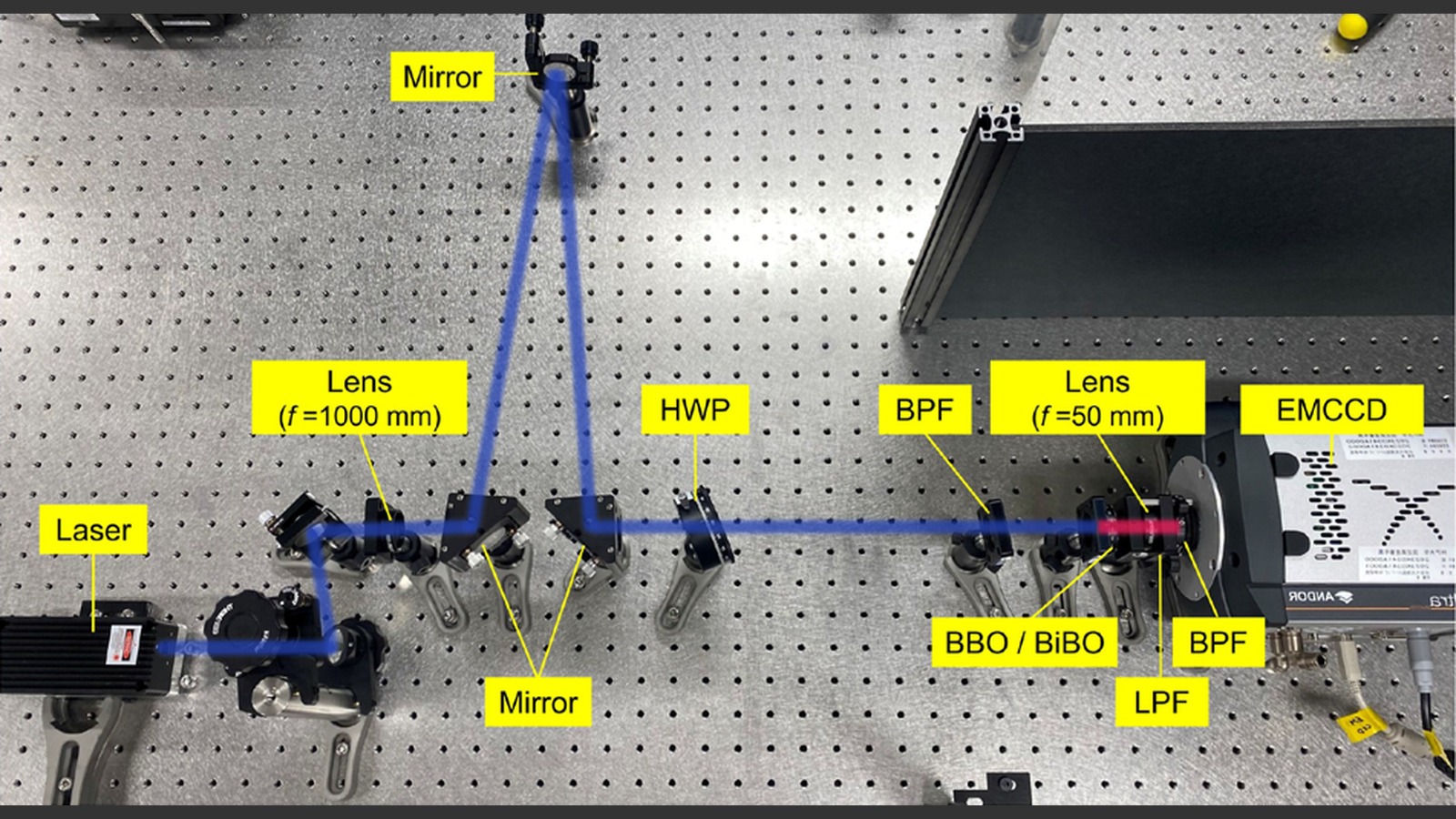
Making two photons isn’t the same as catching them both. In a new experiment, researchers found a way to collect more pairs of photons using a crystal and a simple trick: give the two photons different polarizations so they can be routed apart. The new setup still detected more pairs after the researchers adjusted for the advantage of that split. And the team found evidence that the pairs shared more than a simple two-way quantum link.[1]
The experiment starts when laser light enters a crystal called beta-barium borate. Occasionally, one photon from the laser is converted into two lower-energy photons. To use a pair, the team needs both detections. In the comparison setup, the photons had the same polarization, so a conventional beam splitter sent a pair to two separate outputs only about half the time. The new setup created photons with perpendicular polarizations. A splitter that sorts by polarization could send one to each output without relying on that coin flip.[1]
The camera saw more than a better split
The researchers compared both sources using the same pump and camera settings. For each milliwatt of pump power, the camera recorded about 1,128 pair detections a second with the new source and 389 with the comparison source. The team doubled the latter number to estimate what it would have recorded without the splitting penalty. Against that adjusted baseline of about 779, the new source still delivered about **45 percent more detected pairs**. The experiment compared two particular setups. These are camera counts, not a tally of every pair the crystal produced.[1]
That matters because a measurement like this only sees the correlations in the pairs it actually catches. One photon detected on its own does not tell you where its partner landed. Getting both makes it possible to look for patterns in thousands of paired detections, rather than trying to infer those patterns from two separate totals.[1]
What 62 dimensions means for two photons
The team divided each camera view into 121 possible spatial modes. It measured which pairs of locations clicked together, and then made a separate measurement of the directions the photons traveled. In the position measurements, partners tended to land at corresponding places. In the direction measurements, the two photons tended to head opposite ways across the beam. Using both sets of measurements, the researchers reported evidence of entanglement spanning at least 62 spatial modes within the set they tested. That number describes the breadth of the shared state, not the number of photons or .[1]
The researchers also used the correlations to reconstruct a test object in the laboratory. They did not demonstrate a deployable imaging system or show that it beats a conventional camera on a real-world task. The immediate result is a source that gave this apparatus more usable pair detections and showed strong spatial correlations in the same apparatus.[1]