
Skip to content
HARDWARE · EXPLAINER · QUANTUM CURIOSITIES

This Diamond’s Flaw Is the Whole Point: It Can Hold a Qubit

A missing atom can be useful hardware, and different diamond designs have very different ideas about staying cool.
Sources checked Published
My reading list
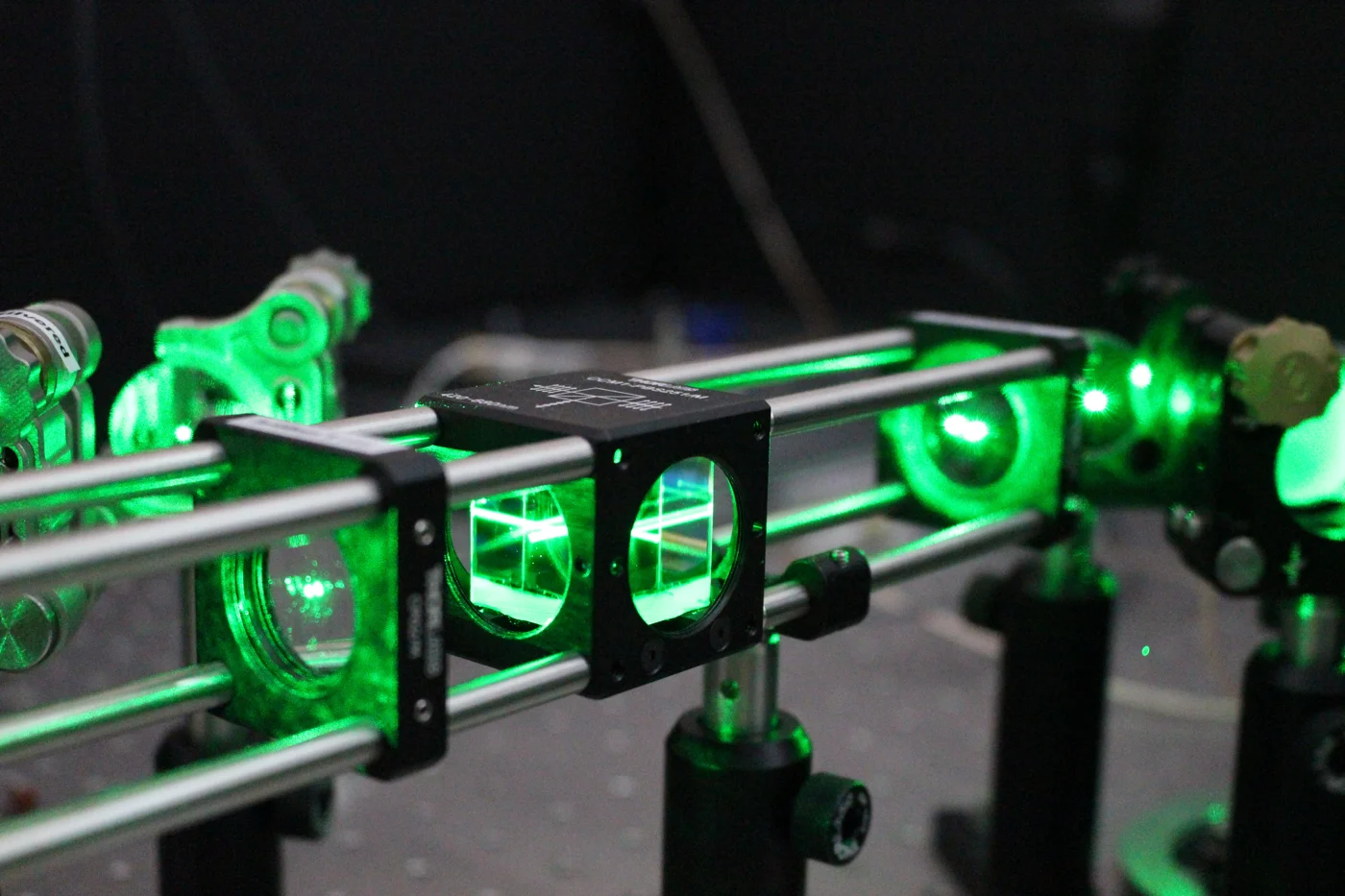
A green laser and beamsplitter used to control nitrogen-vacancy centers in Gavin Morley’s laboratory. This is not the Fraunhofer accelerator or QuTech prototype.
Photo: Gavin Morley

A green laser and beamsplitter used to control nitrogen-vacancy centers in Gavin Morley’s laboratory. This is not the Fraunhofer accelerator or QuTech prototype. Image credit“Attocube beamsplitter GWMorley” — Gavin Morley. CC BY-SA 4.0. · https://creativecommons.org/licenses/by-sa/4.0/

For a jeweler, a diamond’s imperfections can be a problem. For a quantum engineer, the right imperfection can be the useful part. Researchers deliberately work with tiny defects in diamond that provide quantum states they can control, turning an otherwise unlikely material into a computing building block.

One example is a nitrogen-vacancy center. NIST explains that it combines a nitrogen atom replacing a carbon atom with an empty neighboring site where another carbon should be. The defect’s electron spin has distinct quantum energy states that can be manipulated with light and microwaves.
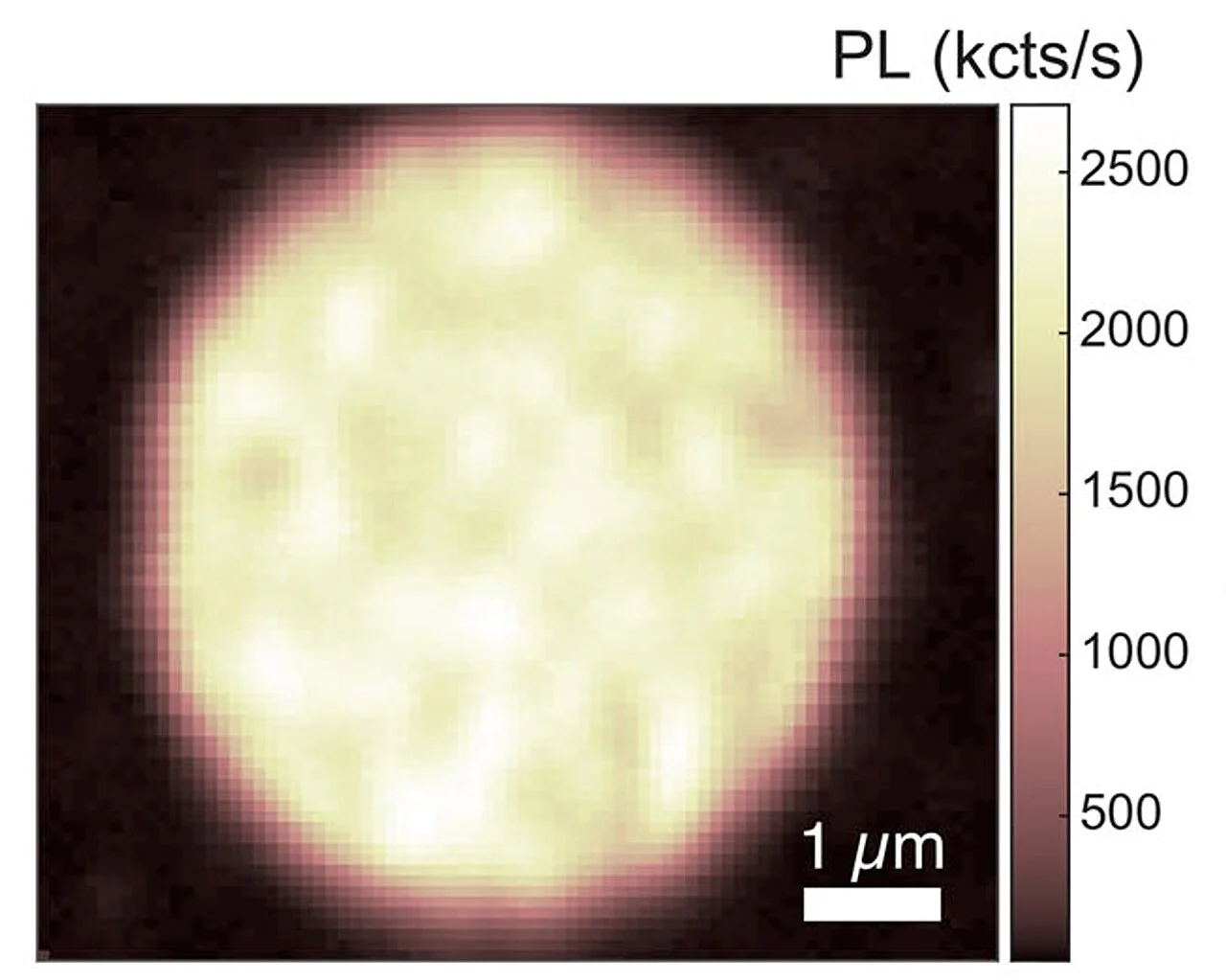
Fluorescence microscopy reveals a concentrated spot of nitrogen-vacancy centers in a diamond sample. The color scale records measured light emission; this is not a drawing or a photograph of either computer discussed here.
Fluorescence microscopy reveals a concentrated spot of nitrogen-vacancy centers in a diamond sample. The color scale records measured light emission; this is not a drawing or a photograph of either computer discussed here. Image credit“Irradiated spot of diamond with high concentration of nitrogen-vacancy centers” — Lillian B. Hughes, Zhiran Zhang, Chang Jin, Simon A. Meynell, Bingtian Ye, Weijie Wu, Zilin Wang, Emily J. Davis, Thomas E. Mates, Norman Y. Yao, Kunal Mukherjee, Ania C. Bleszynski Jayich. CC BY 4.0. · https://creativecommons.org/licenses/by/4.0/

Some diamond computing hardware can even work without a giant cryogenic fridge. Fraunhofer reported installing Quantum Brilliance’s diamond-based accelerator in May 2025, in a standard server rack alongside conventional computing hardware. It uses nitrogen-vacancy centers and was introduced as a platform for research and hybrid quantum-classical algorithms.

But diamond does not automatically mean room temperature. A September 9, 2026 QuTech announcement describes a different prototype using tin-vacancy centers, operating at about 1.55 kelvin, or minus 271.6 degrees Celsius. It combines a diamond spin system with tiny optical components designed to guide emitted photons.

That prototype contains one module; it has not yet demonstrated optical connections between multiple computing modules. The proposed payoff is eventually linking separate quantum processors with light. Both examples show why diamond defects attract researchers, while useful scale and computing performance still depend on much more than choosing a remarkable material.

READ NEXT

Continue exploring

All Hardware stories
  1. Explore the related question

    Your Quantum Program Gave a Different Answer. That May Be Good News.

    Repeated results can look inconsistent even on a perfect quantum device. The useful answer often lives in the pattern that emerges across many runs.

    Sources checked
  2. Hardware desk

    Some Quantum Computers Move Their Atoms to Do the Math

    In trapped-ion machines, getting the right qubits together can mean giving the atoms a carefully controlled commute.

    Sources checked
THE QUANTUM BRIEFING

A clearer signal.
Straight to your inbox.

A little perspective on a fast-moving field.

Read a briefing preview →

Selected quantum coverage in a weekly briefing. Read the preview or register your interest.