
A diamond amplifier offers another way to hear faint quantum signals
A newly peer-reviewed experiment boosts microwave signal power without superconducting circuitry, but still trails leading amplifiers on noise and bandwidth.
Reading tools for text size, copying, printing and your reading list
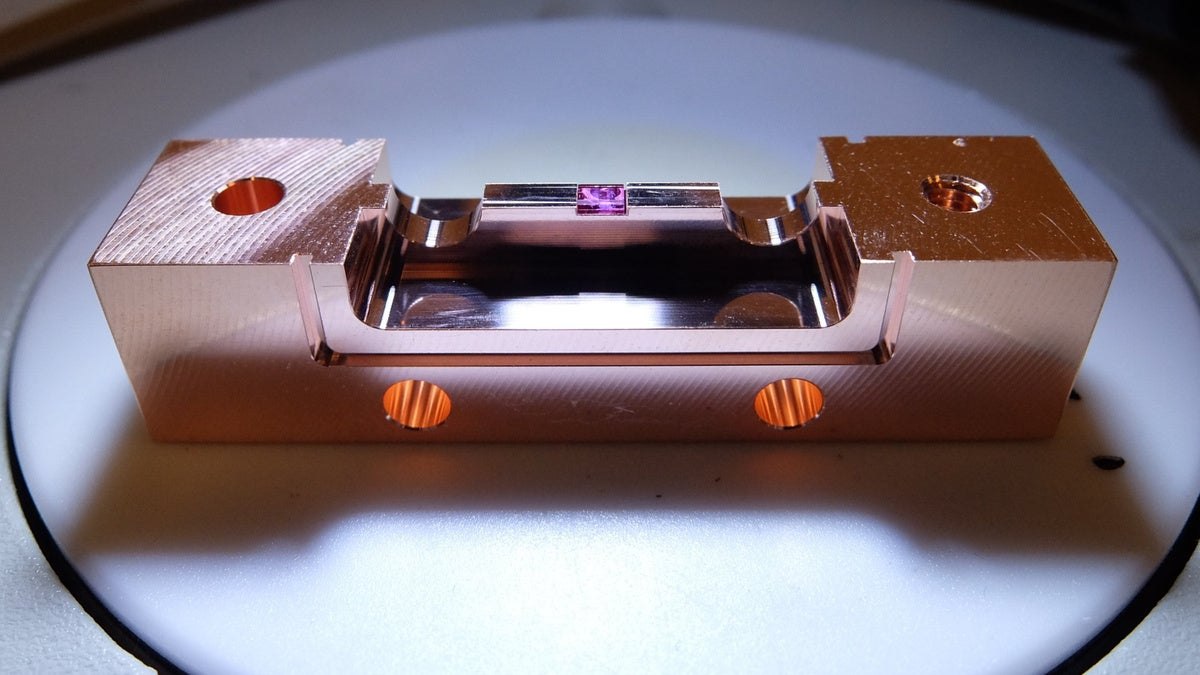
Researchers led by Okinawa Institute of Science and Technology report more than 1,000-fold amplification of microwave signal power in Nature Communications on November 16. The fresh milestone is peer-reviewed publication: the experiment first appeared in a May 2025 preprint.[1][2]
The maser, a microwave relative of a laser, amplifies signals using nitrogen-impurity electron spins in diamond instead of a superconducting circuit. A microwave pump supplies energy; a dilution refrigerator keeps it close to absolute zero.[1]
Making a signal bigger is only half the task. An amplifier also adds noise that can obscure the information researchers want. The published experiment reports minimum added noise of 3.05 ± 0.23 quanta, including the half-quantum theoretical limit. That is not noise-free amplification, and the maximum gain is not a claim of 1,000-fold better sensitivity.[1]
The supporting methods show the engineering behind those measurements. The team used a calibrated noise source, controlled the microwave wiring and added a cancellation signal to suppress the pump before it reached later electronics. For saturation tests, it bypassed the following transistor amplifier so that this component would not set the measured limit.[3]
This is still a laboratory amplifier, not a demonstrated upgrade to a quantum computer. Its noise, gain-bandwidth performance and frequency tunability do not yet match leading superconducting alternatives. Reading semiconductor and searching for dark-matter signals are possible applications, not results established here.[1]