
A diamond probe maps hidden fields inside a superconducting chip
EPFL researchers combine two imaging methods to see where a circuit’s signals live, while accounting for how the measurement changes the device.
Reading tools for text size, copying, printing and your reading list
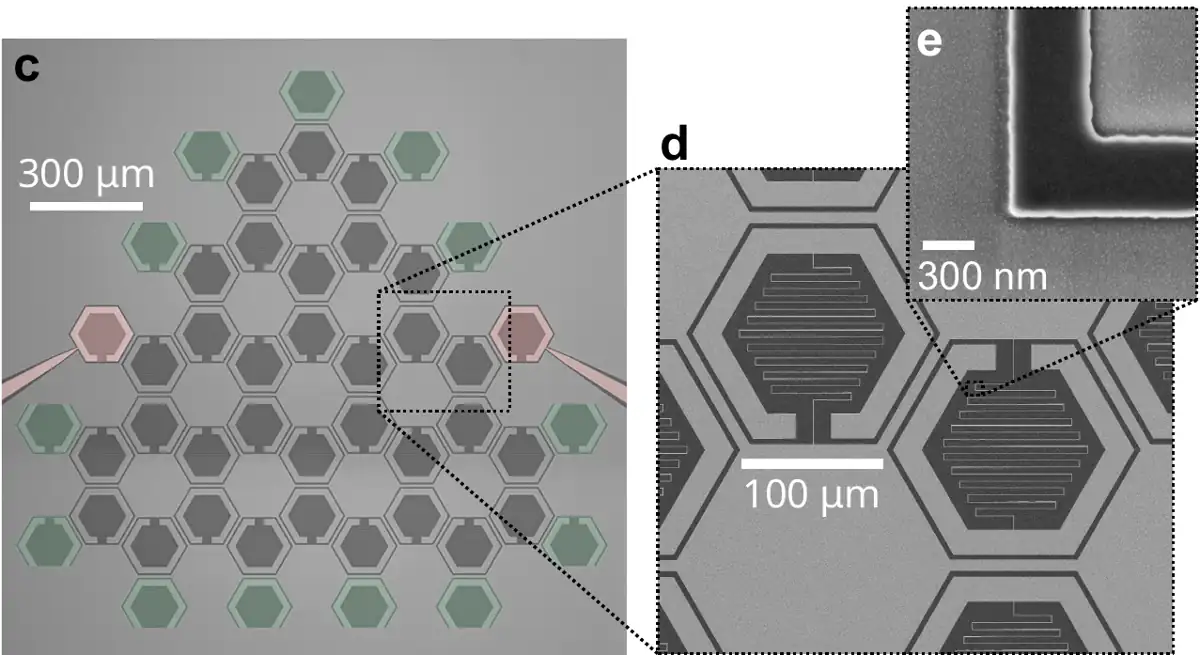
Researchers at EPFL have combined laser scanning with sensors inside diamond to inspect a superconducting chip in ways its input-and-output signals cannot reveal.[1]
Their November 10 preprint, not yet peer reviewed, reports experiments on 33 connected microwave resonators arranged in a honeycomb. These structures sustain oscillating electrical signals; they are components for quantum research, not a 33- computer.[1]
Think of the difference between hearing a musical note and seeing which part of an instrument is vibrating. A frequency tells you something useful, but a spatial map answers another question: where is the activity concentrated? For a chip designer, that distinction separates a signal at a connector from a picture of its distribution inside the device.
Benedek Gaál and colleagues used a weak scanning laser to map the array’s natural oscillation patterns, called modes. The probe temporarily disturbs superconductivity, and its effects can spread beyond the illuminated spot. Comparisons with simulations helped separate that measurement effect from the chip’s structure.[1]
Defects in diamond called nitrogen-vacancy centers supplied a complementary map of the driven microwave magnetic field. The team delayed the microwave pulse until the chip recovered from laser illumination. Placing the diamond itself also shifted the circuit’s properties, an effect included in their modeling.[1]
The lesson is practical: a probe can reveal a device and change it at the same time. Using two views is valuable only when researchers understand what each measures. A striking image alone cannot establish that a circuit behaves as designed.
The experiment tested weak signals in a linear regime, where the response scales with the drive. Extending spatial measurements to interacting, nonlinear systems is a proposed next step, not an achieved quantum-computing result.[1]