
Tiny energy drains help quantum chips start fresh
A Beijing experiment tests a fast reset without extra reset-specific wiring. The important result is where the qubits end up, not just how quickly they lose energy.
Reading tools for text size, copying, printing and your reading list
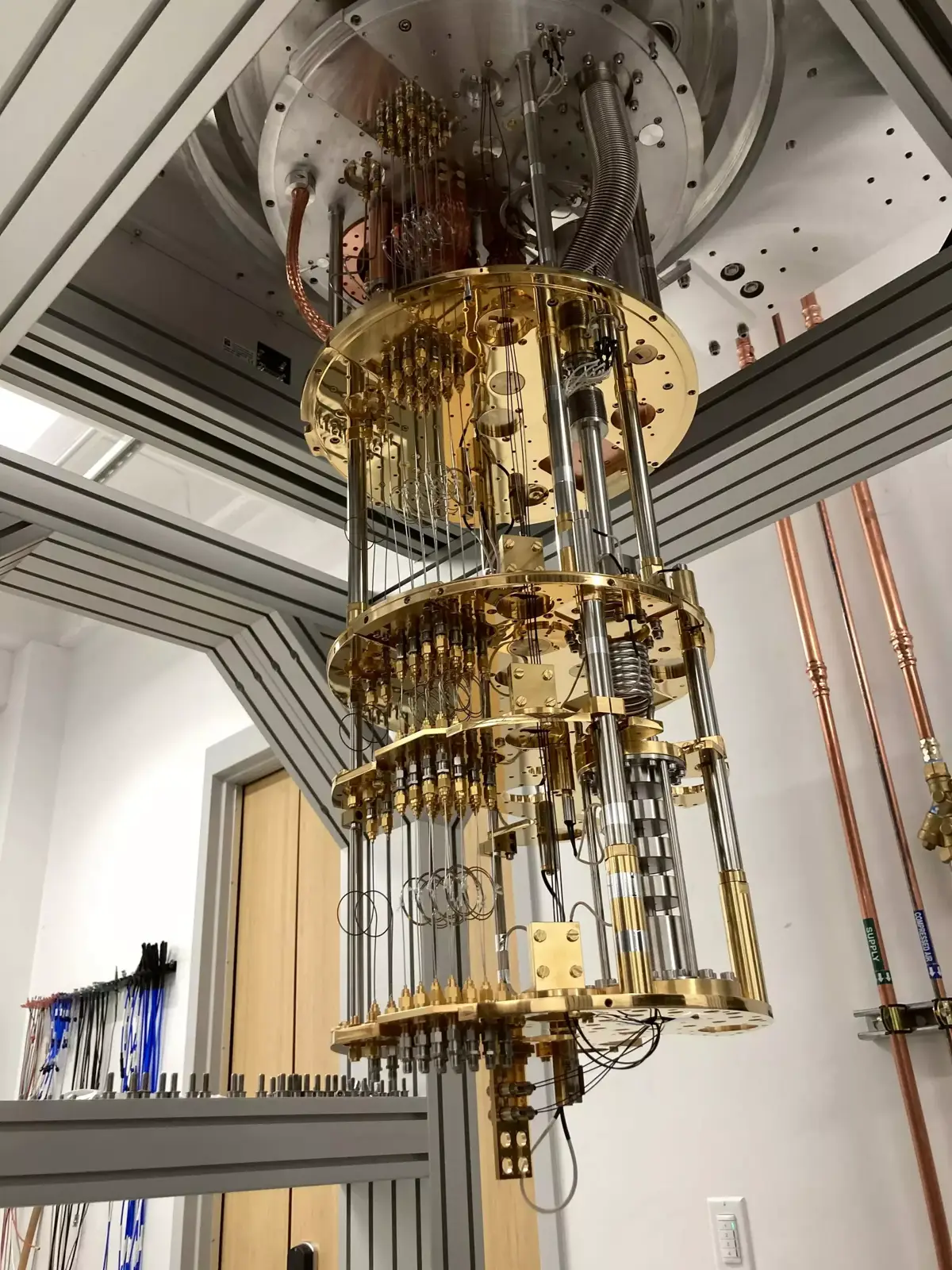
A quantum chip needs a way to start over. Researchers in Beijing have tested tiny energy drains built into a superconducting processor, using a 400-nanosecond pulse to clear unwanted excitation from , the circuits that carry quantum information.[1]
The experiment measured 20 qubits on a 72-qubit test chip. When the measured qubits started excited, carrying extra energy, the median fraction of readouts still classified as excited after the pulse was 0.67%. The November 10 preprint reports a promising hardware component for repeated computation, not a complete error-corrected machine.[1]
A drain that can be switched on
Resetting matters because a qubit often has to return to a known starting state before its next job. Residual energy can spoil that preparation. Repeated error checks make the problem particularly demanding: the computer must keep preparing and measuring qubits rather than waiting for them to settle naturally.[1]
Feiyu Li and colleagues at the Beijing Academy of Quantum Information Sciences and collaborating institutions give each qubit a dedicated resonator, a circuit that exchanges energy efficiently at a particular frequency. Several resonators connect to a shared line ending in thin palladium–gold resistors.[1]
A control pulse tunes a qubit into resonance with its energy drain, allowing excitation to escape, then returns it to its operating frequency. The resistors sit on the chip, avoiding additional reset-specific connections to external microwave circuitry. The drain itself is passive; activating the reset still takes a control pulse.[1]
That separation is the engineering idea: the qubit should lose energy quickly when it needs a fresh start, but retain it during a calculation. Building a stronger drain is not enough if it also washes away information at the wrong time.
Read the reset result, not just the fastest number
For qubits prepared in the excited state, the median excited-state reading fell from 94.74% without reset to 0.67% with the 400-nanosecond pulse. For qubits prepared in the ground state, the lowest-energy state, it fell from 0.70% to 0.29%. The team used the same measurement threshold with and without reset, collecting 8,192 readings per prepared state under each condition.[1]
These are classified measurement outcomes, so preparation and readout errors remain part of the picture. The qubits were tested in groups to reduce interference; the paper does not demonstrate simultaneous reset of the entire 72-qubit processor.[1]
The authors also report a median decay time constant of 48.1 nanoseconds during reset, compared with 24.6 microseconds away from resonance. A time constant describes how quickly excitation decays, not the moment every qubit has finished resetting. The residual-excitation results above come from the longer 400-nanosecond pulse.[1]
Getting back into the computational states
A second test tackles leakage: population escaping into a third energy level outside the two used for computation. On one qubit, Q0, a 400-nanosecond pulse reduced readouts classified as that third level from 77.54% to 0.51%. Most post-pulse readings instead indicated the excited computational state.[1]
Returning from an unwanted third level is therefore a different job from reaching the lowest-energy starting state. A future sequence would need to account for both. This is a useful way to judge reset claims: ask where the qubit starts, where it ends and which measurement supports the answer.
No journal publication is listed in the preprint record. The authors identify better thermal connections, pulse control and the balance between reset speed and unwanted energy loss as next engineering steps. The important next evidence would be reliable repeated operation and improved error-correction performance, beyond these component measurements.[1]
Keep your reading trail
Keep up with these topics
Explore the subjects covered in this story.