
Quantum gates take instructions through 10 kilometers of fiber
A new experiment delivers control signals between ultracold systems. It shows why connecting quantum processors requires more than transporting quantum information.
Reading tools for text size, copying, printing and your reading list
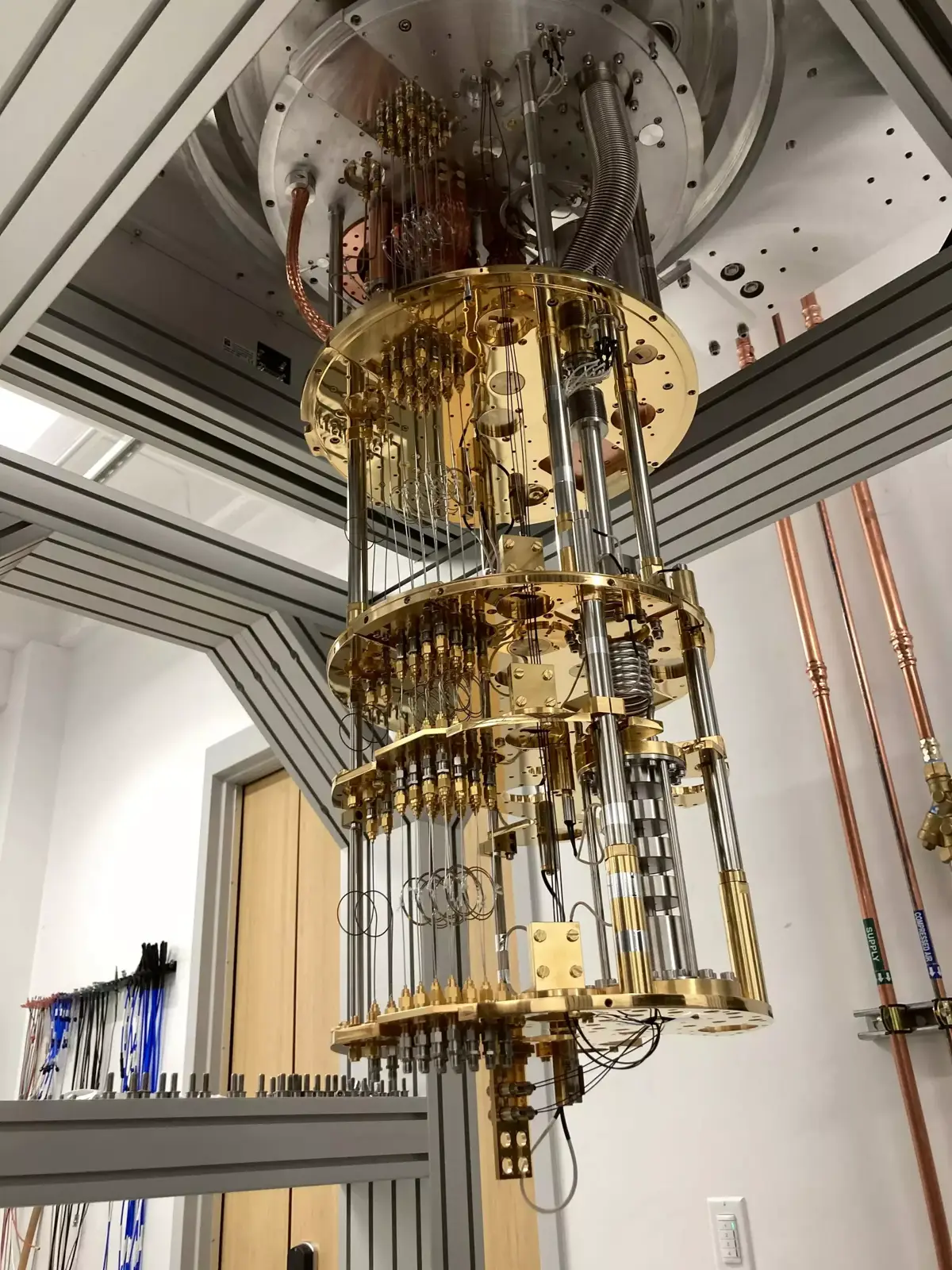
Researchers have delivered the instructions for quantum operations through 10.1 kilometers of optical fiber. The experiment connects control hardware in one ultracold refrigerator to two qubits, the units that carry quantum information in another, testing a way to deliver controls between separate modules.[1]
The important distinction is what traveled. The cable carried classical control signals, not an quantum state. Both qubits involved in the reported entanglement experiment were inside the receiving refrigerator.[1]
Quantum machines need ordinary instructions
A quantum computer still needs ordinary commands: when to apply a pulse, how strong it should be and how that pulse lines up with another. The useful question is not just how to preserve delicate quantum information, but how to deliver those instructions reliably.
Think of musicians following a shared beat. Sending each musician the right notes is not sufficient if the timing reference drifts.
The team converts microwave control waveforms into light, sends them through fiber and converts them back at the receiving end. A shared optical reference helps compensate for frequency differences between devices. The experiment controls a and a cavity qubit, which stores information in an electromagnetic field.[1]
Two different performance questions
The November 9 preprint reports an average elementary single-qubit of 95.36%, with a reported uncertainty of ±0.13 percentage points. Its prepared entangled state had 80.6% fidelity, with a reported uncertainty of ±13.1 percentage points. Fidelity describes agreement with a desired quantum operation or state; those two measurements are not interchangeable.[1]
A control operation can be accurate without making every later state preparation equally accurate. Comparing a gate number with a state number as if they were the same test would obscure what the experiment actually established.
It also matters where a measurement is made. The paper retains local readout. This is not a demonstration of a complete computer controlled and measured through a single long-distance connection, and the fiber length does not establish that the refrigerators were geographically ten kilometers apart.[1]
The next engineering test
A practical way to read a networking claim is to ask three questions: what crossed the link, what stayed at each end and what the researchers measured afterward? Here, those questions separate a useful control experiment from a much stronger claim about transporting quantum states.
That distinction gives the result its engineering value. A modular quantum computer would need a system for coordinating its parts as well as a way to connect their quantum information. Improving one layer does not finish the other, but neither layer can simply be ignored.
The work is a preprint that has not yet been peer-reviewed from Tsinghua University, the University of Science and Technology of China and collaborators. The authors identify coupling stability and conversion efficiency as remaining limitations. Independent tests and integration with quantum links are the next evidence to watch.[1]
Keep your reading trail
Keep up with these topics
Explore the subjects covered in this story.