
Quantum computers spend time checking themselves. Horizon is combining the tests.
A new hardware disclosure targets the growing cost of measuring qubit crosstalk. Its 700-fold figure concerns test settings, not application speed.
Reading tools for text size, copying, printing and your reading list
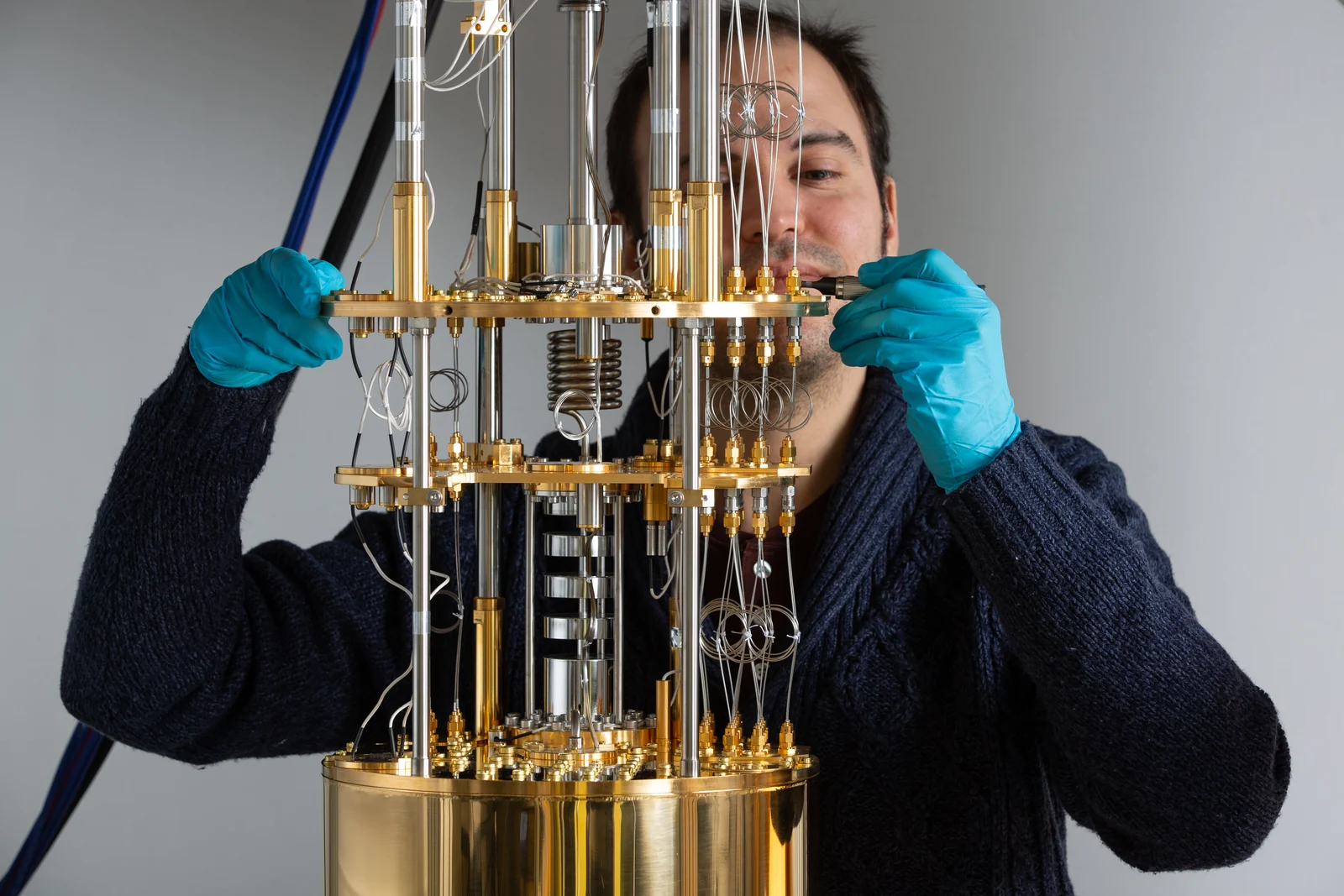

Quantum computers need regular checks before they can do reliable work. Horizon Quantum says it has reduced one part of that overhead by testing unwanted interactions between many together, rather than checking each possible pair separately.[1]
In a technical disclosure published November 10, the company reports experiments on Rigetti’s 108-qubit Cepheus processor and its own Ember-1 machine. The result targets the time spent understanding hardware errors. It is not a demonstration that a useful quantum calculation ran hundreds of times faster.[1][2]
The most eye-catching comparison is seven measurement settings instead of roughly 5,000 for a 100-qubit system. That is a claim about how tests are organized, not a complete stopwatch measurement. Separating the two explains both the promise and the remaining work.[1]
The cost of checking every pair
A qubit is a physical system used to store quantum information. In a superconducting processor, one qubit can unintentionally affect another. An unwanted interaction called ZZ crosstalk changes how their quantum phases evolve, changing the interference on which quantum operations depend, even when the processor should be idle. Control crosstalk is different: a pulse aimed at one qubit also disturbs another.[1]
Knowing where these effects occur helps engineers choose corrective control sequences. But finding them can itself become a large job. A system with 100 qubits has 100 × 99 ÷ 2 = 4,950 distinct pairs. At 1,000 qubits, the count is 499,500. Ten times as many qubits means just over 100 times as many possible pairs.
Horizon’s approach combines many characterization tests into a small collection of measurement settings. The company says the required number of settings grows logarithmically: adding qubits increases the setting count much more slowly than testing every pair individually.[1]
What was tested on hardware
For ZZ crosstalk, the team used Rigetti’s Cepheus-1-108Q and compared selected qubit pairs against conventional joint-Ramsey measurements. In that reference experiment, researchers watch how one qubit’s phase changes with a second qubit first in one state and then in the other. The difference reveals the unwanted coupling.[1]
The company shows agreement for three example pairs and says it selected sets of pairs randomly for validation. Separately, it extended the method to control crosstalk on Ember-1, showing a comparison between combined and individual measurements. These are company-reported hardware tests, not independent replication.[1]
The disclosure also cautions that poor coherence or large readout errors can make inferred couplings uncertain. Some qubits can therefore appear to have many strong long-range interactions. A dense-looking map is not automatically evidence that every apparent connection is a real hardware defect.[1]
Seven settings is not seven seconds
Dividing 4,950 pair settings by seven gives about 707. That reproduces the scale of the company’s more-than-700-fold setting-count claim. It does not establish the same reduction in total elapsed time, because each setting still needs repeated measurements and the results must be processed.[1]
Horizon also gives a hypothetical 1,000-qubit example: 10,000 repeated measurements, called shots, for each test and 500 microseconds per shot, assumed to be five times a 100-microsecond coherence time. Multiplying 499,500 pairs by those assumptions produces 693.75 hours, or about 28.9 days. Ten combined settings under the same shot-time assumptions total 50 seconds.[1]
That arithmetic is consistent, but the comparison is a projection, not a measured 29-day-to-50-second run on the 108-qubit processor. The simple calculation does not provide an end-to-end accounting of programming, acquisition and analysis overhead. Nor does it settle how precision holds up across different hardware, larger systems or alternative parallel testing strategies. The reviewed disclosure does not provide a full reproducible methods description.[1]
What changes for users
This is distinct from Horizon’s November 9 announcement about integrating Oxford Quantum Circuits’ Toshiko system into its software. That integration concerned access and control. The new disclosure supplies numerical characterization evidence on Rigetti and Ember-1 hardware; it should not be read as a measured performance upgrade to Toshiko.[1][3]
For users, the potential benefit is less machine time consumed by checking the machine itself. For engineers, the useful result is a more scalable way to identify interactions that control software may suppress. Neither benefit by itself proves fault-tolerant computing or practical advantage over a classical computer.[1]
The next convincing step would be an independently reproduced benchmark reporting precision, repeated-shot requirements and full elapsed time on the same hardware against strong conventional alternatives. Horizon’s disclosure makes a testable claim about a real scaling problem. Those broader measurements would establish how much working time the method actually returns to users.