
The quantum hardware did not change. Its error model did.
A Riverlane preprint reports a better reading of existing error-correction data. Its measured-data result must not be confused with a larger simulation result.
Reading tools for text size, copying, printing and your reading list
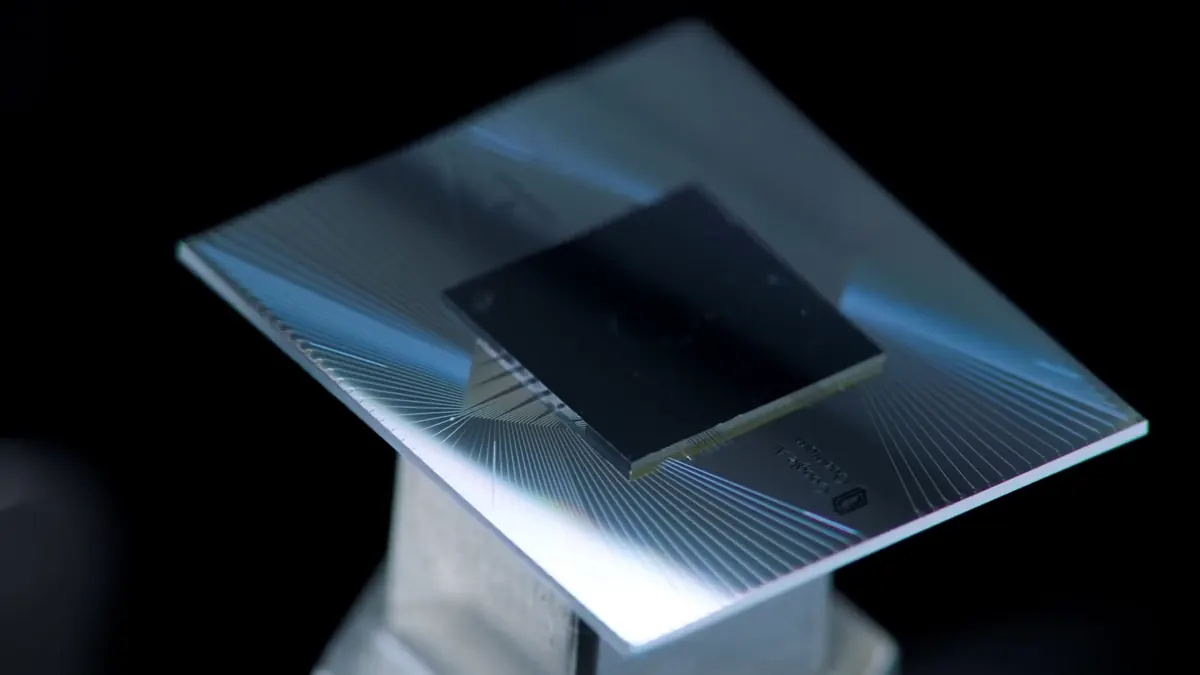

A new result need not come from a new quantum chip. A Riverlane preprint submitted to arXiv on November 4 describes an approach that expands the error model used to interpret detector data, including correlated mechanisms missing from the starting model. One reported improvement comes from reanalyzing Google’s existing experimental data, not changing the hardware that produced it.
That distinction matters because the paper also reports a larger reduction in a simulation. The simulation and the experimental-data reanalysis answer different questions. They should not be collapsed into one headline percentage.
A decoder needs a map of plausible causes
Think of a decoder as trying to interpret a pattern of alarms. Its task is easier when the model includes the kinds of faults that could plausibly produce that pattern. Changing how likely an existing explanation seems is not the same as adding a missing explanation.
A simple analogy is a building with several sensors. Two alarms could reflect two separate faults, or one event affecting both sensors. A model that permits only isolated faults may interpret a simultaneous pattern differently from a model that permits a shared cause.
This is only an explanatory analogy. Coincidence alone does not establish a causal mechanism, and the engineering problem requires a well-defined connection between detector patterns and the corrections being considered.
The paper’s proposal uses detector statistics to augment the model’s available correlated mechanisms. That is a different intervention from manufacturing a quieter component or increasing the number of qubits.
Keep the two results separate
A logical error is a failure of the protected information, rather than just a fault in one physical component. A round is one error-checking cycle. Code distance describes the strength of the error-correcting code; it is not the number of .
In the experimental-data reanalysis at code distance seven, the reported logical error rate per round changes from 0.00209 to 0.00180, with reported uncertainty of 0.00001 on each value. That is about a 14% relative reduction. The paper’s larger 75% reduction belongs to a simulated setting with added correlated noise, not this experimental-data comparison.
Both experimental-data comparisons use two-pass correlated PyMatching. The baseline uses Google’s reinforcement-learning-optimized noise weights. The augmented model adds mechanisms and also re-learns probabilities for existing and added mechanisms. The comparison therefore should not be described as changing only the list of mechanisms while holding every weight fixed.
The distinction between relative and absolute change is important too. Subtracting the two measured-data rates gives 0.00029 per round. Dividing that change by 0.00209 gives approximately 13.9%. Neither quantity means that 14 percentage points of all computations were rescued.
The two experimental-data rates describe a narrower comparison than the simulation percentage. Their units are logical errors per round, not processor speed or the percentage of physical components that malfunctioned.
Better decoding is a system result
A result on stored data can show that the same observations admit a better interpretation under the tested approach. It does not, by itself, establish how much extra computing effort is required, how quickly an online decoder can respond or how broadly the improvement transfers to other devices and noise conditions.
Those are not reasons to dismiss a reanalysis. They are the next questions that turn a promising method into an operational claim. A fair comparison should preserve the training-and-test separation, describe the starting model, account for any model-selection effort and report the relevant runtime costs.
It should also make clear which part changed. Was the decoder changed? Were probabilities retuned? Were new mechanisms added? Were the input data or evaluation conditions changed? Without that accounting, a better number is harder to interpret or reproduce.
What this result earns
This is a preprint, not a claim of a newly peer-reviewed result. It makes an interesting and testable argument for improving the model supplied to an error-correction workflow. It does not show that a physical processor was rebuilt, or that every quantum computer would receive the same benefit.
The reason to share it is the underlying idea: better hardware is not the only route to better system performance. Sometimes the useful improvement is a more accurate account of the errors the hardware is already producing.
The next stronger story would connect that idea to independent reproduction or a documented real-time deployment. Until then, the experimental-data result deserves its own, narrower headline—not the larger number from a simulation.
This is a different development from Riverlane’s GPU-assisted calibration work, which addressed the time needed to train a decoder’s error model. Here, the important question is which error mechanisms the model is allowed to include.
Keep your reading trail
Keep up with these topics
Explore the subjects covered in this story.