
Skip to content
RESEARCH · QUANTUM SENSING

Diamond spins cooperate in nanoscale spirals

Controlled interactions tame disorder at room temperature.

Published Source report Sources checked
Reading tools for text size, copying, printing and your reading list
My reading list
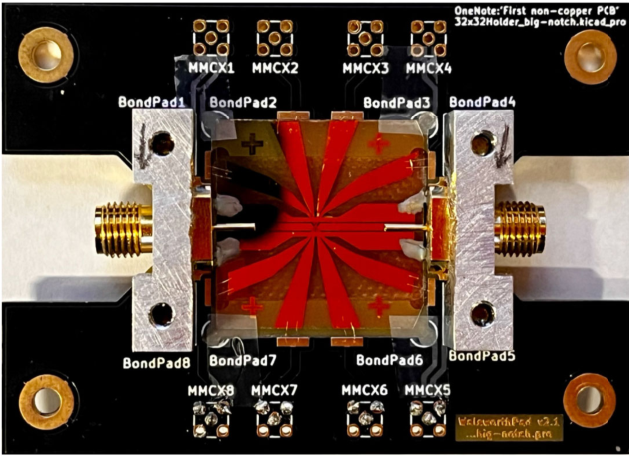
Control chip mounted on a circuit board.
The experimental gradient chip on its circuit board. Figure7(g), extracted from the paper.Piotr Put et al.

Researchers have made randomly positioned spins in diamond move collectively by winding them into nanoscale spirals and tuning their interactions with microwave pulses. The experiment works under ambient conditions.[1]

The Physical Review X paper appeared November16. Its preprint dates to June2025: the new event is journal publication, not an experiment first disclosed yesterday.[1][2]

Dense groups of spins can be useful sensors, but uneven interactions usually disrupt cooperation. Magnetic-field gradients create the spiral pattern; engineered interactions suppress the effects of disorder.[1]

This demonstrates controllable collective dynamics, not a clinical scanner or a quantum computer. The researchers describe improved magnetic sensing, generation and spin squeezing as opportunities still ahead.[1]

Keep your reading trail

Evidence & context

2 linked sources

Laboratory experiment.

How to read the evidence and dates

An announcement records what an organization stated. An experiment reports an observation. A simulation or resource estimate depends on its assumptions. QubitWire’s analysis connects these sources; the labels are not quality scores.

Published is the article’s first QubitWire publication. Updated marks a substantive content change. Sources checked records a review of the underlying evidence. An older paper can support a new explanation, and another press release about the same work is not independent replication.

Sources

  1. Put et al., PRX paper

    November16,2026.

  2. Preprint history

    June2025 firstsubmission.

READ NEXT

Continue exploring

All Research stories
  1. Explore quantum sensing

    Better spin control makes a quantum sensor easier to read

    Driving two spin transitions together produced a clearer magnetic-field signal in a room-temperature boron-nitride experiment.

    Published · Source report · Sources checked · About 2 min read
  2. Explore quantum sensing

    Could a diamond sensor map how electricity moves through tissue?

    A $3.2 million research project aims to turn faint magnetic signals into a map of tissue conductivity. Here is what a convincing first image would show.

    Published · Source report · Sources checked · About 3 min read