
Skip to content
RESEARCH · FLUXONIUM / QUANTUM CONTROL

Two-channel digital pulses shorten modeled fluxonium gates

A new simulation coordinates magnetic-flux and charge signals to control a superconducting qubit. The shorter gate needs more elaborate timing, not merely shorter pulses.

Published Source report Sources checked
Reading tools for text size, copying, printing and your reading list
My reading list
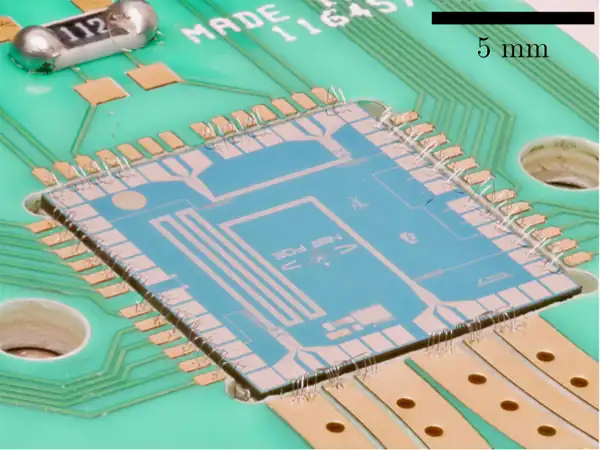
A blue Josephson pulse-generator chip is wire-bonded to a green circuit board, with a 5-millimeter scale bar.
A Josephson pulse-generator chip used in NIST’s 2022 transmon-control study.Illustrative photoL. Howe, M. A. Castellanos-Beltran, A. J. Sirois, D. Olaya, J. Biesecker, P. D. Dresselhaus, S. P. Benz, and P. F. Hopkins

Researchers have proposed a faster way to control fluxonium, a type of , by organizing ultrashort electrical pulses into carefully timed packets. The November 10 preprint addresses a practical problem: digital pulse patterns developed for transmon qubits do not transfer efficiently to fluxonium.[1]

The results come from simulations, not a fabricated controller. They exclude energy loss and decoherence, pulse distortions and a systematic analysis of timing mismatch between the two control channels.[1]

One protocol groups pulses on the magnetic-flux control channel. A second pairs flux and charge signals, offset by a quarter of the qubit’s cycle, to reinforce the desired operation. For one modeled qubit, the second design shortens a state-flipping gate from 68 to 27 nanoseconds, with calculated fidelity around 99.99%. Fidelity measures how closely the modeled operation matches its target.[1]

That is about a 2.5-fold reduction in gate duration, calculated from 68 ÷ 27. It is not a 2.5-fold quantum-program speedup: the study examines individual single-qubit operations, with different control arrangements and modeled fidelities. Nor does this comparison establish an advantage over the best microwave controls.

The 15-picosecond pulses also should not be mistaken for 15-picosecond gates. A 27-nanosecond gate spans 1,800 such pulse-width intervals. That is an elapsed-time comparison, not a count of pulses. Pulse timing and accumulated rotations, not just the width of each pulse, determine the complete operation.[1]

The next step is testing whether those advantages survive real pulse distortion, timing errors and energy loss, followed by experimental benchmarking and two-qubit control.[1]

Keep your reading trail

Evidence & context

1 linked source

Simulated single-qubit control protocols; timings and fidelities are not measured controller performance.

How to read the evidence and dates

An announcement records what an organization stated. An experiment reports an observation. A simulation or resource estimate depends on its assumptions. QubitWire’s analysis connects these sources; the labels are not quality scores.

Published is the article’s first QubitWire publication. Updated marks a substantive content change. Sources checked records a review of the underlying evidence. An older paper can support a new explanation, and another press release about the same work is not independent replication.

QubitWire take

The pulse is only one ingredient: a complete gate also depends on timing, calibration and coordinated control signals.

Sources

  1. High-Speed Control of a Fluxonium Qubit via Picosecond Pulses from Josephson Digital Circuits

    Preprint disclosed November 10, 2026. Numerical protocols and Table I inspected; hardware implementation and a full noise budget remain future work.

READ NEXT

Continue exploring

All Research stories
  1. More on superconducting hardware

    Loading data has an energy price in a new quantum-memory model

    A superconducting-memory preprint separates query speed from energy use. Its comparison shows why a small quantum address can conceal a much larger machine.

    Published · Source report · Sources checked · About 2 min read
  2. Quantum control / Networking

    Quantum gates take instructions through 10 kilometers of fiber

    A new experiment delivers control signals between ultracold systems. It shows why connecting quantum processors requires more than transporting quantum information.

    Published · Source report · Sources checked · About 3 min read