
A 20-qubit experiment targets quantum computing’s input problem.
DLR researchers shortened quantum input-preparation circuits in benchmarks and tested an approach on a real processor. Accuracy and the cost of the whole calculation still decide the payoff.
Reading tools for text size, copying, printing and your reading list
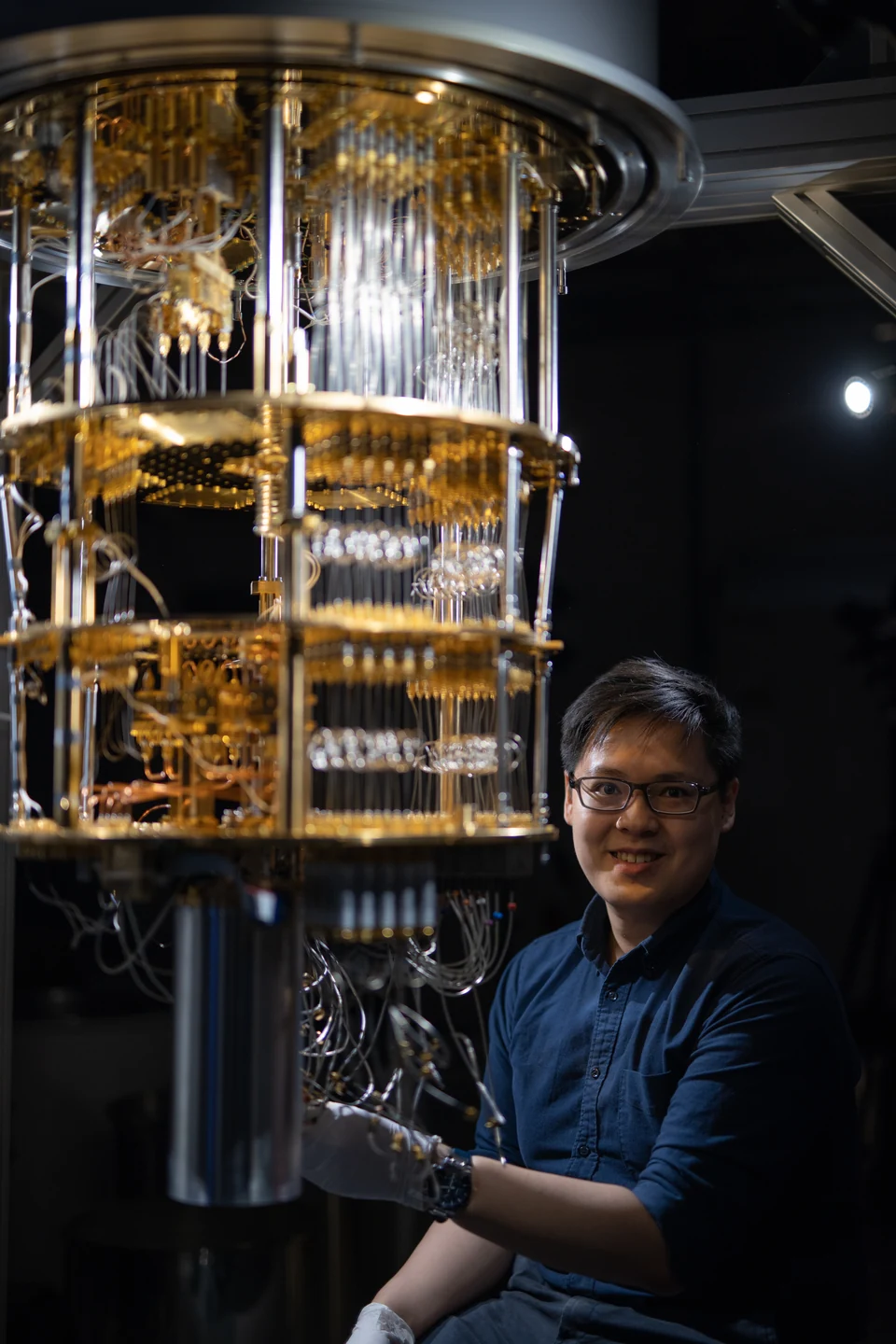

In a preprint submitted November 6, researchers at the German Aerospace Center, DLR, and the University of Cologne describe methods for preparing data inputs with shorter quantum circuits. They tested the approach on 20 of an IQM processor. The work targets a cost that is easy to miss when discussing quantum speedups: preparing the input.[1]
A quantum algorithm may start with its input already encoded in a quantum state. Real hardware must prepare that state. DLR’s new work concerns amplitude encoding, where numbers are represented in the amplitudes that determine measurement probabilities. QubitWire’s earlier data-loading explainer covers why that preparation cost matters.[1][2]
The DLR team simplifies the circuits used for preparation, allowing a trade-off between accuracy and the number of sequential gate layers. The number of sequential layers is called circuit depth. The favorable scaling depends on structure in the data and approximation; it does not remove the worst-case cost of preparing an arbitrary state exactly.[1]
One method removes redundant conditions controlling qubit rotations. Another rewrites the rotations in a form whose smaller contributions can be omitted at a chosen accuracy. The two can be combined.[1]
In benchmarks assuming any qubit could interact directly with any other, their combined method used roughly 100 times fewer sequential CNOT-gate layers for some inputs than Qiskit’s reference preparation routine at comparable accuracy. These are layers of a particular two-qubit operation. That comparison, at 15 data qubits, measured circuit depth, not application runtime.[1]
The benchmark and hardware test answer different questions. The benchmark compares recipes for preparing inputs under a particular connectivity assumption. The experiment asks whether one resulting recipe can produce the intended measurement pattern on a physical device. Combining them does not turn the benchmark ratio into a measured hardware speedup.
What ran on the chip
The experiment used a Gaussian input, a smooth, bell-shaped pattern, on 20 qubits of IQM’s Emerald processor. After being adapted to the chip, its circuit had 56 sequential layers. The experiment ran October 12 and used 256,000 repeated measurements to estimate how often different results appeared.[1]
For validation, the team grouped measurement outcomes into a 64-by-64 grid. The paper’s reported infidelity of 0.011 ± 0.002 is based on those binned outcomes: it measures their mismatch with the binned target, with zero denoting perfect agreement. It is not a full reconstruction of the quantum state, including its relative phases.[1]
What the result makes easier to test
The distinction between the coarse distribution and the full state matters for what happens next. Two states can give the same probabilities in one measurement basis while behaving differently in a later calculation. The binned result is useful evidence of preparation, but it does not certify every property a subsequent algorithm might need.
A practical follow-up would use the prepared input in a specified application, hold final-answer accuracy fixed and count all preparation and measurement costs against a strong classical method. For now, the contribution is a shorter preparation recipe for suitable inputs, plus a bounded demonstration that it can run on a real chip.