
Double-Resonator Coupler Design Simulates a 20-Nanosecond CZ Gate
A proposed superconducting circuit uses two resonator paths to suppress idle coupling, but its speed and error figures remain simulation results.
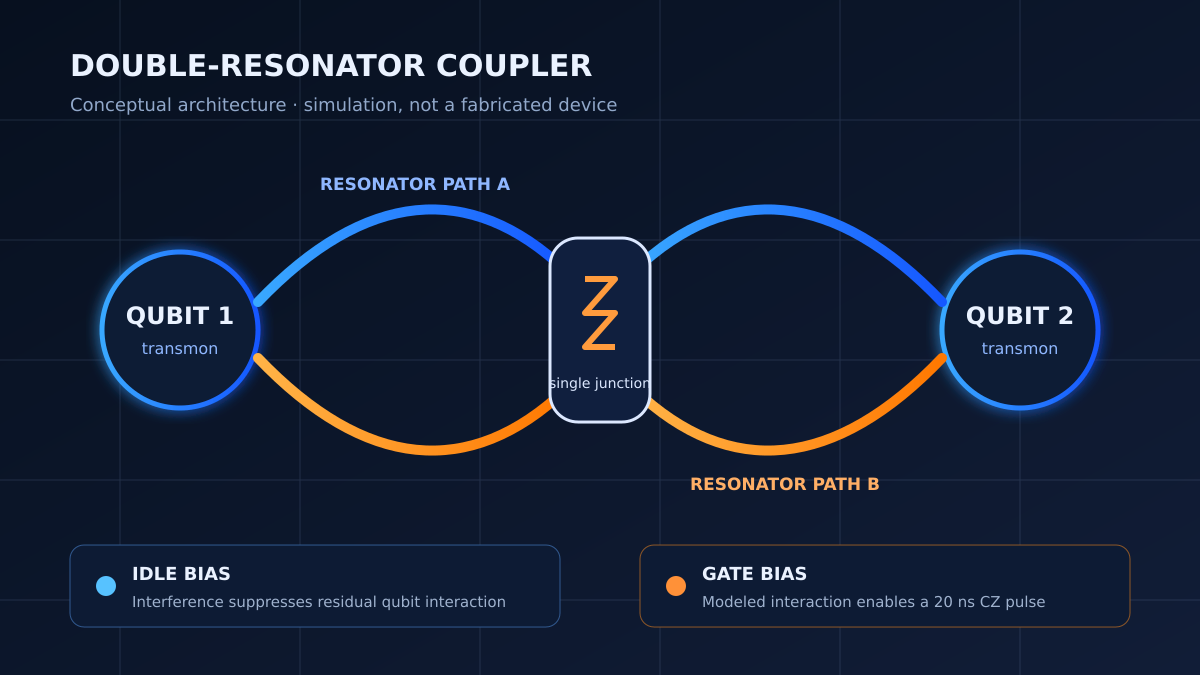
A Seoul National University and Samsung-affiliated team has proposed a double-resonator coupler for superconducting transmon qubits. Two resonator modes, joined by one , create competing virtual exchange paths whose interference can tune the interaction between neighboring physical qubits. That mechanism targets a persistent hardware trade-off: neighboring qubits should interact strongly during a gate but remain effectively isolated while idle. A broader low-coupling operating region could ease frequency allocation, although the paper's parameter sweep shows that greater flexibility weakens the available activated interaction.
For one modeled parameter set, numerical diagonalization finds two flux biases with zero residual ZZ interaction outside the straddling regime while nearby transverse coupling stays below 1 MHz. The activated ZZ interaction reaches 69.2 MHz, and an optimized simulated 20-nanosecond pulse has coherent infidelity near 1e-5.
Those numbers do not come from a fabricated device. With an assumed 50-microsecond T1 for qubits and coupler modes, the authors estimate relaxation infidelity of 3e-4; an assumed flux-noise model adds 1.6e-5. Shortening the simulated pulse to 16 nanoseconds pushes coherent infidelity toward 1e-3, underscoring the speed-error trade-off.
The decisive next step is fabrication and calibration, followed by leakage, crosstalk and randomized-benchmarking measurements across realistic device variation. Larger-processor tests would also need to show that the extra resonators and flux controls improve usable connectivity without introducing new frequency-crowding or control overhead.