
D-Wave Demonstrates a Fast Gate for Dual-Rail Erasure Qubits
A Nature experiment reports an approximately 500-nanosecond entangling gate that largely preserves detectable photon-loss errors.
A fast dual-rail gate retains detectable errors
- Reported
- D-Wave’s research team reports an approximately 500-nanosecond controlled-Z gate between two dual-rail cavity qubits.
- Supported observation
- The Nature paper reports about 0.5% erasures per gate and residual Pauli errors below 0.1% in its characterization.
- Conditions
- Two encoded qubits use superconducting microwave cavities and a transmon coupler. Residual errors are evaluated after detected erasures are removed; they must be read alongside the erasure rate. Characterization uses state tomography and interleaved randomized benchmarking. Larger-code comparisons are simulated.
This is not a demonstrated large error-corrected processor. Error behavior worsens at greater repeated-gate depth; the surface-code simulation assumes perfect erasure checks and restricted noise models.
- An entangling gate for dual-rail erasure qubitsNature · Peer-reviewed primary research paper · Source published Source checked
.jpg)
Detectable erasures can be easier for codes to handle than errors with unknown locations. D-Wave researchers report an entangling gate that largely preserves detectable photon-loss errors. The result comes from a peer-reviewed Nature experiment with two dual-rail encoded in superconducting microwave cavities.
The paper reports an approximately 500-nanosecond gate, roughly 0.5% erasures per gate and residual Pauli errors below 0.1% in its characterization.
This remains a two-qubit gate demonstration. Predicted benefits for larger surface-code systems come from simulation and depend on additional engineering assumptions. Repeated error-correction cycles on larger hardware would show whether the measured error structure can produce the predicted improvement in logical performance.
Read the deeper explanation · about 6 min
This estimate covers the explanation below, separate from the overview. Optional depth was added in this reading edition. The article keeps one canonical address and its original chronology. Source review: . The relevant source dates and limitations are recorded below.
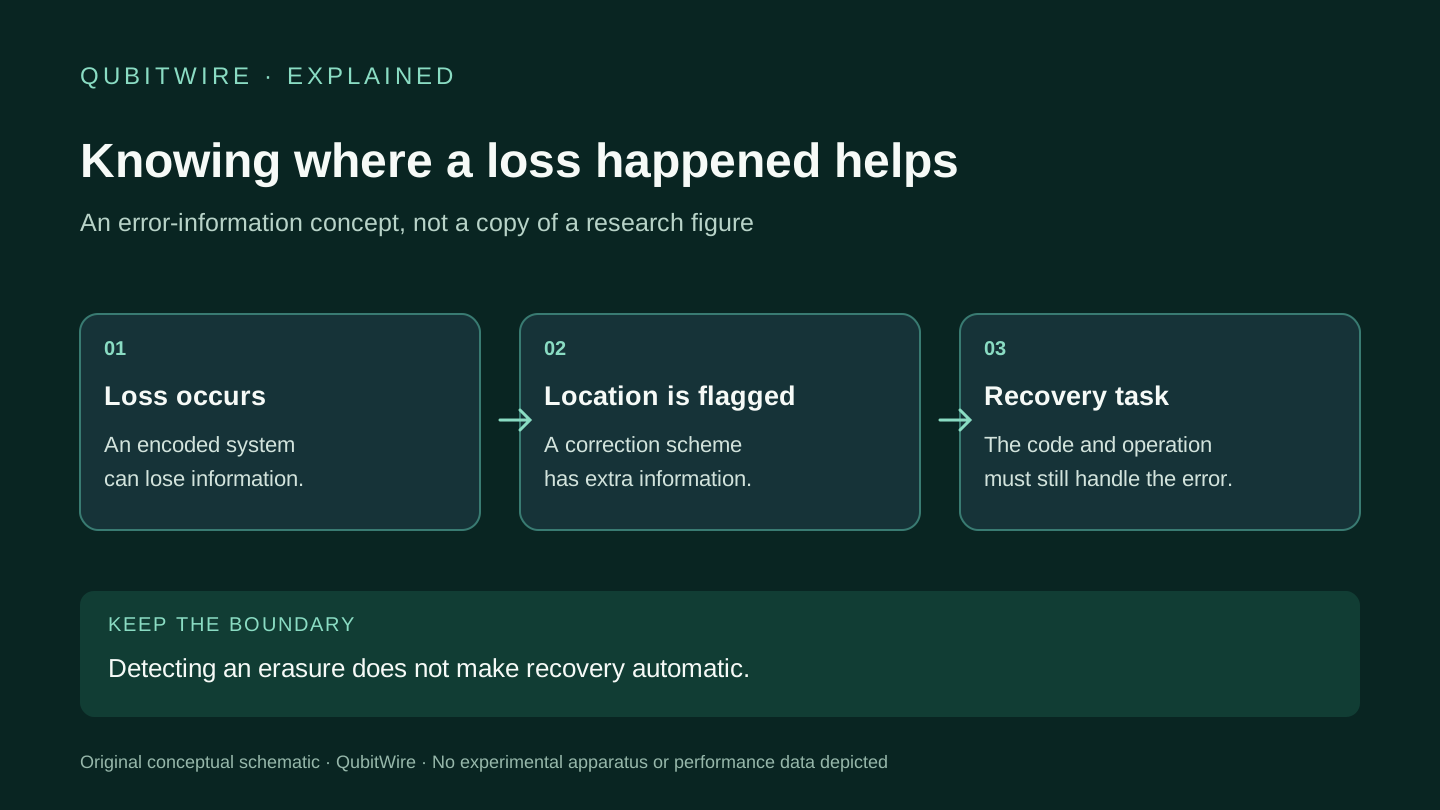
A crossword with a visibly missing letter is a different problem from a crossword containing a confident but incorrect letter. In the first case, the blank tells you where to look. In the second, you must discover both the location of the mistake and the intended answer. Neither puzzle solves itself, but the extra location information can matter enormously.
That is a useful doorway into erasure-aware quantum computing. The analogy is about information available to a correction procedure, not a claim that a quantum state is an ordinary letter. A suitable quantum code may exploit a signal indicating where information has been lost. The signal does not magically restore the state or remove the need for a properly designed encoded system.[2]
On October 1, D-Wave announced a gate-model simulator beta focused on error-aware programming. The announcement concerns selected-user software access and a way to investigate such ideas. It is not a statement that a new physical gate-model processor is generally available or that all errors in a quantum computer have become easy to correct.[1]
Why a location can be valuable
An error-correction procedure works with evidence about what might have gone wrong. Better evidence can reduce ambiguity, provided it is reliable and the code is designed to use it. A known erasure location is different from an unknown disturbance that may have occurred at several possible places.
The distinction is easiest to see in a deliberately simple classical example. If a repeated three-bit word is received as one, blank, one, the two visible bits support an obvious reconstruction. If it is received as one, zero, one, the majority still helps in that toy code, but a different pattern of errors can create ambiguity. This is not a quantum code demonstration or a recommendation to copy unknown quantum states. It only illustrates why different error information changes a decoding problem.
Quantum error correction uses structured encoding and measurements rather than unrestricted copying. The important reader takeaway is not a recipe. It is that the type of error, the information about its location and the reliability of that information all belong in a performance claim.
A simulator is a place to ask questions
A simulator lets a researcher or programmer study behavior under a specified model. That can be extremely useful. It can reveal how an assumption affects a result and help compare approaches before every physical component is available. Its usefulness depends on being clear about what the model includes.
If a model assumes every relevant loss is detected perfectly, the resulting performance should not be described as though imperfect physical detectors had already achieved it. If some unwanted errors are excluded, the result applies to the model without those errors. These are not objections to simulation. They are the conditions that make a simulation result interpretable.
D-Wave's October announcement belongs in that category of software capability and access. Readers should not mistake a beta invitation, a simulated logical result or a programming feature for an independently measured physical device benchmark. The company can make meaningful software progress without those categories being collapsed into one.[1]
The hardware result has its own date
An August Nature paper reported an entangling gate for dual-rail erasure qubits. Its significance lies in investigating an operation while preserving a useful distinction between error types. That physical research provides relevant background, but it is not the October beta announcement and should keep its own publication date.[2]
This chronology matters because scientific progress often arrives in layers. An experiment can motivate a software tool; a software tool can help explore new experiments. When a news article combines those layers without dates, a reader may reasonably assume the entire sequence happened at once and that every component has already been integrated.
A clear timeline is more informative. It can distinguish a physical operation studied in a paper, the software environment now being offered and the future system-level result still needed. That lets a visitor return later and recognize which part actually changed.
Not every warning is correct
An erasure signal is useful only in the context of how it is produced and interpreted. A physical system can miss an event or produce a misleading indication. A proposed evaluation therefore needs to consider both the quantum operation and the reliability of the information supplied to the decoder.
The everyday analogy is a smoke alarm. Knowing which room triggered an alarm helps, but its value depends on whether the alarm is sensitive to the relevant event and how often it rings unnecessarily. The analogy does not describe the microscopic device. It shows why an error flag should be evaluated rather than treated as a perfect oracle.
A strong technical account will also explain what happens to errors that are not converted into detectable erasures. A method that makes one class easier to handle can still face another class that remains difficult. Readers should resist a headline that turns a useful bias in error behavior into a claim of an error-free computer.
Counting the correction bill
Correction has a cost. A useful comparison needs to include the physical resources, operations, measurements, waiting and processing required by the chosen method. An approach can reduce one cost while increasing another. Which tradeoff is worthwhile depends on the target task and hardware conditions.
A hypothetical example makes the point. Two modeled procedures could reach the same target error probability, but one might require more detection steps while the other requires more physical qubits. Calling either universally cheaper without defining a cost function would hide the decision rather than explain it. The example does not estimate D-Wave's architecture or the August experiment.
This is where a well-designed simulator can be valuable: not as a machine for declaring a winner, but as a controlled way to examine how a result depends on assumptions. The most useful output may be a boundary showing where one approach stops helping, rather than a single best-case number.
Why this is different from simply resetting
Resetting a system to a known state and protecting an unknown encoded state are not equivalent goals. If a procedure removes the information that a computation was meant to preserve, reaching a tidy final state does not count as successful memory protection. That distinction also matters when discussing feedback and order in noisy quantum circuits.
The practical question is always: what information was the procedure required to keep? A correction claim should identify that target, the operations performed and the comparison that establishes improvement. Otherwise a reassuring word such as stabilization can conceal a change in the task itself.
For a visitor, this is a powerful reusable question. It works across memory demonstrations, gate experiments, simulator results and ambitious roadmaps. It makes a reader harder to mislead without requiring them to become an expert in every code family.
The next result worth returning for
Follow the relationship between the model and the hardware. Which modeled error assumptions have been measured? Does the useful error structure survive a broader set of operations? How much does imperfect detection change the result? Is the claimed improvement still present when the complete correction cost is counted?
A new beta participant or a polished interface can be commercially relevant. The stronger technical follow-up is evidence addressing one of those questions. QubitWire should make the distinction visible rather than label every update a breakthrough.
The appeal of erasure-aware computing is that failure can sometimes carry useful information. That is a subtler and more durable story than a promise that quantum computers will stop making mistakes. The next generation may become more capable partly because it learns to make certain mistakes easier to recognize, measure and account for.
Evidence for this explanation
- D-Wave: selected-participant gate-model simulator beta
1 October 2026 company software announcement. Selected beta participants and planned broader access are distinct from physical gate-model processor availability.
- An entangling gate for dual-rail erasure qubits
Nature paper published 5 August 2026. Paper identity and author abstract checked via the official PubMed record (PMID 42557378); the physical gate experiment is separate from the October simulator beta.