
D-Wave Opened a Gate-Model Simulator. The Quantum Computer Comes Later.
A new beta lets selected teams explore error-aware programs. It is preparation for future dual-rail hardware, not access to that hardware today.
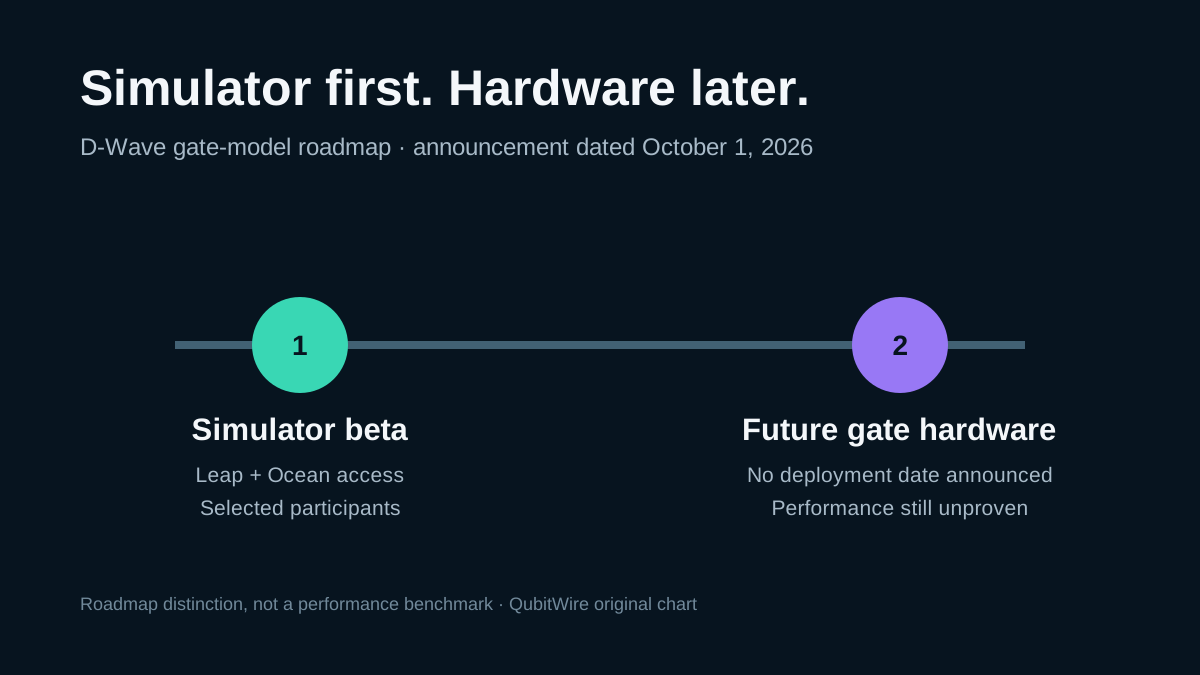
D-Wave has opened a beta program for a gate-model simulator, giving selected organizations a way to test error-aware software before the company’s planned gate-model quantum hardware arrives. That sequence matters. The October 1 announcement describes a classical simulation environment delivered through D-Wave’s Leap cloud service and Ocean software tools, not a newly deployed fault-tolerant quantum computer.[1]
The first named participants are BBVA, FirstQFM, Florida Atlantic University and the Jülich Supercomputing Centre. Their work can explore how applications and control strategies respond when errors are identified during a computation. A simulator can expose developers to the programming model and help them form testable questions, but it cannot establish how physical hardware will behave at scale.[1]
The architecture behind the simulator uses dual-rail . Information is encoded across two physical modes so that some loss events produce a detectable state rather than an undetected wrong answer. In principle, knowing that an erasure occurred can make an problem easier than correcting an error whose location is unknown.[1][2]
There is real experimental evidence beneath that idea. A peer-reviewed Nature paper published in August reported an entangling gate for D-Wave’s dual-rail design. The experiment measured a gate time of about 500 nanoseconds, an erasure rate near 0.5 percent per gate, residual Pauli error below 0.1 percent and bit-flip error around one in a million. Those are component-level measurements, not a full fault-tolerant computer.[2]
The new beta therefore sits between a laboratory result and a future system. It translates the architecture’s error signals into something application developers can study now. That can be useful for designing decoders, control logic and workflows that account for detected errors. It does not show that those workflows will deliver a practical advantage on future hardware.[1][2]
D-Wave says the dual-rail approach is designed to reduce the hardware overhead needed for error correction. The word designed is doing important work. Lower overhead depends on the complete error mix, the code, control fidelity, connectivity and how performance changes as the system grows. The beta announcement provides no system-level logical-error benchmark or hardware delivery date.[1]
For readers, the clean way to track this program is to separate three milestones: a simulator that models error-aware behavior, physical gates that have been measured in a laboratory and a future machine that runs useful fault-tolerant circuits. D-Wave has evidence for the second and has now released controlled access to the first. The third remains the destination.[1][2]
The next decisive update will need hardware results. Look for the number of operating dual-rail qubits, repeated logical-circuit performance, the cost of real-time decoding and comparisons with alternatives under the same workload. Until then, this beta is best understood as a development tool and an invitation to prepare—not proof that the gate-model computer has arrived.[1]
Keep your reading trail
Keep up with these topics
Choose the subjects you want to find again in Your Updates.