
Skip to content
RESEARCH · QUANTUM SENSING · EXPLAINER

Earth's Hidden Water Has Weight. NASA Wants a Quantum Sensor to Track It

Cold atoms could let an orbital pathfinder detect tiny gravity differences caused by shifting water and ice—but it is not mapping aquifers yet.
Sources checked Published
My reading list
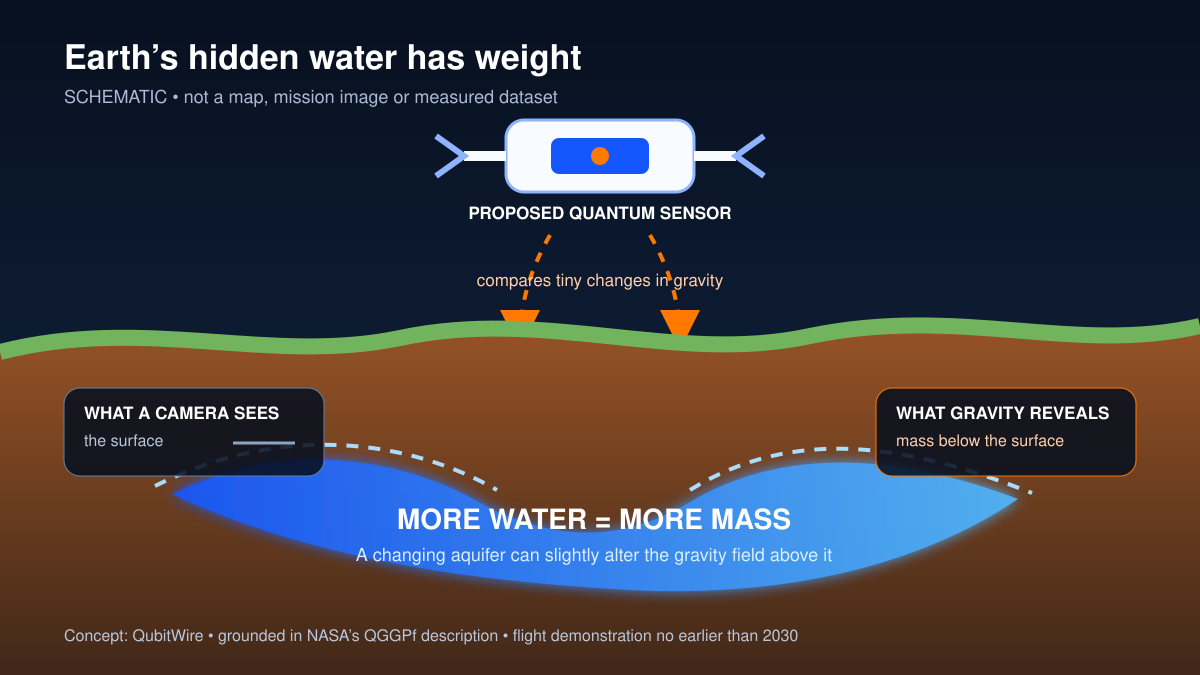
Schematic cutaway showing a proposed quantum sensor above land and an underground aquifer, with labels explaining that more subsurface water adds mass and slightly changes gravity.
Illustration: QubitWire

Water and ice add mass to Earth. A changing underground reservoir can therefore slightly change the gravity field above it. NASA's proposed pathfinder would test the quantum-sensing technology from orbit; this QubitWire diagram is schematic, not mission imagery or measured data. Image creditDiagram: QubitWire. Original schematic based on NASA Earth Science Technology Office's April 13, 2026 QGGPf description. · https://qubitwire.com/editorial-standards

Satellites can photograph lakes and ice, but underground water can stay hidden. NASA is developing a quantum sensor that would look for its gravitational effect instead. Because water has mass, a changing reservoir or ice sheet slightly changes the pull above it—an indirect view where a camera cannot see.

This is quantum sensing, not a quantum computer solving a calculation. The planned Quantum Gravity Gradiometer Pathfinder would measure small differences in Earth's gravity field from low orbit. Those differences can reveal where mass has shifted, although interpreting them as water still requires other data and models.
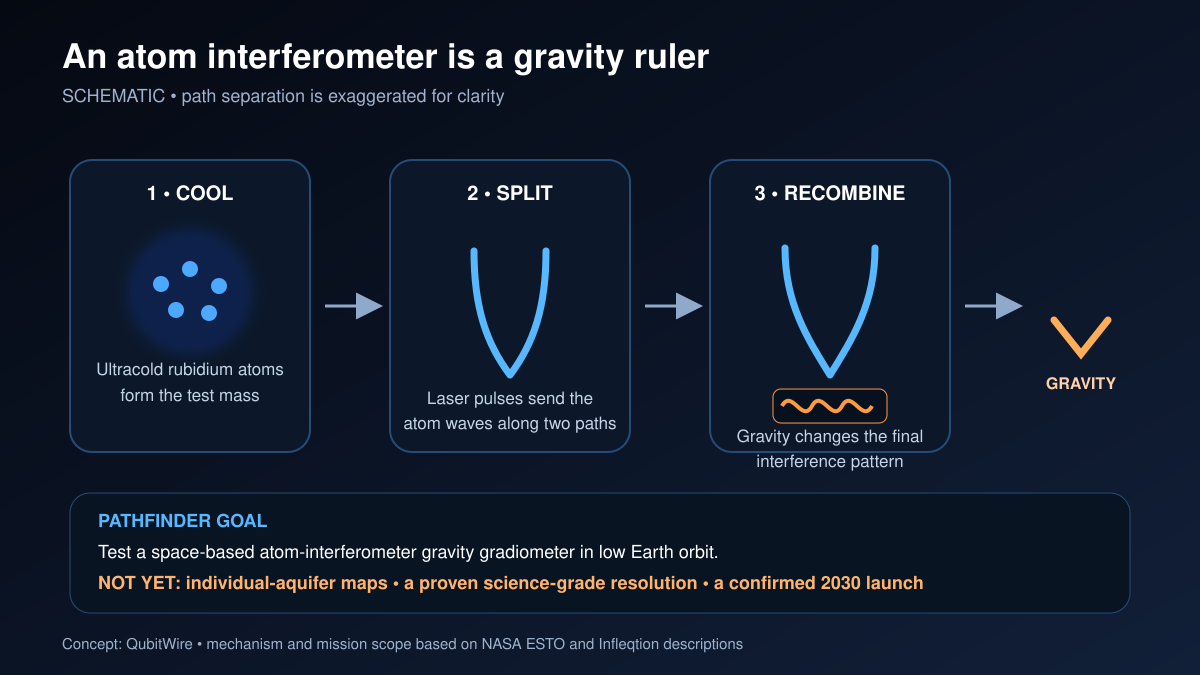
Three-step schematic showing ultracold rubidium atoms, laser pulses splitting their wave-like paths and recombination into an interference pattern shifted by gravity.
In atom interferometry, laser pulses split and recombine the wave-like quantum states of ultracold atoms. Gravity changes the resulting interference pattern. Path separation is exaggerated here, and the pathfinder has not yet demonstrated individual-aquifer mapping or a science-grade spatial resolution. Image creditDiagram: QubitWire. Original mechanism schematic based on NASA ESTO and Infleqtion descriptions. · https://qubitwire.com/editorial-standards

The instrument uses atom interferometry. Laser pulses split and recombine the wave-like quantum states of ultracold rubidium atoms; gravity changes the final interference pattern. NASA says the pathfinder would be the first space-based instrument to observe Earth's gravity with this method. An August contractor update reports a $20 million follow-on award for hardware development and testing.

None of that means NASA is mapping individual aquifers today. The device is a technology demonstration, not a finished science mission, and neither NASA nor Infleqtion provides a proven spatial resolution or orbital dataset. The contractor's 2030 expectation is forward-looking; NASA says flight would be no earlier than 2030.

Before hidden water becomes a usable map, the sensor head and electronics must survive testing, launch and stable operation in orbit. The clearest success would be repeatable gravity measurements that agree with established methods and show what the quantum instrument adds. Until then, the promise is a new way to weigh change beneath Earth's surface.

READ NEXT

Continue exploring

All Research stories
  1. Explore the related question

    That Gold Quantum Chandelier? It’s Actually a Very Serious Fridge

    The glamorous hardware in quantum-computer photos has a surprisingly practical job: keeping a tiny processor extraordinarily cold.

    Sources checked
  2. Research desk

    These Tiny Drums Share a Quantum Beat

    An experiment with vibrating aluminum membranes shows how mechanical motion can join the quantum-information toolkit.

    Sources checked
THE QUANTUM BRIEFING

A clearer signal.
Straight to your inbox.

A little perspective on a fast-moving field.

Read a briefing preview →

Selected quantum coverage in a weekly briefing. Read the preview or register your interest.