
Skip to content
RESEARCH · QUANTUM NETWORKING · QUANTUM MEMORIES

Erbium crystal combines quantum-light generation with temporary storage

A newly published study shows why efficiency, storage time and quantum verification need to be read as separate tests.

Published Updated Source report Sources checked
Reading tools for text size, copying, printing and your reading list
My reading list
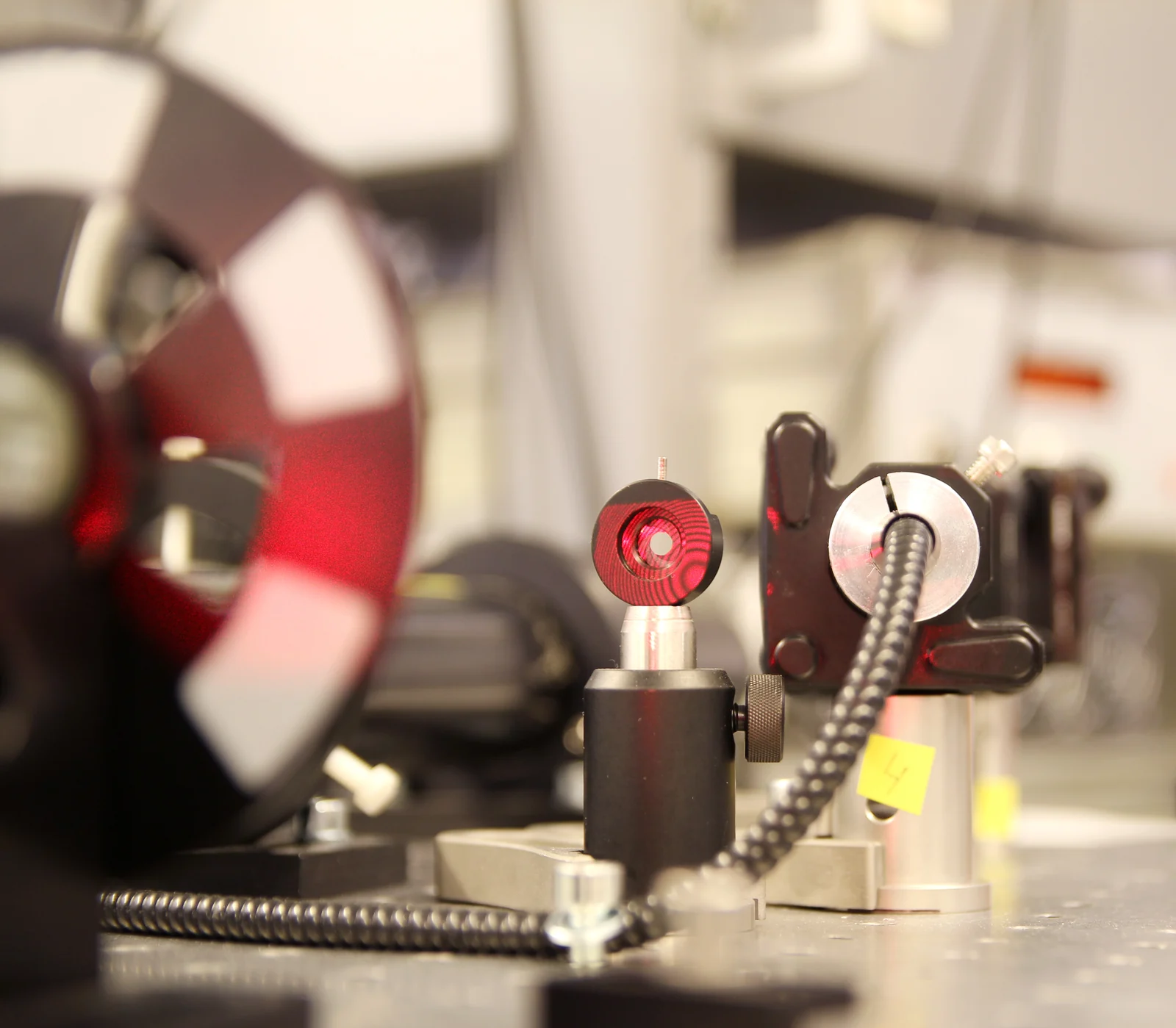
Optical mounts and a fiber connection illuminated by a red alignment laser in an NTNU laboratory.
Illustrative photoPer Henning / NTNUView the NTNU photograph and source

Australian National University researchers have demonstrated an erbium-crystal system that generates quantum-correlated light while retaining a correlated state in the crystal for later recall, a combination that could help coordinate future optical quantum networks. Their study appeared in PRX Quantum on November 13.[1]

The appeal is practical: network operations need quantum information to arrive at the right time. A component that supplies correlated light and holds part of that correlation could combine jobs otherwise assigned to separate devices. Erbium also operates at wavelengths compatible with telecommunications fibers.[1]

What the separate tests measured

Efficiency and storage time. A classical light test reached 81% rephasing efficiency, a measure of how much of the light signal the crystal could recover. A separate test found a characteristic decay time of about 25 microseconds for the stored spin signal.[1]

Capacity. The researchers detected correlations across 70 distinguishable time slots. Those correlations weakened across the sequence.[1]

Quantum verification. The direct test used a lower-gain setting with 17% efficiency. The system generates its own light and would require changes to accept arbitrary incoming quantum information.[1]

The new event is journal publication, rather than the first public disclosure. An earlier version, under a different title, was posted in September 2024 and revised in August 2025, already reporting the main storage and multimode results.[2]

The useful takeaway is a promising combination of functions, with clear work remaining. Longer storage, higher efficiency and larger capacity discussed as future improvements should not be mistaken for capabilities already delivered together.[1]

Keep your reading trail

Evidence & context

2 linked sources

Peer-reviewed laboratory study; earlier preprint public since 2024. Maximum classical efficiency and quantum-entanglement verification used different settings.

How to read the evidence and dates

An announcement records what an organization stated. An experiment reports an observation. A simulation or resource estimate depends on its assumptions. QubitWire’s analysis connects these sources; the labels are not quality scores.

Published is the article’s first QubitWire publication. Updated marks a substantive content change. Sources checked records a review of the underlying evidence. An older paper can support a new explanation, and another press release about the same work is not independent replication.

For material corrections, check the article’s context note and source trail. A routine formatting or link change does not create a new scientific result.

QubitWire take

The contribution combines light generation and storage. It does not establish one device simultaneously achieving all headline metrics or accepting arbitrary incoming quantum states.

Sources

  1. Stuart et al.: High-Performance Spin-State Memory for Telecom Quantum Information Applications

    PRX Quantum 7, 043031, published November 13, 2026; accepted September 23. Full methods separate classical I4LE efficiency, spin-storage decay, temporal-mode correlations and low-gain entanglement verification.

  2. Earlier preprint and submission history, arXiv:2409.12503

    First submitted September 19, 2024; revised August 11, 2025. Earlier public account includes the principal efficiency, storage and multimode results.

READ NEXT

Continue exploring

All Research stories
  1. Quantum networking / Photonics

    Sparrow and Welinq want quantum computers to work together through light

    A new agreement explores photonic quantum-computing clusters. A working link needs measured performance, not just shared cloud access.

    Published · Source report · Sources checked · About 3 min read
  2. Quantum networking

    A fiber test combines quantum signals, ordinary data and precision timing

    A laboratory study puts three network functions on one fiber link, while leaving deployment and independent-clock tests ahead.

    Published · Source report · Sources checked · About 1 min read