
Four Entangled Qubits Could Become a New Kind of Dark-Matter Listening Device
A newly funded Fermilab project will test whether four entangled probes can detect a weak signal more effectively than independent sensors. It is a plan for a controlled experiment, not a dark-matter discovery.
Some of the most interesting uses of a may not involve asking it to run a computer program. They may involve asking it to notice something extraordinarily faint.
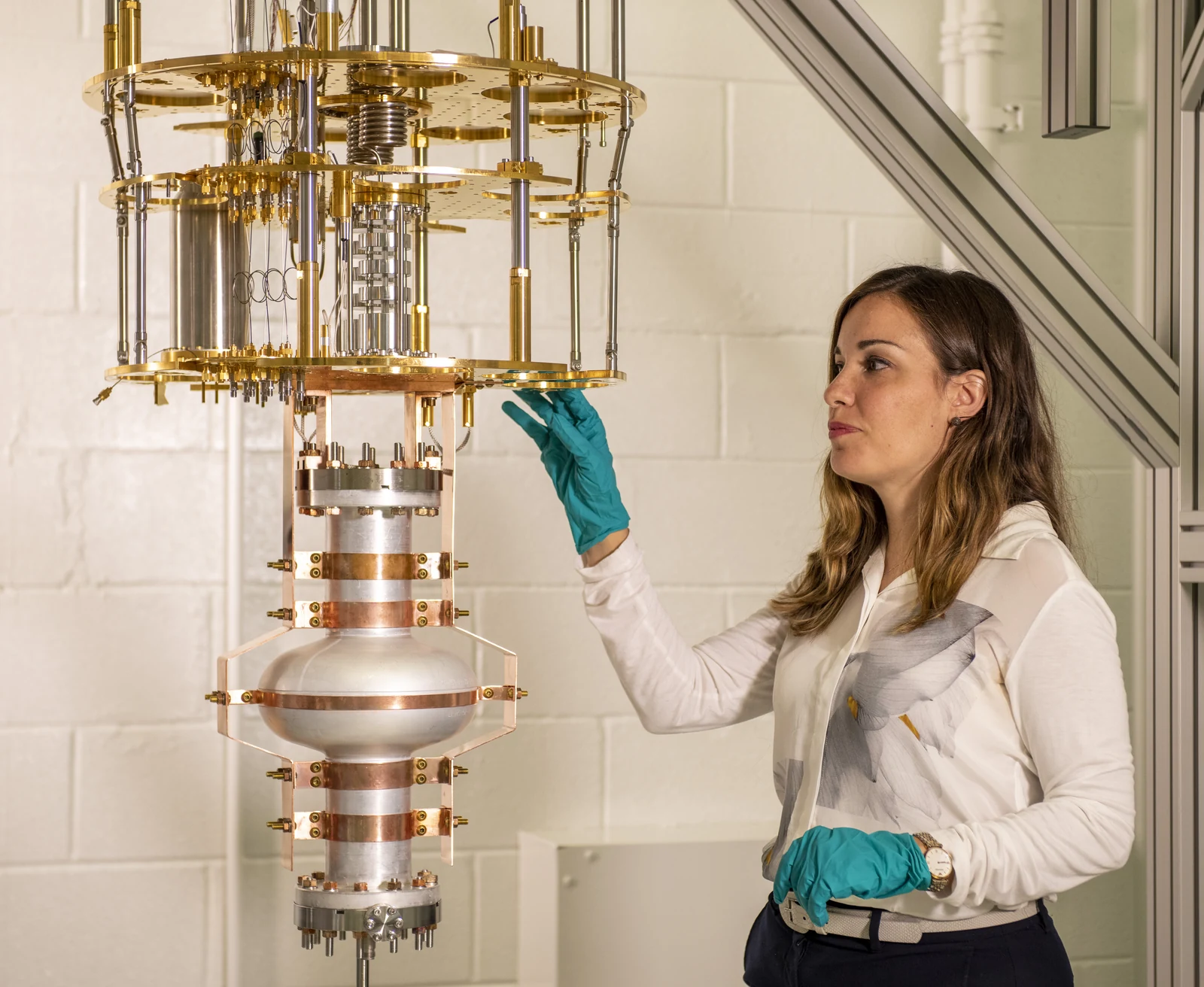
An Early Career project announced by Fermilab on 8 October 2026 takes that possibility seriously. The work, led by Rakshya Khatiwada, will investigate -qubit sensing for dark-matter research. The described programme includes a comparison using four entangled probes and independent sensors, with a simulated weak signal providing a controlled test. No dark-matter detection is announced.[1]
Four can sound small in an industry that often advertises much larger qubit counts. For this question, however, the first issue is not how many devices fit in a headline. It is whether a carefully prepared relationship among a few probes produces a useful measurement advantage once the real experimental costs are counted.
A sensor asks a different question
A computing experiment might ask whether a device can transform information according to a circuit and produce an answer to a defined task. A sensing experiment asks how reliably a physical interaction can be inferred from measured outcomes. The same broad quantum concepts can be involved, but the success criteria are different.
What entanglement could contribute
Entanglement creates joint states whose properties cannot be reduced to a list of independent states for the separate probes. For sensing, the attraction is that a shared response can, under suitable conditions, carry information differently from a collection of independent responses.
That possibility should not be translated into “the sensors communicate instantly” or “one qubit knows what the others know.” Those phrases obscure the measurement process. The experiment still has preparation, interaction, readout and statistical analysis, all occurring through physical systems with limitations.
A familiar idealized comparison illustrates the attraction. In a simplified noise-free model with comparable resources, independent probes can give a sensitivity scale proportional to 1/√N, while an ideal collective strategy can reach 1/N. Here N is the number of probes. These are teaching examples, not measured performance or forecasts for the Fermilab apparatus.
With four probes, those normalized expressions are one-half and one-quarter. That arithmetic is an invitation to examine assumptions, not a prediction that the Fermilab device will achieve exactly twice the sensitivity. Preparation quality, interaction time, noise and readout can change the practical result substantially.
Why a simulated signal helps
A controlled signal lets researchers know what should be present. That makes it possible to test whether an apparent improvement reflects the sensing method, a calibration issue or a choice in the analysis.
For an unknown physical signal, there is no equivalent answer key. Establishing the response to a known stimulus first is therefore part of building a credible detector, not an embarrassment to hide. It can reveal where a method works, where it fails and which operating conditions matter.
The new project should be read in that sequence. A successful weak-signal test would be evidence about the method in the tested setting. It would not, by itself, identify dark matter or establish that every candidate interaction could be detected. A future detection claim would need a different and much stronger evidentiary argument.
Count the whole experiment
Suppose one configuration produces a sharper estimate after a single successful run but takes longer to prepare. Suppose another loses fewer trials. Suppose a third is less sensitive to slow calibration drift. There is no universal winner until the relevant resource is specified.
Useful comparisons could include uncertainty after a fixed total measurement time, probability of correctly identifying a known injected signal, or robustness across repeated operating conditions. The relevant measure should be chosen before inspecting the most flattering outcome.
An experiment should also disclose which trials were excluded and why. Discarding unusable events can be scientifically appropriate. Treating the retained events as if they arrived without a cost is not. The success probability and preparation overhead belong in the same account as the final sensitivity.
A small, well-controlled comparison can isolate a mechanism. Researchers can vary preparation, deliberately change noise conditions and compare the outcome with the independent-probe baseline. That is often more informative than enlarging a system before understanding what limits it.
The most valuable follow-up would report a defined comparison: what was prepared, which signal was injected, how the independent sensors were operated, how long the experiment ran and which uncertainty or detection metric improved.