
Glass Dust, Laser Light—and a Room-Temperature Quantum Link
A levitated nanosphere’s motion became entangled with light leaving an optical cavity. The intriguing part is the interface, not a finished quantum memory.

A glass sphere about 100 nanometres across was held in vacuum by focused laser light. In an experiment reported by researchers in Florence and CNR-INO, the sphere’s center-of-mass motion became with an optical field that left the cavity and propagated away.[1][2]
What was actually linked
The experiment did not entangle two complete computers. It linked a localized mechanical motion with selected quadratures of outgoing light. That distinction matters because a travelling optical mode can carry quantum correlations beyond the place where they were created.[1][2]
The team reconstructed optomechanical correlations using heterodyne detection. CNR reports a separability parameter of 0.918 ± 0.029; the classical boundary is one, so the measured value below that boundary is the evidence supporting entanglement. The announcement also reports stability across a frequency band wider than 40 kilohertz.[1]
Room temperature is not the same as simple hardware
The cavity operated at room temperature, avoiding the deep cryogenic environment used by many quantum platforms. The setup still required vacuum, optical tweezers, two laser roles, mirrors and careful measurement. Room-temperature operation removes one constraint; it does not turn the apparatus into a tabletop product.[1]
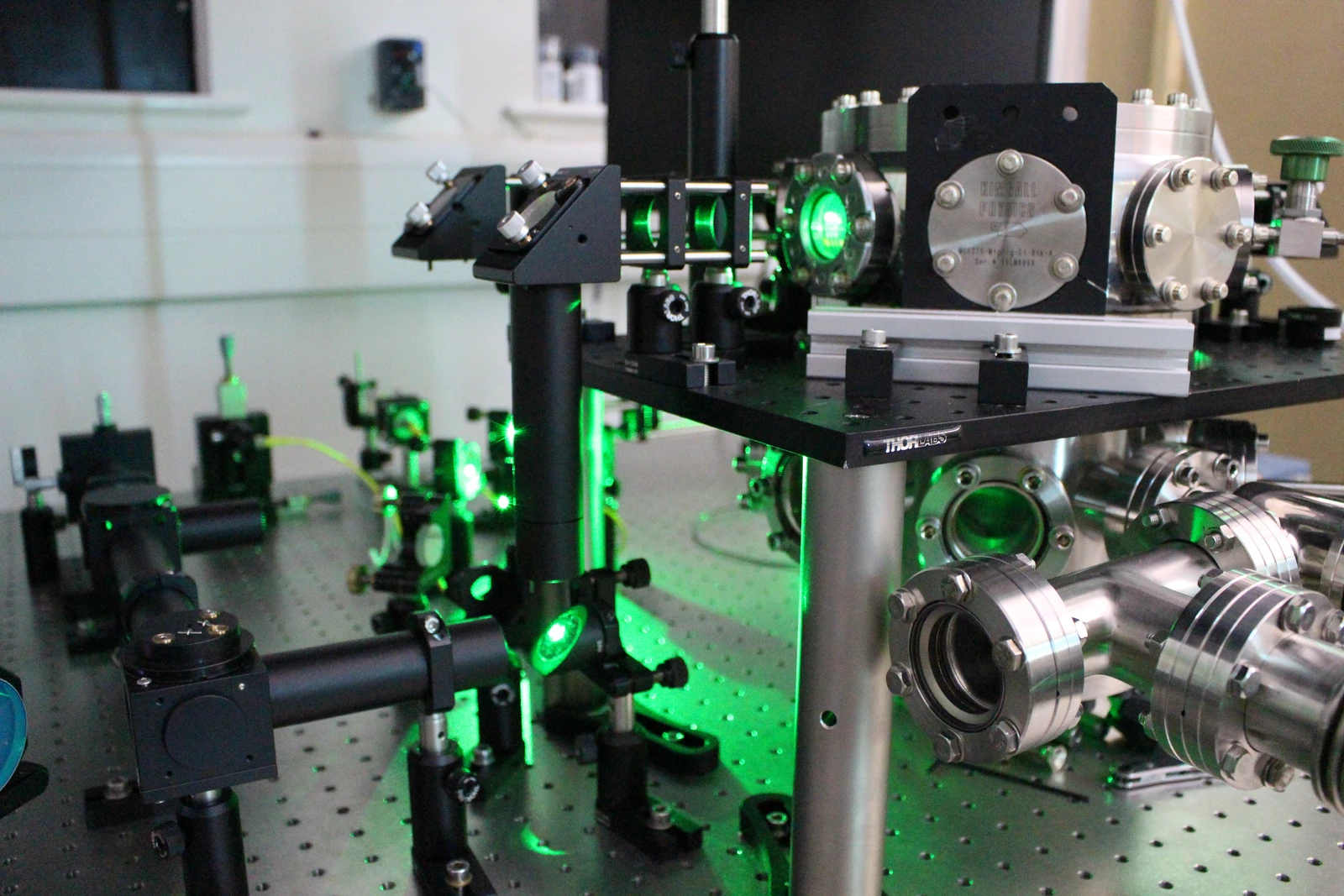
The lead photograph is historical context from Gavin Morley’s laboratory. It shows an optical table and vacuum chamber used to levitate a roughly 40-nanometre nanodiamond in 2016. It is not the Florence glass-nanosphere apparatus, and the caption preserves that distinction.
Why the moving light matters
A stationary system that can exchange quantum correlations with travelling light is a useful interface idea. The researchers point to continuous-variable quantum communication, quantum-state storage and tests of macroscopic quantum physics as possible directions. Those are implications, not capabilities demonstrated end to end here.[1][2]
The published experiment demonstrates a controlled physical link, not a working memory with measured write time, storage lifetime and readout fidelity. It also does not show a quantum network or a computation outperforming a classical method.[1][2]
The next evidence to watch is operational: how faithfully can a state be written, retained and released, and can the interface connect to another quantum system? For now, the result makes one bridge unusually concrete—a levitated object in one place sharing quantum correlations with light that can leave.[1][2]