
Scientists turned an infrared photon green without erasing its twist
A Nanjing-led experiment changed the color of single photons while retaining a much subtler feature: a quantum pattern made from multiple ways their light waves can twist.
Reading tools for text size, copying, printing and your reading list
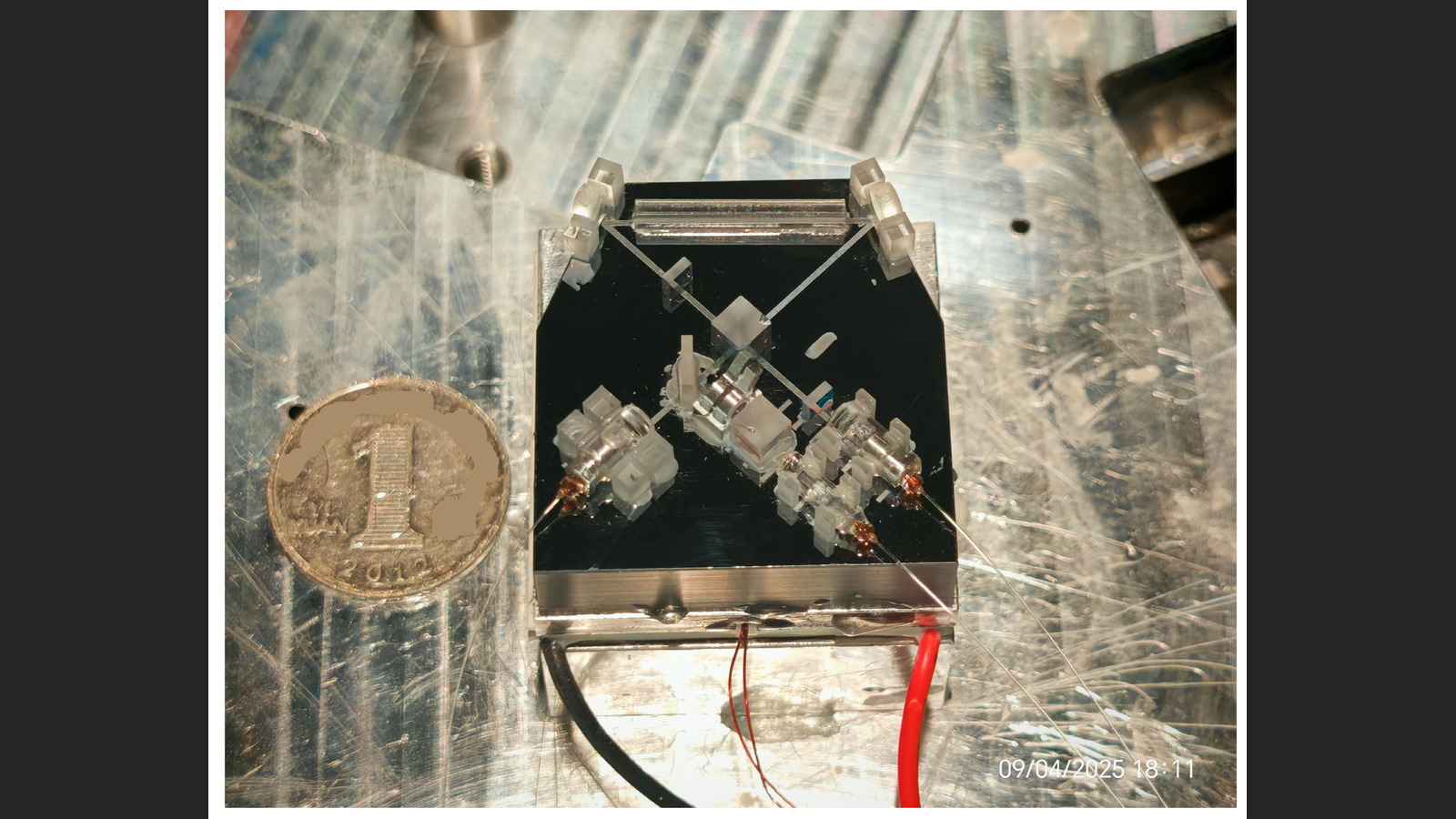
The jump from infrared to green was the easy part to describe. A team led by researchers at Nanjing University converted light from 1,560 nanometers, a wavelength commonly used in fiber optics, to 520 nanometers, in the visible green. What made the experiment unusual was what survived: a pattern encoded in the shape of the photon’s wave. The team reconstructed these patterns after conversion for sets of up to 16 modes.[1]
One photon, many possible twists
The wavefront of light can wind around its direction of travel, like a spiral staircase. In this experiment, different amounts and directions of twist are distinct modes of a property called orbital angular momentum. Instead of choosing one twist, the researchers prepared a single photon in a superposition of several: a quantum state in which the possible twists have specific weights and phase relationships. It is still one photon, not a bundle of photons and not 16 separate messages.[1]
A patterned plate shaped the wavefront. To prepare their largest state, the researchers split the light into two polarizations, shifted the twists in one set by one step, then recombined the sets so their modes interleaved. Before any color change, they reconstructed a state designed for 128 modes with 78.7% fidelity, a measure of agreement with the intended state. Their own metric, which combines target dimension and fidelity, put the effective dimension near 101. That is not a count of modes successfully converted to green.[1]
What survived the color change
The color change happened in a crystal. A pulse of 780-nanometer pump light supplied extra energy to turn a 1,560-nanometer photon into a 520-nanometer photon. The pump also carried minus one unit of twist, so the expected output shifted each mode by one step. The test was not whether every twist number stayed the same. It was whether the pattern of weights and relative phases survived that known shift.[1]
The team reconstructed the converted states for four, eight and 16 modes. Their fidelity to the intended outputs was 90.1%, 88.1% and 80.4%, respectively. Those figures describe the shape of the reconstructed quantum states, not the percentage of incoming photons successfully converted. The team recorded fewer paired detections after conversion and estimated that fully measuring a state larger than 16 modes would take more than two weeks at its available count rates.[1]
Why keep the twist?
Fiber links, memories and detectors do not always operate at the same wavelength. An interface that changes color without scrambling the information carried by the light could help those devices work together. This preprint does not demonstrate a fiber network or show that all 128 modes can make the jump. It shows that a laboratory converter need not erase a tested pattern of multiple twists, and it pinpoints why proving that for a larger pattern will take a better converter or a faster measurement.[1]