
A diamond disk measured magnetic fields by dimming invisible light
Researchers used a disk of diamond just 4.2 micrometers wide to read magnetism from the infrared light it absorbed. A second disk exposed a drawback: trapping light longer made it harder to separate the magnetic signal from noise.
Reading tools for text size, copying, printing and your reading list
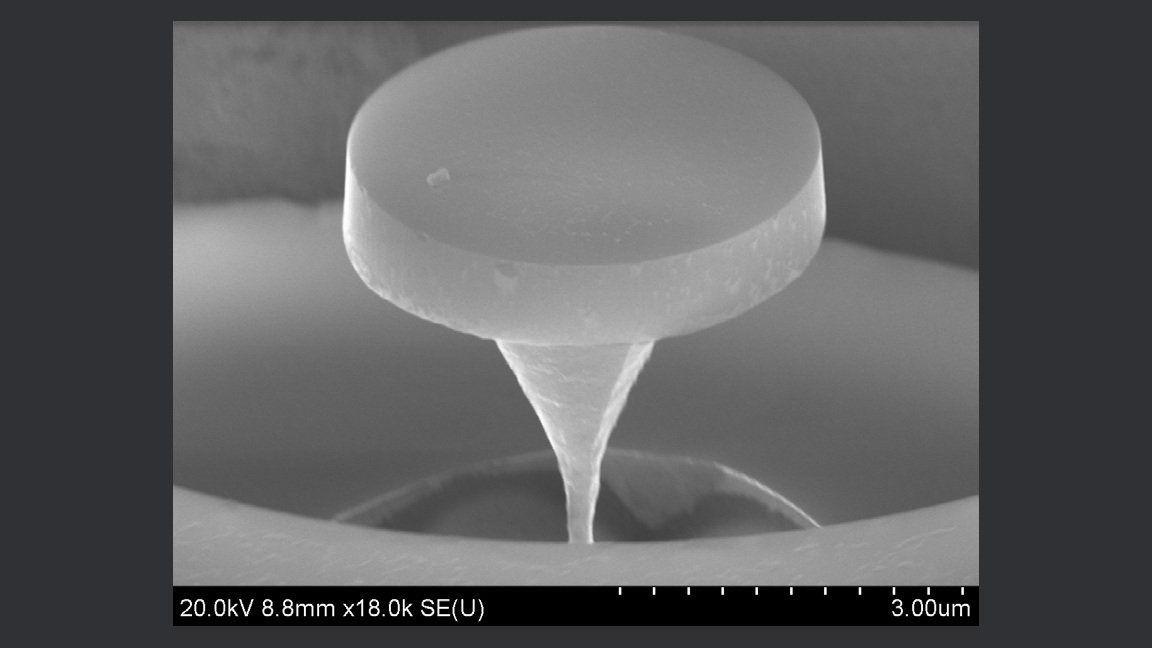
A diamond disk about the width of a bacterium can tell when the magnetic field around it changes. Instead of collecting the glow that usually gives a diamond quantum sensor its signal, researchers at the University of Calgary measured how much infrared light made it through. Their new preprint reports magnetic sensing with a 4.2-micrometer disk, smaller than many single cells. It also shows why a cavity designed to hold light longer does not automatically make a better sensor.[1]
Read the light that doesn't come back
The detector relies on defects called nitrogen-vacancy centers. Each is a nitrogen atom beside a missing carbon atom in the diamond lattice. The electronic spin associated with the defect responds to magnetic fields. A microwave sweep lets the researchers identify the frequencies at which those spins respond. When the field changes, the resonant frequencies shift.[1]
One common way to see that response is to shine green light on the diamond and look for a change in its red glow. This team used green light to prepare the defects but read their state with an infrared probe near 1,042 nanometers, beyond what the eye can see. The spin state affects how much of the probe is absorbed. Measuring that small change in transmitted light gives the researchers a signal they can track.[1]
The disk is too small for a straight pass through the diamond to pick up much absorption. A thin fiber feeds the probe into a mode that circles the disk's rim, like sound traveling along the wall of a whispering gallery. The repeated trips let light interact with the defects over a longer path without making the sensor physically larger. The team had previously used this family of cavities to study optical absorption; the new experiment uses it to measure magnetism.[1][2]
When keeping more light made the reading noisier
The smaller disk measured a magnetic sensitivity of 253 ± 9 nanotesla per square root hertz. This is a measure of the noise in the reading, not the smallest field the setup could ever detect. Averaging reduced the noise at first, but slow drift limited how far that could go. The authors estimated a drift-limited minimum of about 13 nanotesla in this setup.[1]
A second disk, 4.4 micrometers wide, trapped light more effectively and produced a larger change in transmission. Yet its measured magnetic sensitivity was worse: 368 ± 12 nanotesla per square root hertz. The team points to temperature fluctuations and imperfect coupling to the fiber as reasons the stronger optical response did not translate into a better reading.[1]
The researchers did not show that this approach beats the best glow-based diamond sensors. The new option is a readout that can, in principle, be routed along a waveguide instead of collecting light emitted in many directions. To turn the lab demonstration into a practical chip sensor, the group points to more stable optics and replacing the fiber beside the disk with a waveguide built onto the chip.[1]