
A rare-earth atom gives off different colors depending on where it lands
By trapping thulium in frozen argon and scanning it with a laser, Georgia Tech researchers separated six patterns of absorbed and emitted light that were tangled together.
Reading tools for text size, copying, printing and your reading list
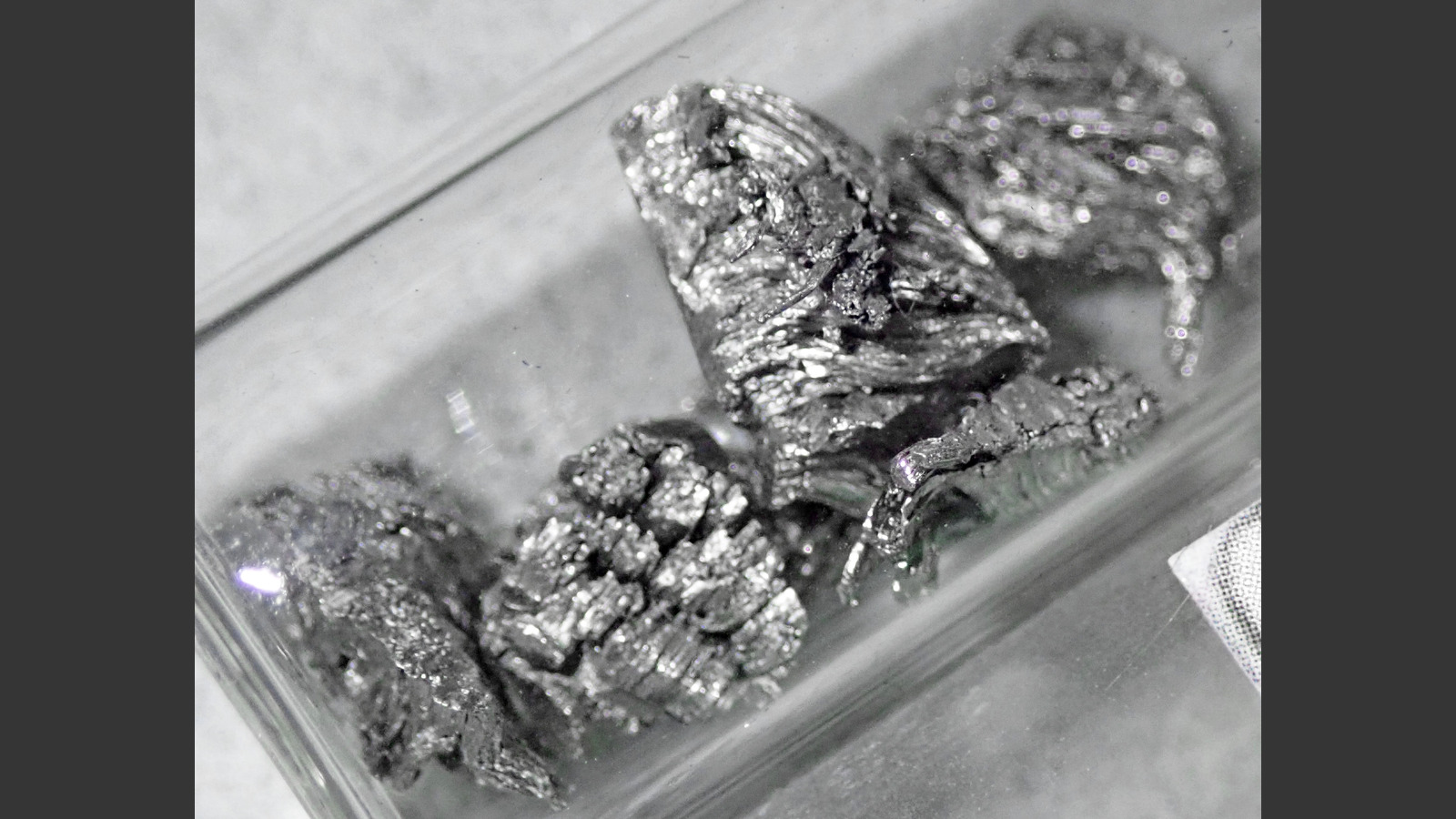
Thulium atoms are all the same element. Put them into a solid, though, and they do not all respond to light the same way. In a new preprint, physicists at Georgia Tech trapped thulium in solid argon, varied the wavelength of a laser and recorded the resulting glow. They found six distinct patterns of absorption and emission, which they attribute to atoms occupying different environments inside the frozen solid. The team did not photograph six positions in the crystal. It inferred those environments by sorting out overlapping signals.[1]
Why freeze a gas around an atom?
Argon is usually encountered as a gas and is reluctant to form chemical bonds. At sufficiently low temperatures it becomes a solid that can hold sparse guest atoms in place. The researchers used a laser pulse to release thulium from a solid target as argon condensed onto a cold surface. That trapped thulium in the growing solid while keeping the supply of guest atoms separate from the flow of argon.[1]
The host is not invisible to the atom. Its surroundings can shift energy levels and change which wavelengths the atom absorbs or emits. Some of thulium’s electrons are shielded by other electrons, however, so certain transitions shift much less than others. One near 1,140 nanometers, in the infrared, is narrow enough to help pick out how different parts of the sample respond, even when the resulting colors overlap. Earlier work by the group had characterized two stable trapping sites.[1][2]
Sorting six fingerprints out of one glow
The researchers assembled a map with the laser wavelength on one axis and the wavelengths of emitted light on the other. When different bands brightened and dimmed in tandem as they tuned the laser, the team could group those bands into a shared fingerprint. That analysis produced six profiles. Some were much easier to separate than others. Two weak profiles overlapped substantially, and the researchers could not rule out charged thulium for every profile. Earlier measurements give stronger evidence that the two best-characterized sites contain neutral atoms.[1][2]
One of those sites stood out: it emitted a band near 560 nanometers with a measured lifetime of about 600 nanoseconds. Two other bands from the same site, near 671 and 780 nanometers, persisted for about 45 and 100 milliseconds, respectively. That contrast shows why the choice of color matters if researchers want to read a state quickly. It does not mean the experiment measured a holding its information for 100 milliseconds. These are lifetimes of optical signals, and the full route by which the atom returns to lower energy is not settled.[1]
What this makes easier to test
A future sensor could use a trapped atom’s light to probe its surroundings. To do that reliably, researchers would have to distinguish the signal they want from the shifts that come from how the host trapped the atom in the first place. The new map does not demonstrate a working sensor, a memory or individual-atom readout. It tells researchers which signals to look at separately and which still need to be disentangled.[1]