
A small mirror motion helped LIGO check the fit of its laser beam
A Hanford experiment measured how the shape of light changed while the optics were running. That could help protect the gains from squeezed light.
Reading tools for text size, copying, printing and your reading list
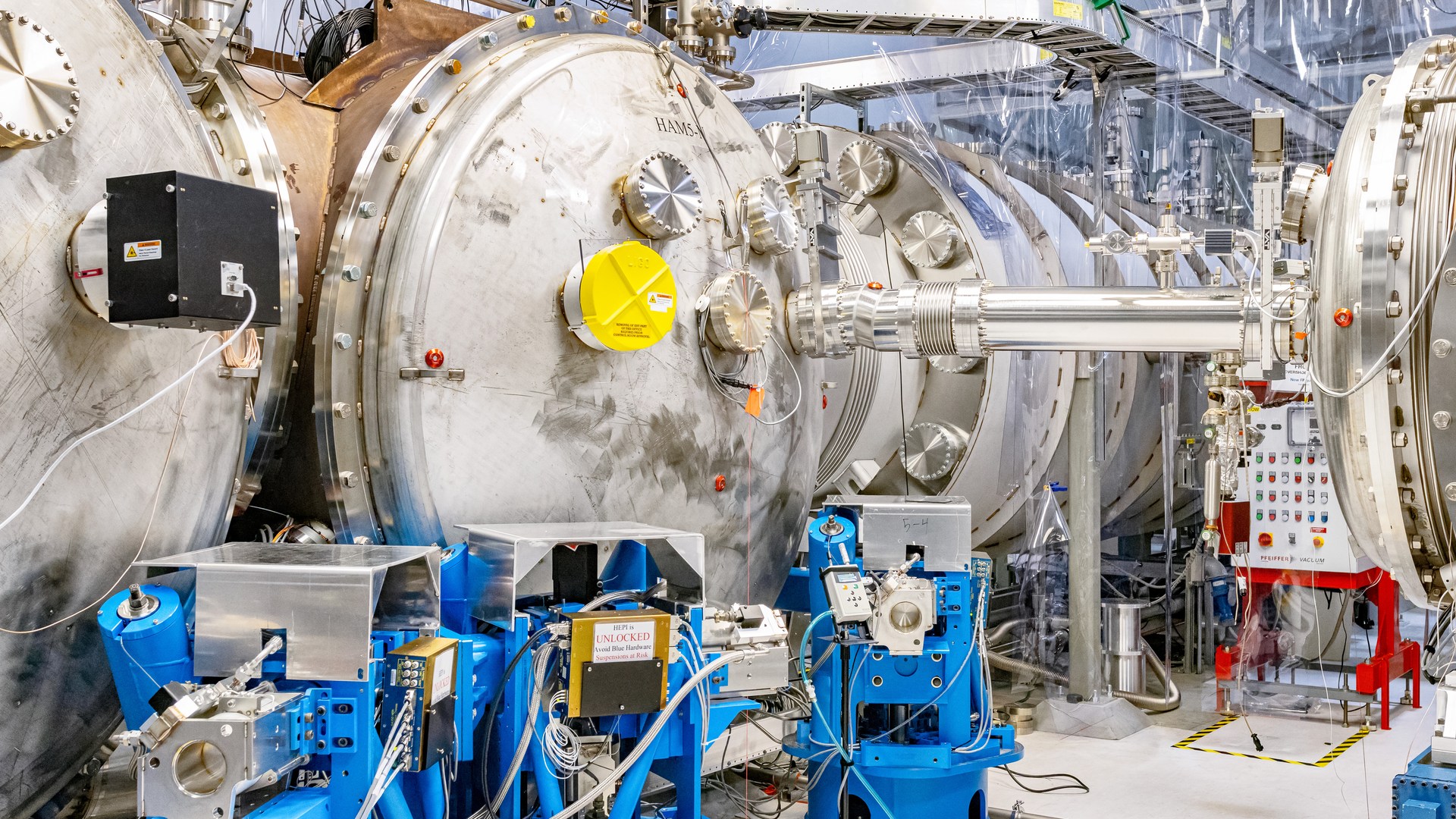
The laser that helps LIGO listen for colliding black holes has to do more than point in the right direction. Its beam also has to be the right shape. At the Hanford Observatory in Washington, LIGO researcher Masayuki Nakano tested a way to measure how well that shape fits the instrument’s optics without taking them out of their operating state. Instead of bringing in a separate reference, the method makes one by nudging the length of the optical cavity, a set of mirrors that keeps light circulating.[1][2]
That matters because LIGO uses a quantum technique called squeezing to make faint signals easier to distinguish from noise. Squeezing reduces fluctuations in one property of the light at the expense of another, and LIGO varies the trade-off according to the frequencies it wants to measure. If light does not fit the optical path well, some of that hard-won reduction in noise can be lost.[1][2]
Measuring a beam while it’s at work
A beam narrows to a waist before spreading out again. Getting the fit right means lining up both the width of that narrow point and where it falls. A change in width can call for a different correction than a shift along the beam’s path. A single reading of how much power makes it through does not necessarily tell the team which adjustment to make.[1]
The new test used a cavity already installed at Hanford to suppress unwanted motion of the input beam. Nakano moved the beam slightly on existing alignment sensors to extract clues about the mismatch. A small, periodic change in the cavity length supplied a reference through the same sensors and electronics. The cavity stayed tuned to the laser, so the measurement could see the shape the optics took on while carrying light, not just how they behaved during a separate scan.[1][3]
At a two-watt input, the new method estimated that 1.28% of the power was in the unwanted beam patterns it tracked. An independent scan measured 1.15%, close within the study’s uncertainty. In two runs at 62 watts, the estimates were 1.9% to 2.0% with the cavity operating. The measurements separated heat-related changes in the size of the beam’s waist from changes in its position. The conventional comparison scan took the cavity off resonance, so it could not preserve the same heating conditions.[1]
One cavity is not the whole detector
This was a readout test on one part of the Hanford instrument, not a demonstration that LIGO can detect fainter gravitational waves. The experiment did not automate the correction or measure a gain in detector sensitivity. The next step is to see whether the same reference works across the interacting cavities of the full interferometer. If it does, the instrument could tell its existing actuators which way to adjust while it is running, rather than just flagging that the beam no longer fits.[1]