
A Chip That Normally Guides Light Can Now Make Its Own Laser Beam
Researchers implanted neodymium in a silicon nitride circuit. It amplified two infrared bands and produced laser light in one of them, using an external pump.
Reading tools for text size, copying, printing and your reading list
Silicon nitride is good at carrying light across a chip. Getting the same material to amplify light and generate a laser beam is a different problem. In a preprint released November 25, researchers at Ghent University, imec and Helmholtz-Zentrum Dresden-Rossendorf report that adding the rare-earth element neodymium let them do both. The implanted circuits amplified light around 920 and 1,100 nanometers. A tiny racetrack-shaped loop made laser light near 1,100 nanometers, but not in the shorter band.[1]
The team started with circuits made on a commercial 200-millimeter wafer platform. After separating the individual dies, the researchers implanted neodymium ions into existing light-guiding channels. A separate laser supplied energy to the ions. As a signal traveled along a channel, energized ions could add light to it. In the racetrack, light went around repeatedly, giving that extra emission enough opportunities to build up and overcome losses.[1]
More light isn't always a laser
The researchers tested the two bands separately. At 920 nanometers, their best reported gain after accounting for losses was 1.5 decibels in a 3.2-centimeter guide, or about 1.4 times the optical power. At 1,090 nanometers, a longer guide delivered 6 decibels of gain, about four times the optical power. Those figures describe two different test devices and wavelengths. Neither is a measure of how efficiently the whole apparatus turns electricity into light.[1]
The laser produced a different signature. Below the pump threshold, its output was a broad glow. Above the threshold, the team saw sharp peaks around 1,100 nanometers. At 920 nanometers, the team measured amplification but no lasing. The authors point to lower gain and potentially less favorable coupling between the loop and the channel beside it.[1]
Why put the light source on the chip?
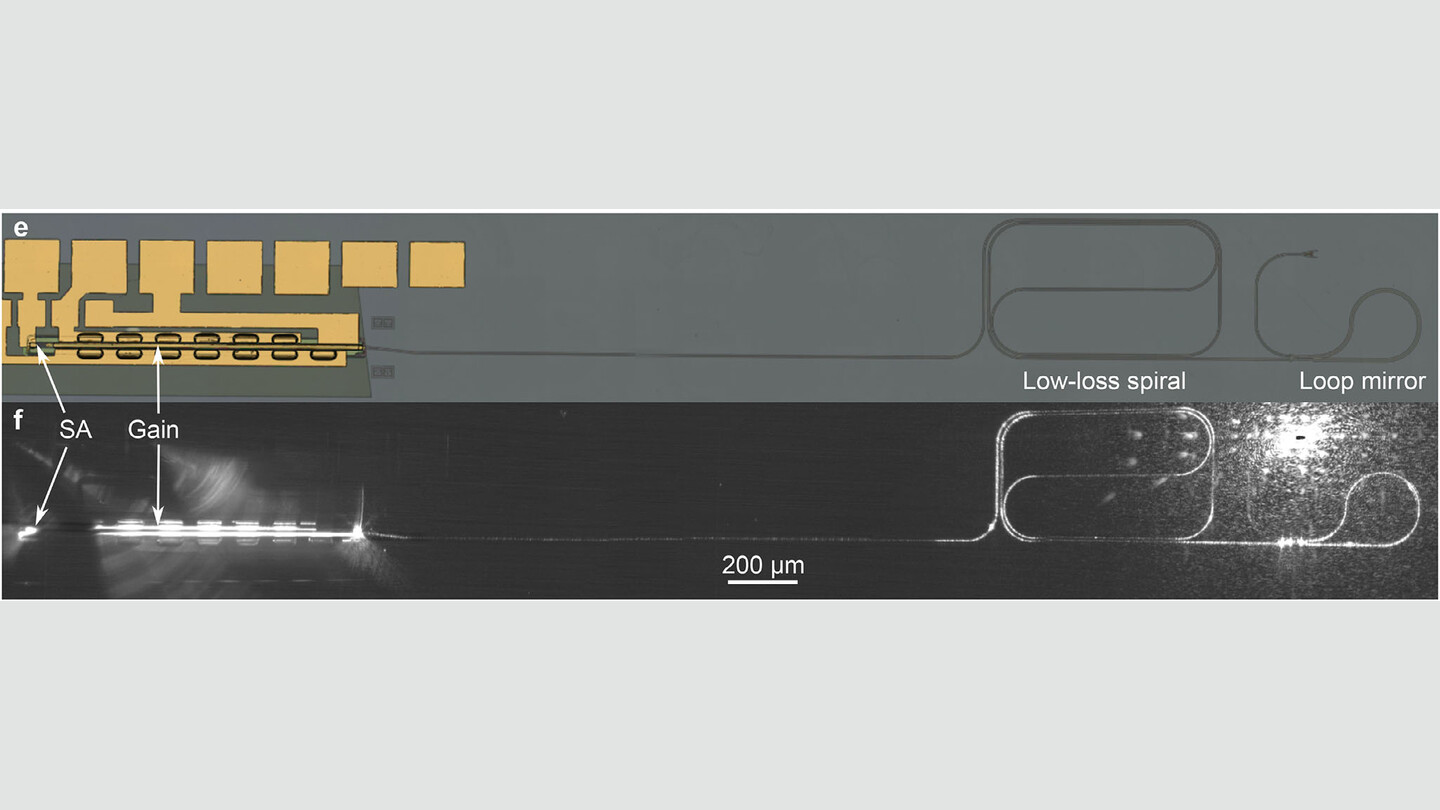
There is more than one way to do it. In work first published last November, some of the same Ghent researchers integrated an 800-nanometer laser by transferring a tiny semiconductor piece to a silicon nitride circuit. The microscope images here show that earlier device. The new work instead puts the light-amplifying ions into the channel material itself and targets different wavelengths. It still relies on an external pump.[1][2]
That distinction matters for quantum instruments, many of which need light at a wavelength matched to a specific atom or defect. A fabrication method that can work in more parts of the spectrum gives designers more options. This team didn't drive a or run a quantum sensor with the new circuit. The next useful measurements are how much laser power usable devices can deliver, how stable the output is, and whether the process yields consistent results across many dies.[1]