
China’s Shenzhou-24 crew arrives for a new round of quantum experiments in orbit
The Tiangong mission will use grids made of laser light to study how atoms behave together and test ways to measure motion with cold atoms.
Reading tools for text size, copying, printing and your reading list
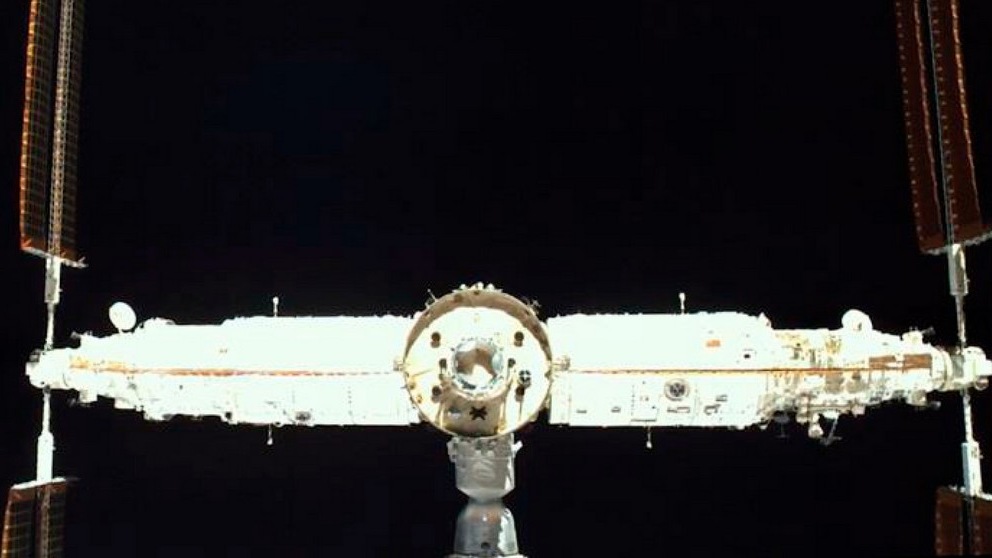
China’s Shenzhou-24 spacecraft docked with the Tiangong space station on November 25, bringing a new crew to an orbiting lab where scientists can watch cold atoms drift for seconds at a time. Among the roughly 90 experiments and technology tests planned for the mission are two different uses of those atoms: exploring states of matter with a grid made of laser light and testing techniques for measuring motion. Neither experiment has reported results under the new mission.[1][2]
Tiangong gives researchers something that is hard to arrange for long on Earth: a lab that falls alongside its experiment. Gravity still acts on the station and the atoms inside. Because they are in orbit together, however, a released cloud does not simply drop to the bottom of its chamber as it would in a stationary lab on the ground. That extra time makes it possible to study clouds that spread very slowly or to give a tiny effect longer to build up.[3][4]
A crystal made of light
One project will use what physicists call an optical lattice. Intersecting laser beams create regularly spaced places where cold atoms can sit, like seats in a theater. Unlike theatergoers, the atoms can sometimes move between seats through a quantum effect called tunneling. By changing the light, researchers can adjust how easily that happens. The atoms act as stand-ins for particles in a material, giving researchers a way to study how their collective behavior changes as conditions change. This is a specialized quantum simulator, not a general-purpose quantum computer.[2][3]
The second project asks a different question: how can an atom help measure motion? In a device called an atom interferometer, laser pulses can split an atom’s wave into two paths and bring them back together. Motion relative to the instrument changes how the waves line up when they meet. The resulting pattern provides a measurement. The International Space Station’s Cold Atom Lab has already used this method to detect vibrations aboard that station. China’s announcement describes technology research, not a flight-ready sensor or a new performance record.[2][4]
What to watch for next
A November 5 paper in Science offers a concrete benchmark for what Tiangong can already do. In a separate experiment, researchers released a cloud of about 20,000 rubidium atoms and tracked its expansion for seven seconds. The cloud spread as slowly as a gas with an effective temperature of about 9.7 trillionths of a kelvin above absolute zero. That number describes the atoms’ motion, not the temperature inside the station. The cold-atom lab used for that work arrived with the Mengtian module in 2022.[3][5]
For the lattice project, the next meaningful result will be a named state of matter and a measurement that shows the atoms reached it. For the motion test, look for a measured signal and a comparison with the vibrations or other noise that can drown it out. The new crew is in place; those are the results that would tell us what orbit bought the experiment.[1][2][4]