
IonQ’s revenue jumped. Nearly half came from a chip foundry
SkyWater contributed about 48% of IonQ’s record third-quarter revenue. The results reveal a changing business—and why revenue, operating loss and accounting profit tell different stories.
Reading tools for text size, copying, printing and your reading list
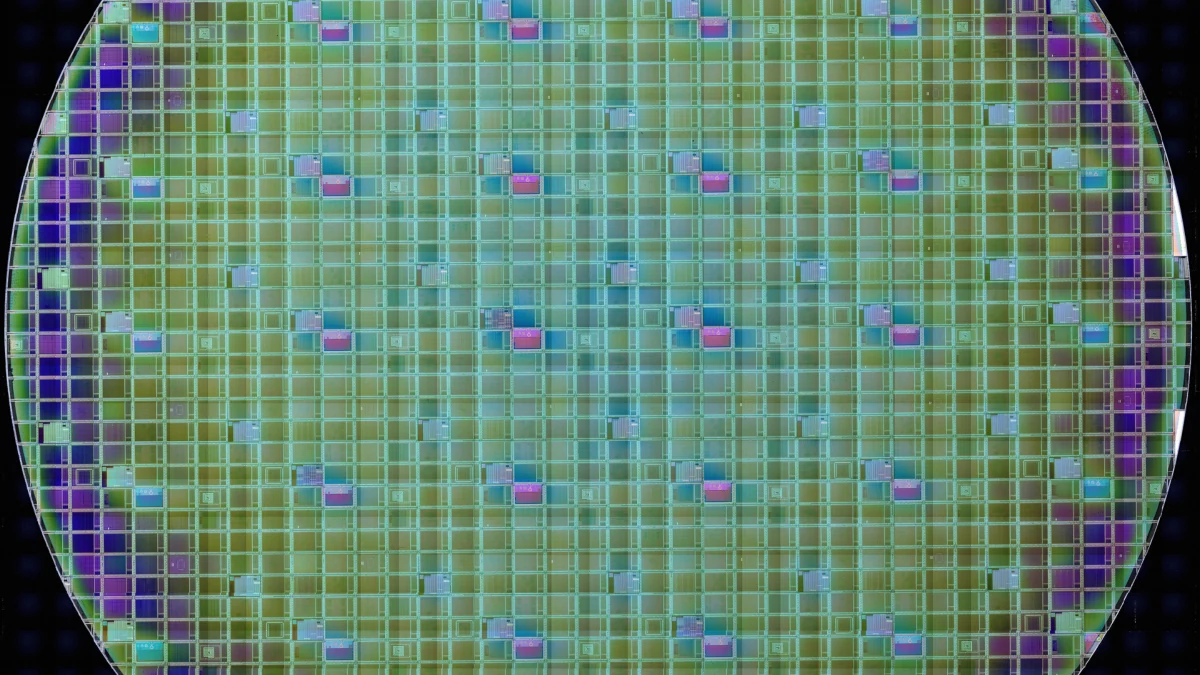

A quantum computing company just reported a spectacular-looking quarter. Understanding it requires looking inside the headline number. IonQ reported $173.8 million in third-quarter revenue on November 5, up 336% from a year earlier. Of that, $83.5 million came from SkyWater Foundry Services. That works out to roughly 48% of the total.[1]
The result poses a useful question for anyone following the quantum race: what, exactly, are these companies selling?
What the revenue actually measures
IonQ completed its SkyWater acquisition on July 31. The manufacturer’s contribution is therefore part of a larger, changed business. In September, IonQ had already incorporated the acquisition into its annual financial outlook.[2]
A foundry makes semiconductor devices. Manufacturing services generate revenue by providing development and production work. That is a different activity from selling access to a quantum computer, even when both activities sit inside the same company.
IonQ reported the other $90.3 million under its Platform business, which spans computing, networking, security and sensing. That category grew 127% from a year earlier. It also covers more than quantum computing alone.[1]
Both figures deserve attention. The foundry contribution shows how much an acquisition can reshape a company’s headline growth. Platform growth shows that the rest of the business also expanded substantially.
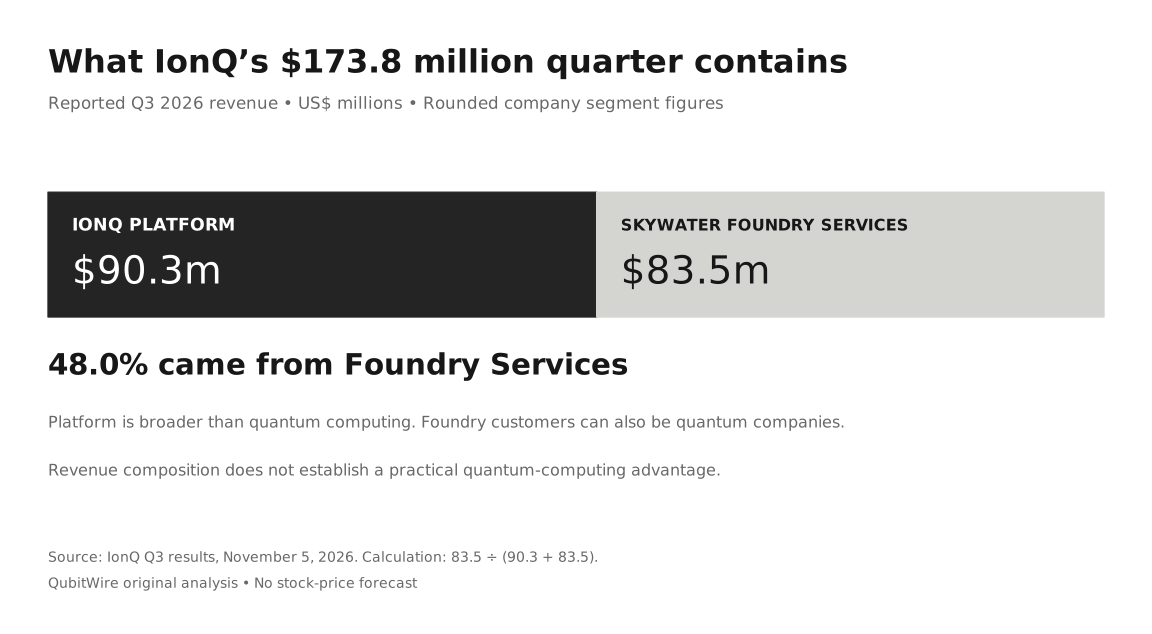
For readers trying to judge the technology, the distinction matters. A revenue total measures commercial activity across the businesses included in it. It does not tell us how many useful quantum calculations customers completed, how accurate those calculations were, or whether a quantum method outperformed the best conventional alternative.
Those questions need their own evidence: workloads, error rates, independent comparisons and customers explaining what they achieved. A financial report and a technical benchmark answer different questions.
How profit and a large operating loss can coexist
The quarter contains a second number that needs context.
IonQ reported $564.0 million in net income attributable to the company under U.S. accounting rules, known as GAAP, alongside a $433.075 million operating loss. Its financial statements also recorded an $896.156 million gain from changes in the fair value of warrants.[1][3]
Warrants are financial instruments connected to a company’s shares. Changes in their accounting value can affect reported profit without representing money paid by customers. Here, that noncash accounting movement was material to the net-income result.
Operating profit focuses more closely on the relationship between revenue and operating expenses. Net income includes additional items beyond operations. Neither number should be presented as a substitute for the other.
Operating loss is also different from cash burn: operating expenses can include noncash charges, while cash flows reflect other movements and timing differences. A fair reading keeps those measures separate.
This is why the most revealing version of the story includes both the impressive revenue growth and the costs of running the expanded company. Leaving out either creates an incomplete picture.
What the next stage needs to show
IonQ raised its full-year revenue outlook to $505 million–$515 million. It reported $1.7 billion in cash, cash equivalents and investments at September 30, or $3.7 billion on a pro forma basis including an equity offering completed October 16.[1]
Those dates matter. The larger figure adjusts the quarter-end amount to include later financing. It is a pro forma calculation, not a separately reported October 16 balance.
For the broader quantum industry, the manufacturing angle may be the more interesting development. Building sophisticated hardware repeatedly requires production methods that work beyond individual laboratory demonstrations. Bringing manufacturing and quantum development under one roof raises a practical question: can tighter coordination improve the path from a promising design to equipment customers can use?
That is a question to test over time. Ownership alone cannot establish improved manufacturing yields, lower costs or better quantum performance. Those outcomes require operating and technical evidence.
The next useful milestones would include clearer information about the composition of Platform sales, the performance of the foundry business, and customer results that connect spending to useful work. Readers can then distinguish a bigger corporate group from progress in each of the technologies it develops.
IonQ’s new results show an expanding business with a substantial semiconductor-manufacturing component. The headline growth is real. Understanding what grew is the part that makes the story useful.