
IonQ’s $2 Billion Financing Has Three Different Share Counts
The October 14 offering separates common shares, prefunded warrants and seven-year warrants. Reading those instruments separately explains which money is announced and which remains contingent.
IonQ announced pricing for a $2 billion equity offering on October 14. The financing has three separate share counts: 20.5 million common shares, prefunded warrants covering 29.5 million shares, and seven-year warrants covering another 100 million shares. It is a pricing announcement; the source does not confirm a closing.[1]
Where the $2 billion comes from
The common shares and prefunded warrants are each priced at $40. Multiplying 20.5 million by $40 gives $820 million; multiplying 29.5 million by $40 gives $1.18 billion. Together they explain the $2 billion headline. This arithmetic uses the announced purchase prices, before considering fees or the detailed terms in the offering documents.[1]
The seven-year warrants have a different role. Their announced exercise price is $69.46 a share. The right to buy shares later is distinct from the common stock and prefunded instruments in the initial financing. A reader should not add all 150 million underlying shares together and assume every share was issued at the same price.[1]
The next document matters
The terms alone do not establish the company’s final net cash proceeds, the timing of settlement or what will ultimately happen to every warrant. Those questions belong to the prospectus supplement, transaction documents and subsequent closing disclosures. The issuer directs readers to its SEC filings for those details.[1]
How capital becomes useful evidence
Here is a useful way to read any funding headline: keep a transaction ledger and an engineering ledger. The first records announced terms, closing, costs and ownership changes. The second records what the business builds and how it performs. A new entry in the transaction ledger can enable work without completing an entry in the engineering ledger.
What the financing cannot measure
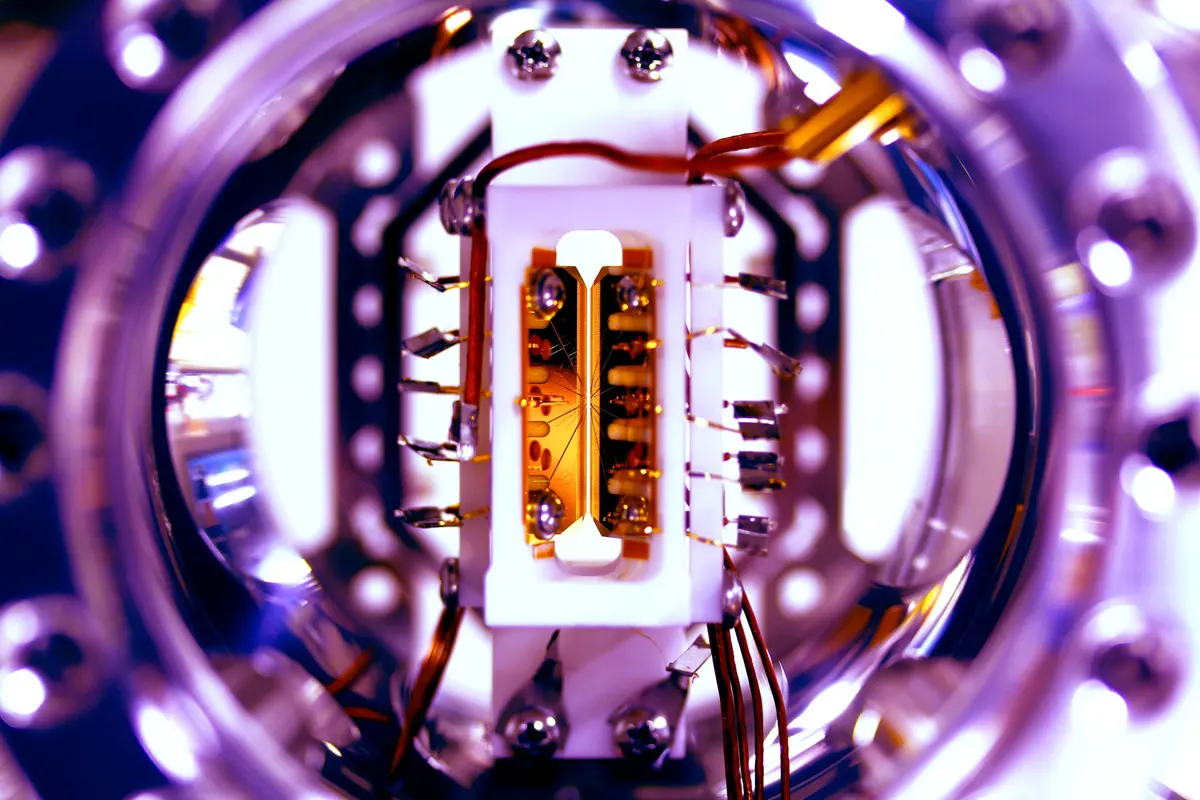
IonQ’s technology uses individual trapped ions as . Its architecture explainer describes the trap, vacuum environment and optical, electrical and classical-control systems that support computation. That combination helps explain why an engineering milestone needs a defined scope: a component test and an end-to-end computing result measure different parts of the machine.[2]
For a hypothetical laboratory, additional capital might allow two teams to test different fabrication routes at once. That could shorten the time needed to learn which route works. It would not determine the experiment’s result. The practical follow-up is therefore a named milestone with an observable outcome, rather than a larger budget treated as a technical score.
The same discipline helps with strategic flexibility. A financing may change the choices available to management, but a reader still needs to distinguish research spending, a purchase agreement, an installed machine and a customer-accepted system. Those events can occur months apart and answer different questions.
A useful follow-up to this story would connect the closing record to later delivery evidence while keeping the original financing terms visible. It should also reconcile which shares were issued and which rights remain outstanding. That gives readers a continuous account instead of a second headline that counts the same transaction twice.
For now, the supported conclusion is narrow and meaningful: IonQ has priced a financing with three different instruments. Follow the closing and instrument disclosures first, then judge the hardware and commercial milestones on their own evidence.