
IonQ’s Proposed $1.3 Billion Security Deal Goes Beyond Quantum Computers
IonQ has agreed to buy Elisity in an all-stock transaction worth up to $1.3 billion. The immediate story is a proposed cybersecurity combination, not a new machine that has broken encryption.
IonQ is proposing to buy a business that helps organizations control who and what can move through their networks. The proposed Elisity acquisition connects immediate enterprise security needs with preparation for future quantum threats. Its significance rests on what the businesses can integrate, rather than a new claim about quantum-computer performance.
On 12 October 2026, IonQ announced an agreement to acquire Elisity in a transaction valued at up to $1.3 billion in stock. The ceiling includes up to $150 million in contingent earnout consideration. IonQ said it expected the transaction to close in the fourth quarter, subject to closing conditions. An agreement is not a completed acquisition, and the maximum earnout is not money already earned.[1]
The deal brings together two security conversations that are often compressed into one: controlling access to a network now, and preparing cryptographic systems for a future in which sufficiently capable quantum computers could threaten some of today’s public-key methods. Those conversations overlap in a security programme. They are not the same technical problem.
Three different security jobs
Zero trust is an architectural approach that avoids treating a user or device as trustworthy simply because it is inside a familiar network boundary. Access decisions depend on identity, context and policy. A company pursuing zero trust still needs to decide which resources exist, who should reach them and how those decisions will be enforced. NIST’s zero-trust guidance provides the architectural context; it is not a certification of this transaction or of any particular product.[2]
Post-quantum cryptography concerns classical cryptographic methods designed to resist attacks by both classical and quantum computers. The mathematics and migration problem differ from network segmentation. Updating cryptography does not automatically remove unnecessary access rights. Tightening access policy does not, by itself, replace an algorithm that an organization needs to migrate.[3]
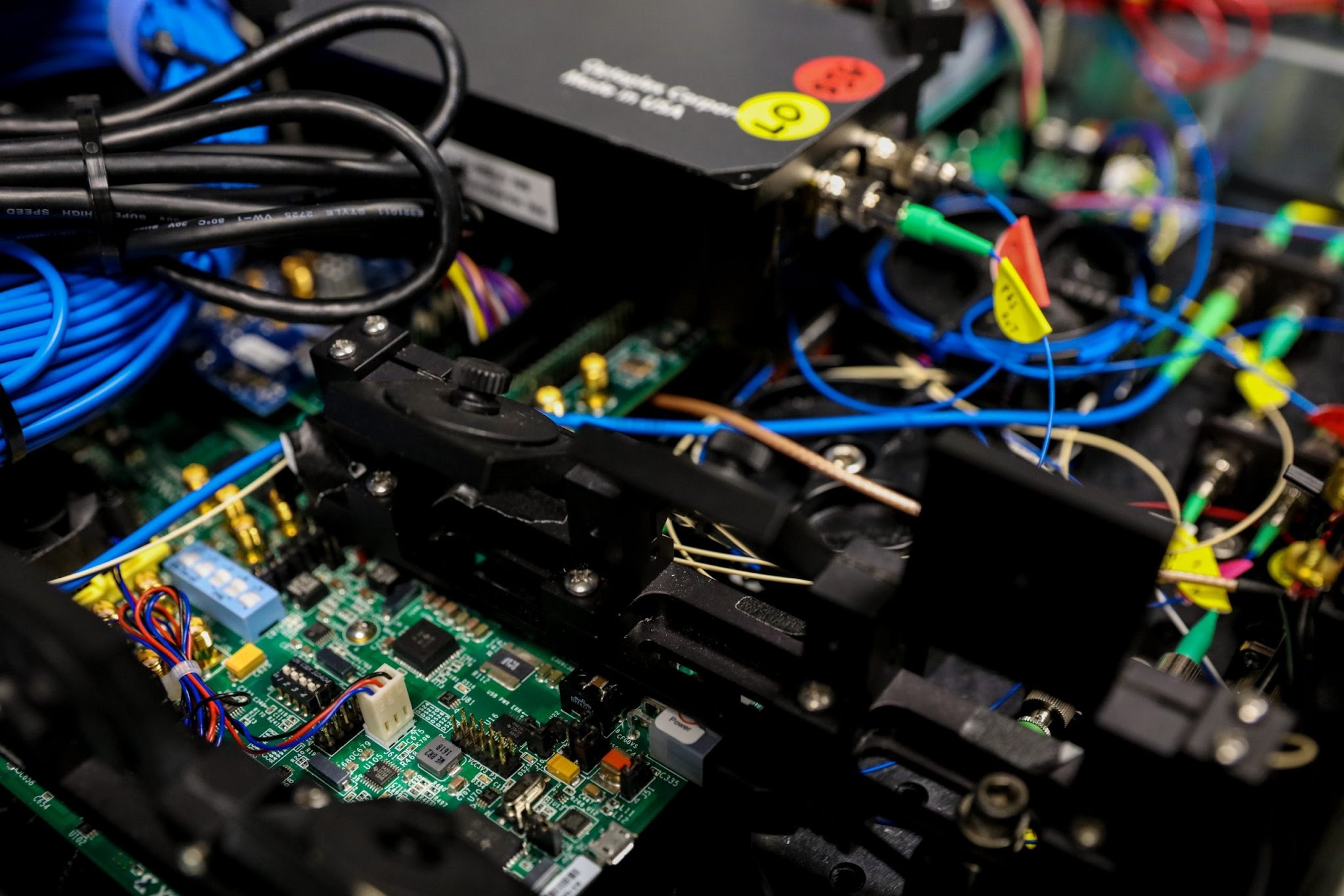
Quantum key distribution is different again: it uses quantum communication techniques to establish keys. Elisity’s access-policy software is not an optical quantum network. The archival equipment pictured here illustrates that separate QKD function, not Elisity’s technology or the proposed combined product.
The integration question is practical: can a broader offering make it easier to inventory a system, identify sensitive relationships, enforce policy and prepare for cryptographic change without adding another confusing layer? The announcement makes that strategic ambition visible. It does not demonstrate the eventual operational outcome.
What “up to” means
An all-stock transaction also should not be described as cost-free. Issuing stock changes ownership claims. The actual economic effect depends on the agreement, share mechanics, conditions and eventual outcomes. Nor should the maximum transaction value be treated as a guaranteed amount paid at signing. The source announcement is the starting point; the operative transaction documents control the detail.[1]
A business event and a hardware result
The deal does not establish that a particular IonQ processor has achieved a new error rate, run a useful algorithm faster than the best classical alternative or reached fault tolerance. Those claims would require their own evidence, with a defined task, resources and comparison.
The reverse mistake is to dismiss the transaction because it is not a milestone. Building a business involves distribution, software, customers, operating discipline and integration as well as research. A transaction can be strategically consequential while saying little about the performance of a processor. Good coverage lets both statements remain true.
What would make the integration convincing?
The strongest follow-up would show what customers can do after integration that they could not do as readily before. That might involve a documented workflow, supported interfaces, a specific deployment or an independently described customer use. The important point is not to invent those outcomes before they exist.
A demonstration should make boundaries visible. Which function is provided by access-policy software? Which by cryptography? Which, if any, requires quantum communication hardware? What existing infrastructure remains? What additional operational burden is introduced? A product that makes those responsibilities clearer would be easier to evaluate than one marketed only with a broad “quantum era” label.
For a deployment claim, ask about the workload and setting. A pilot, a paid production deployment and a general-availability product are not interchangeable. A customer logo without scope does not establish that every part of the proposed combined offering has been installed or validated.
The near-term follow-up is straightforward: did the agreement close on the announced terms, and what changed when it did? The more demanding follow-up comes later: did integration produce something useful, supportable and adopted? Those questions should stay attached to the original story rather than generating a fresh “breakthrough” headline for every administrative milestone.