
A quantum light source in Madrid went a year without an optical tune-up
A new report tracks the source on installed fiber. The link still needed automatic adjustments and logged a power outage.
Reading tools for text size, copying, printing and your reading list
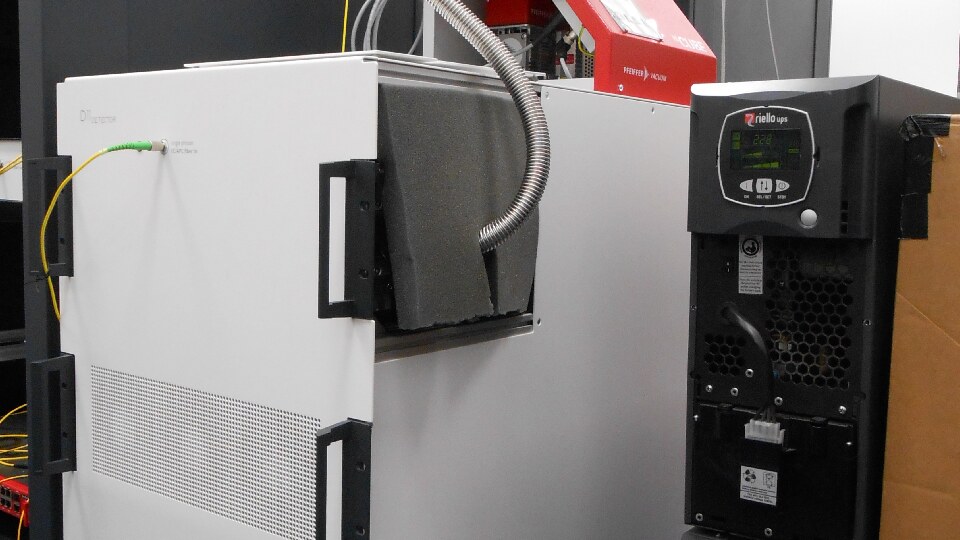
A device that supplies light for a quantum link in Madrid went a year without anyone realigning its internal optics, its developers report in a November 24 preprint. The device fed a link on installed fiber that generated about 12,000 bits of secret key per second. The chart also shows a gap from a power outage. What held up was the alignment inside the light source, not every part of the network.[1]
What stayed put
A quantum key link uses measurements of light to help two endpoints make the same secret key. The key can protect ordinary traffic, but the quoted rate measures how fast the link makes keys, not how fast it carries files. In Madrid, the source sat with one endpoint and sent light through the fiber to the other. A compact mounting plate held the optics in place, and shorter beam paths gave small movements less room to spoil the alignment.[1]
The installed cable could still change the polarization, or orientation, of the light. An automatic controller adjusted for that drift to bring the fraction of incorrect bits below the system’s 4% operating threshold. The chart shows spikes as well as the power interruption. The authors report a median error rate of 2.13% after the 12-month period, but do not provide a complete uptime or key-delivery record. Neither figure guarantees that the link produced keys continuously.[1]
A maintenance result, not a new network
Madrid did not just switch the system on. In April 2025, the network announced that the entanglement equipment was already installed. At the time its supplier was called Quantum Industries. A March 2026 paper included a photograph of ZeroThird equipment during commissioning. The November preprint adds a detailed look at how a source held up in the field, rather than announcing another installation. It also differs from the recent Geneva report, which compared secret-key generation on three named routes rather than studying whether a light source needed to be adjusted.[1][2][3][4][5]
For an operator, the useful next number is the interval between visits across several devices, paired with a record of outages and key delivery. A source that stays aligned can reduce one reason to send a technician. That does not tell an operator how often the fiber, detectors or power supply will still need attention.[1][4]