
A magnetic field strengthened signs of superconductivity in 17 layers of graphene
A field aimed along the carbon sheets deepened a drop in electrical resistance. A weaker field aimed across the sheets suppressed that response instead.
Reading tools for text size, copying, printing and your reading list
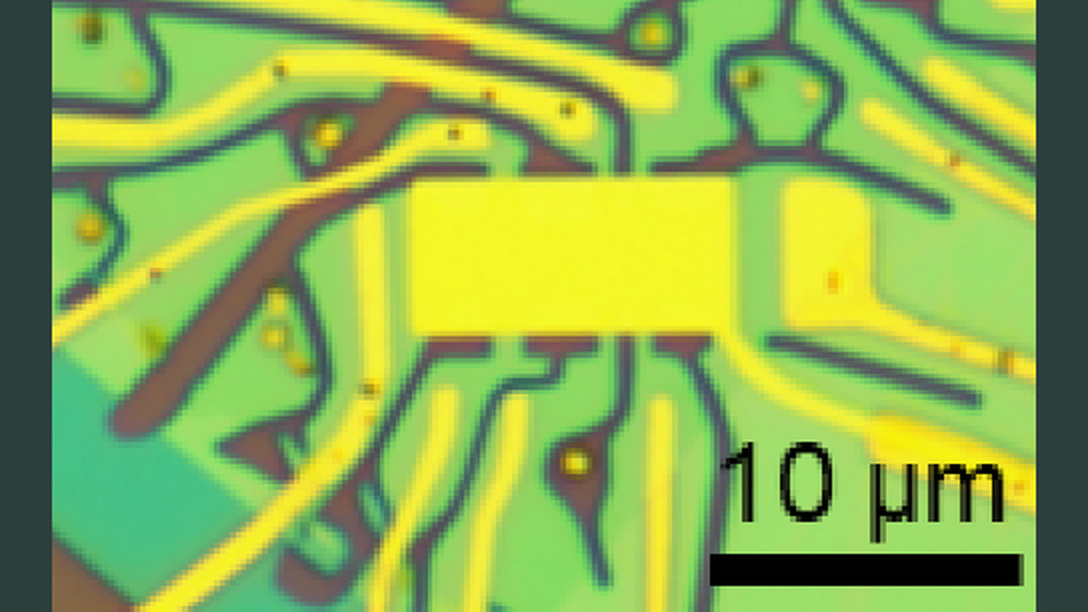
A magnetic field usually makes superconductivity harder to sustain. In a stack of 17 graphene sheets, a field aligned with the sheets did the opposite at first. A team led by researchers at Nanyang Technological University reported that an in-plane field of 0.2 tesla made a sharp resistance dip deeper and extended it across a wider range of settings. The results, made public November 25 in a preprint, offer a way to test how electrons pair when their spins already tend to point the same way.[1]
The same magnet can help or hurt
The team worked with rhombohedral graphene, in which neighboring carbon sheets are shifted in a repeating three-layer staircase. The stack was sandwiched between insulating sheets of hexagonal boron nitride. Two electric gates let the team adjust both the number of charge carriers and which face of the stack they tended to occupy. That matters because the boron nitride on one side was lined up with the graphene closely enough to reshape the electronic states there.[1][2]
The direction and strength of the field both mattered. The team saw signs of superconductivity strengthen in a modest field parallel to the sheets but fade again near 1 tesla. A much smaller field pointing across the sheets, about 25 millitesla, was enough to suppress the response in one measurement. The authors also saw the parallel-field boost in a second device with 15 layers.[1]
This was not a demonstration of a resistance-free wire. In one set of measurements, the sharpest transitions occurred at temperatures between about 29 and 58 thousandths of a degree above absolute zero, using a halfway drop in resistance to define the transition. The lowest resistance reported across that region was still about 10 ohms. The resistance dip, the characteristic change at a critical current and the sensitivity to temperature and field are the evidence for the superconducting response.[1]
Why one face of the stack mattered
When the gates pushed charge carriers to the side farthest from the aligned boron nitride, the team saw the superconducting signature. Under the opposite gate setting, where carriers were concentrated at the aligned surface, it did not see the same signature. The researchers' calculations suggest that the alignment strongly rearranges the available electronic states at that surface. The experiment gives them a way to change those states without replacing the carbon stack.[1]
The researchers also used small oscillations in the normal-state resistance as a fingerprint of how electrons were distributed. They found two different oscillation frequencies where two equivalent groups of electrons would have produced one. On their interpretation, the groups sit in two different regions of momentum space, called valleys, and are unequal in size. These valleys are not physical hollows in the sample. And the measurement does not directly show which electrons paired.[1]
The pairing question is still open
The authors offer one possibility: magnetic fluctuations might help electrons with similar spins pair across the two valleys. Other explanations remain open, including ones that involve vibrations of the material. The chance to test those ideas is the payoff: in the same device, researchers can tune the electronic state with voltage and then see how the superconducting response changes with the angle and strength of a magnetic field.[1]