
Skip to content
RESEARCH

Two sheets of carbon gave trapped light a tuning dial

In a twisted graphene stack, voltage stretched an infrared surface wave by nearly 90% at a fixed laser frequency. Most of that control came in a narrow window.

Published Source report Sources checked
Reading tools for text size, copying, printing and your reading list
My reading list
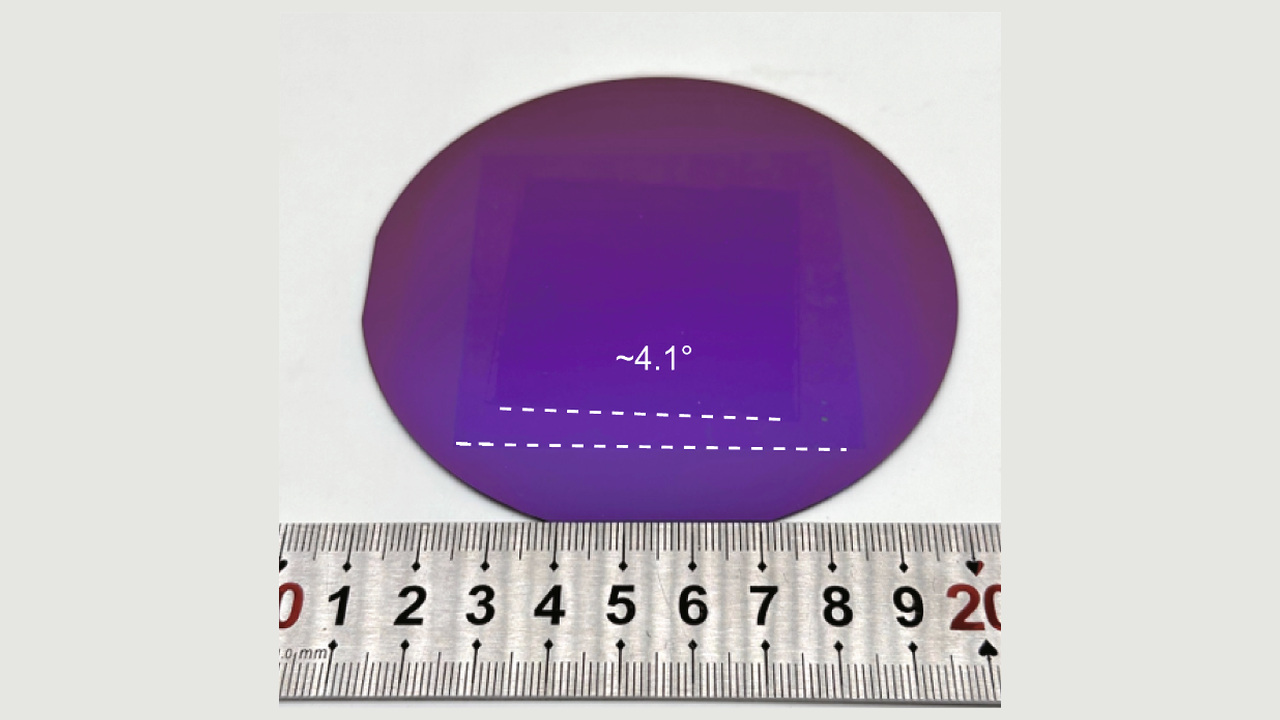
A purple wafer on a metal ruler, with dashed lines and a label marking a roughly 4.1 degree angle between graphene sheets.
An optical photograph of twisted bilayer graphene on a wafer from a separate 2024 photodetector study. The marked 4.1° angle belongs to that sample, not the new experiment.Qinci Wu and colleaguesQinci Wu, Jun Qian, Yuechen Wang, Luwen Xing, Ziyi Wei, Xin Gao, Yurui Li, Zhongfan Liu, Hongtao Liu, Haowen Shu, Jianbo Yin, Xingjun Wang and Hailin Peng. Waveguide-integrated twisted bilayer graphene photodetectors, Nature Communications 15, 3688 (2024), Figure 4b, DOI 10.1038/s41467-024-47925-x. CC BY 4.0. Cropped from the figure, resized and framed.

The infrared laser never changed frequency. But inside a stack made with two rotated sheets of graphene, the spacing between the ripples it launched changed by nearly 90% as researchers changed the voltage applied to the stack. The ripples were not ordinary light traveling through air. They were hybrid waves tied to the material, whose tightly confined fields let researchers probe how its electrons respond. The experiment, reported in a November 25 preprint, shows that rotating the two carbon sheets by a few degrees changes where that dial has the most effect.[1]

What was actually stretching?

Imagine laying two fine meshes on top of each other and rotating one slightly. A larger pattern appears, even though the holes in either mesh have not changed. In graphene, two sheets of carbon atoms make a similar pattern, called a moiré. It changes the energies available to electrons. The team, led by researchers at the University of Notre Dame, sandwiched its graphene between layers of hexagonal boron nitride, a crystal that can carry waves coupling light to the vibration of its atoms. Those waves can combine with collective ripples in graphene's electrons.[1]

Tiny gold disks helped launch the hybrid waves. A scanning microscope picked up the fringes left by the waves as they traveled. The gap between the fringes told researchers about the wavelength; how fast those fringes faded told them about loss. In one comparison they saw no fringes in the graphene region at charge neutrality. As they added charge using voltage, the fringes appeared. At higher twist angles they also found a second change: keep adding charge past a certain point, and the wavelength responds much less.[1]

Why the twist matters

In an unrotated comparison sample, the response changed more gradually. Above about four degrees of twist, most of the change was packed into a narrow range of charge density. That range shifted as the twist angle increased. At one infrared frequency, the change between the lowest and highest charge densities they could access approached 90% for the largest angles tested. A separate temperature sweep on a 4.5-degree sample still showed the crossover at room temperature. The study didn't say that the full 90% held at every temperature.[1]

Earlier experiments had already imaged confined waves in twisted graphene. Here the extra result is a voltage range that the twist angle helps set. Calculations suggest the response tails off because different groups of electron states mix as charge is added, not because the two sheets act independently. A practical next test would be to use that narrow range to tune a tiny optical cavity repeatedly while measuring how much of the wave it loses. This study measured waves in a material stack, not a finished switch or a quantum computing device.[1][2]

Keep your reading trail

Evidence & context

3 linked sources

Preprint Fig. 2 compares the guided hybrid-mode wavelength between the lowest and highest accessible charge densities. It approaches 90% change at 1480 inverse centimeters for the largest angles. The fixed laser frequency and free-space wavelength did not change. Room-temperature persistence was tracked separately on a 4.5 degree sample.

How to read the evidence and dates

An announcement records what an organization stated. An experiment reports an observation. A simulation or resource estimate depends on its assumptions. QubitWire’s analysis connects these sources; the labels are not quality scores.

Published is the article’s first QubitWire publication. Updated marks a substantive content change. Sources checked records a review of the underlying evidence. An older paper can support a new explanation, and another press release about the same work is not independent replication.

Sources

  1. Borodin and colleagues: Moiré-enabled polariton control in large-angle twisted bilayer graphene

    Preprint submitted November 23, publicly listed November 25. Figures 1–4 distinguish wavelength, damping, temperature and computed band mixing.

  2. Hu and colleagues: Real-space imaging of the tailored plasmons in twisted bilayer graphene

    Earlier primary experiment showing confined infrared plasmons whose behavior depended on twist angle.

  3. Wu and colleagues: Waveguide-integrated twisted bilayer graphene photodetectors

    A separate 2024 experiment, not validation of the new 90% result. Provides the original 4.1-degree sample photograph in Figure 4b.

READ NEXT

Continue exploring

All Research stories
  1. Research

    A Chip That Normally Guides Light Can Now Make Its Own Laser Beam

    Researchers implanted neodymium in a silicon nitride circuit. It amplified two infrared bands and produced laser light in one of them, using an external pump.

    Published · Source report · Sources checked · About 3 min read
  2. Research

    A slower pulse gave two trapped ions more room for error

    In a University of Sussex experiment, a longer electronic pulse sequence held up across roughly four times the range in a trap-frequency tuning test. The team still used lasers to cool and read the ions.

    Published · Source report · Sources checked · About 3 min read