
Manoj Kumar Joshi wins Infosys Prize for trapped-ion quantum research
His experiments show why quantum simulators need ways to interpret their results, not just more particles.
Reading tools for text size, copying, printing and your reading list
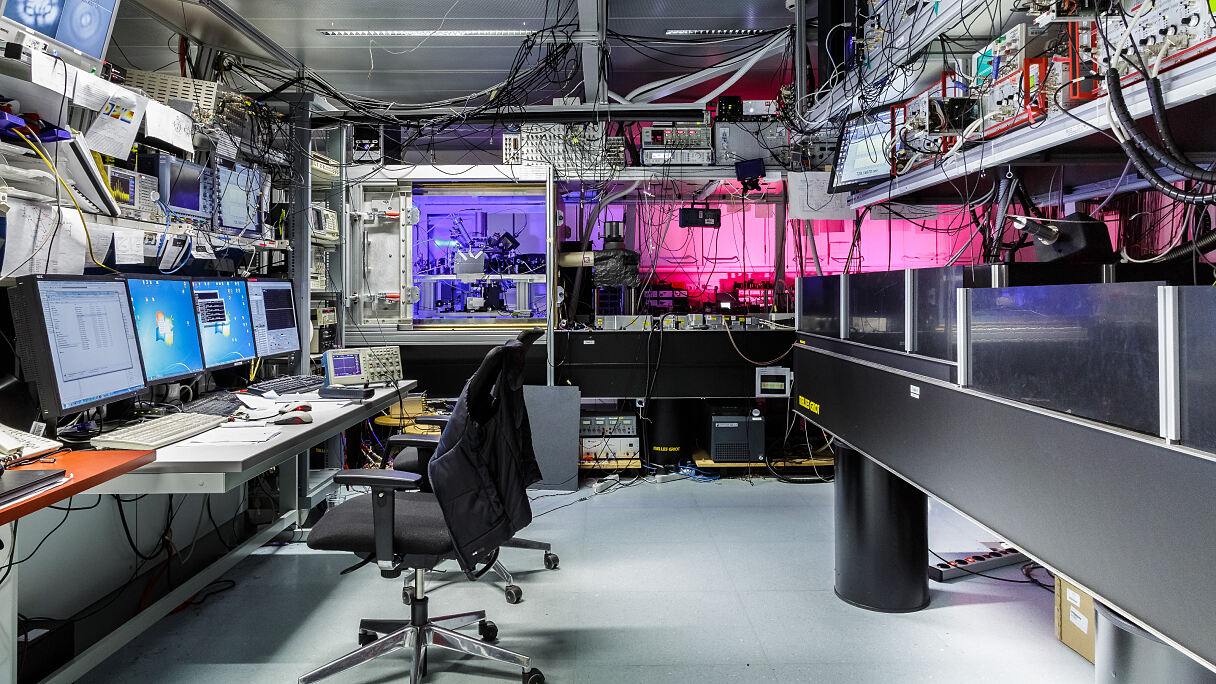
Manoj Kumar Joshi has won the 2026 Infosys Prize in Physical Sciences for work using trapped, electrically charged atoms in programmable experiments that reveal how quantum matter behaves. The Singapore University of Technology and Design physicist was among six winners announced on November 12; each category carries a US$100,000 prize, a gold medal and a citation.[1]
The recognition highlights a less familiar purpose for quantum hardware: studying nature, rather than replacing everyday computers. A quantum simulator uses one controllable quantum system to investigate another. Joshi works with electrically charged atoms held in a vacuum and manipulated with lasers.[2]
Building a larger machine is only part of that task. Researchers also need ways to understand what its particles are doing together. Quantum makes that difficult: the information describing a group cannot always be reduced to separate descriptions of its members.
In a study published in Nature in 2023, Joshi and collaborators used a programmable chain of 51 ions to investigate entanglement. They learned compact mathematical descriptions of smaller sections containing up to 20 sites, then checked those descriptions against independent experimental measurements.[3]
The distinction matters. Fifty-one ions describes the experimental platform; 20 sites describes the largest subsystems analyzed by that reconstruction method. Neither number, by itself, establishes a general-purpose computing advantage.
Another piece of the same measurement challenge is knowing how much confidence to place in a simulator’s answers. In August 2026, the University of Innsbruck described work involving Joshi and Christian Roos that attached quantitative error bounds to quantum-simulation predictions, with demonstrations on systems of 10 and 51 ions.[4]
These are earlier research results, not experiments first unveiled with today’s award. Together, the studies illustrate a practical challenge: useful quantum machines require both control over particles and credible ways to interpret their output.
The next challenge identified by the Innsbruck researchers is extending their error-bound approach to two-dimensional systems, where independent classical checks become harder as the system grows.[4]