
Shorter quantum circuits bring a tunneling simulation into view
A preprint tests two ways to represent motion on IBM and IonQ hardware. The successful approach combines more qubits with compressed circuits and filtered measurements.
Reading tools for text size, copying, printing and your reading list
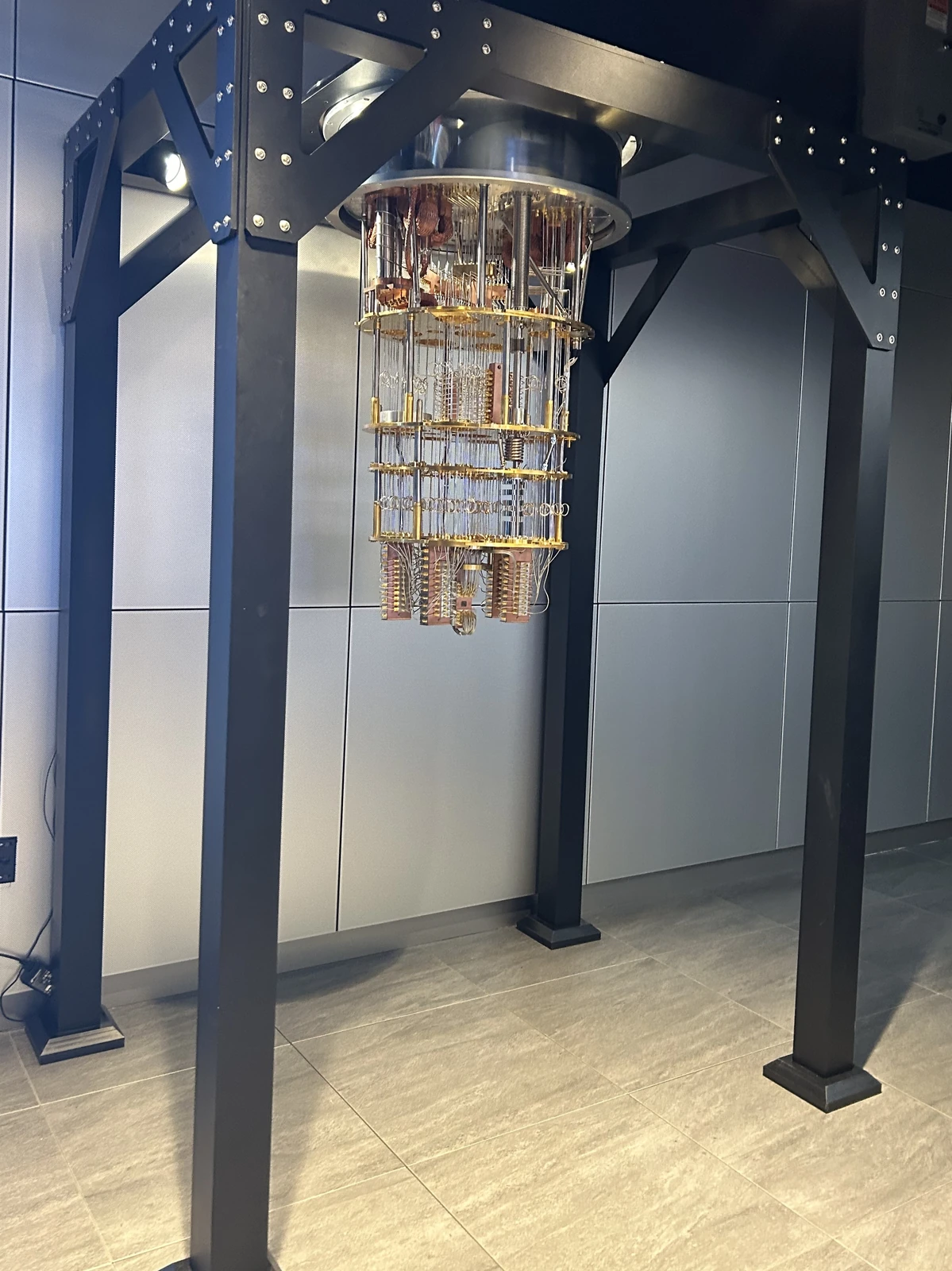
Researchers have reproduced a simulated particle's movement through an energy barrier on IBM and IonQ quantum processors using shortened circuits and filtered measurements. The new preprint offers a practical lesson for quantum computing: saving is not always the same as saving the calculation.[1]
The experiment models quantum tunneling, in which a particle can move between two regions separated by a barrier that it could not cross according to classical mechanics. It is a small, classically tractable test, not evidence that either machine outperformed an ordinary computer. The useful result is a comparison of how two complete implementations cope with imperfect hardware.[1]
Masanori Hanada and colleagues represented position in two ways. One stores 16 possible locations in 4 qubits, using binary labels much like ordinary computer addresses. The other assigns a qubit to each of 14 locations, with exactly one qubit read as 1 marking the modeled particle's position.[1]
The second arrangement spends more qubits, but gives neighboring positions a simple connection. For this particular model, the researchers can compress repeated simulation steps into a circuit whose size does not grow with the number of steps.[1]
On IBM Phoenix and IonQ Forte, those compressed circuits used roughly 200 two-qubit operations. In the accepted measurements, the probability of finding the modeled particle in the right-hand well fell from about 97% to 6% on IBM and 96% to 12% on IonQ as the distribution shifted to the other side. The tested binary circuits, which needed thousands of such operations, did not reproduce that transfer.[1]
The word “accepted” matters. The analysis discarded measurements outside the intended single-excitation pattern. Across measurement times and the tested qubit groups, the double-well experiment retained about 26–76% of IBM outcomes and 16–82% of IonQ outcomes. This can remove some errors, but it does not fix mistakes within the retained results.[1]
Nor does the experiment establish that one way of representing numbers is inherently better. The implementations use different grids, boundary conditions and compilation methods. In additional noiseless calculations, the uncompressed version of the larger-qubit approach also needed thousands of operations. Other ways of directly building these small circuits can be shorter still, although they solve differently specified tasks.[1]
The next challenge is interaction. When two modeled oscillators are coupled, the mathematical shortcut no longer compresses the whole evolution in the same way. In those smaller coupled tests, the binary circuits were shorter and neither approach consistently won. That boundary is the point: a clever shortcut becomes useful engineering only when its advantages survive the problem researchers actually want to solve.[1]