
Moving an atom array is a calculation with a physical deadline
A new atom-transport study links fast hologram calculation to the optical sequence that prepares a working array.
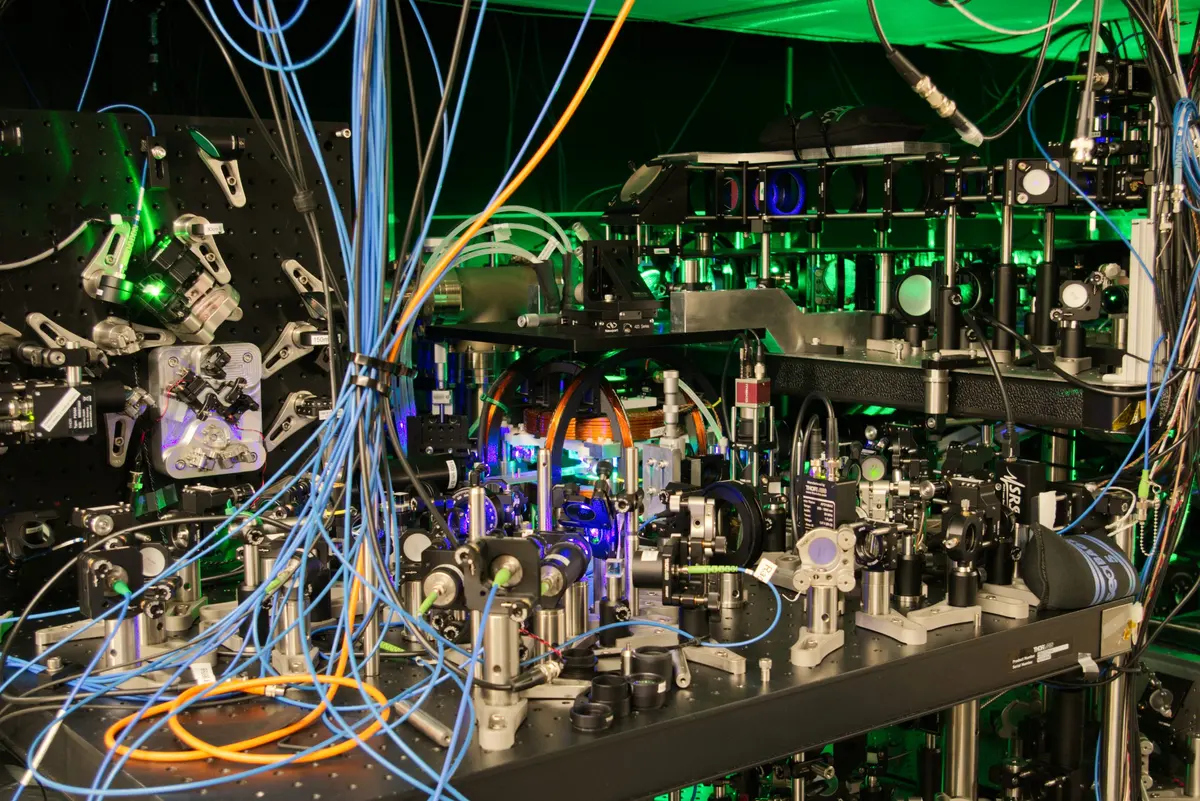
A preprint submitted on October 15 describes parallel three-dimensional rearrangement of neutral atoms using holograms calculated on a GPU. Starting from a stochastically loaded array, the researchers report assembling 100 atoms in under 20 milliseconds, with a per-atom rearrangement survival probability of 99.31(12)%. The method computes intermediate holograms faster than the spatial light modulator refreshes. The result is a preparation and transport capability; its useful interpretation keeps movement, atom survival and subsequent quantum operations as separate quantities.[1]
An optical trap is not a little mechanical container. It is a shaped light field whose interaction with an atom creates a confining potential. Moving many traps therefore means changing a light pattern while preserving useful confinement. A spatial light modulator changes the optical field through many controllable elements. A hologram encodes the pattern required at the atoms. The computational task is to produce a sequence of patterns quickly enough that the physical device never has to wait for the next instruction.
The sequence matters as much as its endpoints. Two light fields can place traps at the same desired positions while having different optical phases. An abrupt transition between them can briefly alter the intensity experienced by the atoms. A trajectory that looks smooth as a list of coordinates may therefore be rough as an optical field. Thinking in terms of a continuous field explains why phase handling belongs in a rearrangement algorithm. It connects the mathematical representation to unwanted motion and heating during transport.
Parallel movement changes the scheduling problem. Sequential transport spends time moving one atom or a small subset before starting another. Simultaneous movement can shorten that schedule, but the paths must remain compatible with confinement, geometry and control bandwidth. Adding a third spatial direction creates more possible routes around conflicts. It also adds another coordinate whose optical implementation has to be controlled. The relevant benefit is a complete feasible rearrangement, not simply an animation with a larger number of moving points.
The measured pipeline takes 18.23 milliseconds on average from receiving the initial image to uploading the final hologram. That includes extracting occupancy, assigning atoms to destinations, and computing and uploading the intermediate patterns. One GPU calculates a hologram in 0.284 milliseconds, compared with the modulator’s 0.696-millisecond refresh cycle. Extra processing time can therefore improve trap uniformity without slowing the sequence.[1]
Now consider an invented survival example. If each of 100 atoms independently survives a move with probability 0.99, the probability that all survive is 0.99 raised to the hundredth power, about 36.6%. That does not say that most atoms are lost; the expected number surviving is 99. It distinguishes a high per-atom survival rate from the stricter event of obtaining a completely intact array. Real losses may be correlated, and repair strategies can change the practical outcome. The example is arithmetic under declared assumptions, not a prediction for this experiment.
The paper already reports two useful array-level checks: a defect-free final array in 50% of iterations immediately after rearrangement, and a temperature increase of 9(3) microkelvin against a 480-microkelvin trap depth. Those observations keep the high per-atom survival figure attached to the actual preparation task. Following the array into a later gate or simulation remains a separate test.[1]
The broader story is that neutral-atom preparation is already an interaction among software, optics and motion. A faster calculation is valuable when it changes that combined process: shortening a cycle, improving field uniformity or opening a useful path through space. The paper gives a concrete example of that interaction. Its next chapter should follow the prepared array into a measured operation, retaining the cost of repair and cooling so that the transport achievement remains connected to the scientific work it enables.
Keep your reading trail
Keep up with these topics
Choose the subjects you want to find again in Your Updates.