
Skip to content
RESEARCH · RESEARCH / EXPERIMENT

One particle of antimatter. Months in a trap. A much bigger test ahead.

A Northwestern experiment brings a positron under quantum control. The next question is whether matter and antimatter match as precisely as physics expects.
Published Source report Sources checked
My reading list
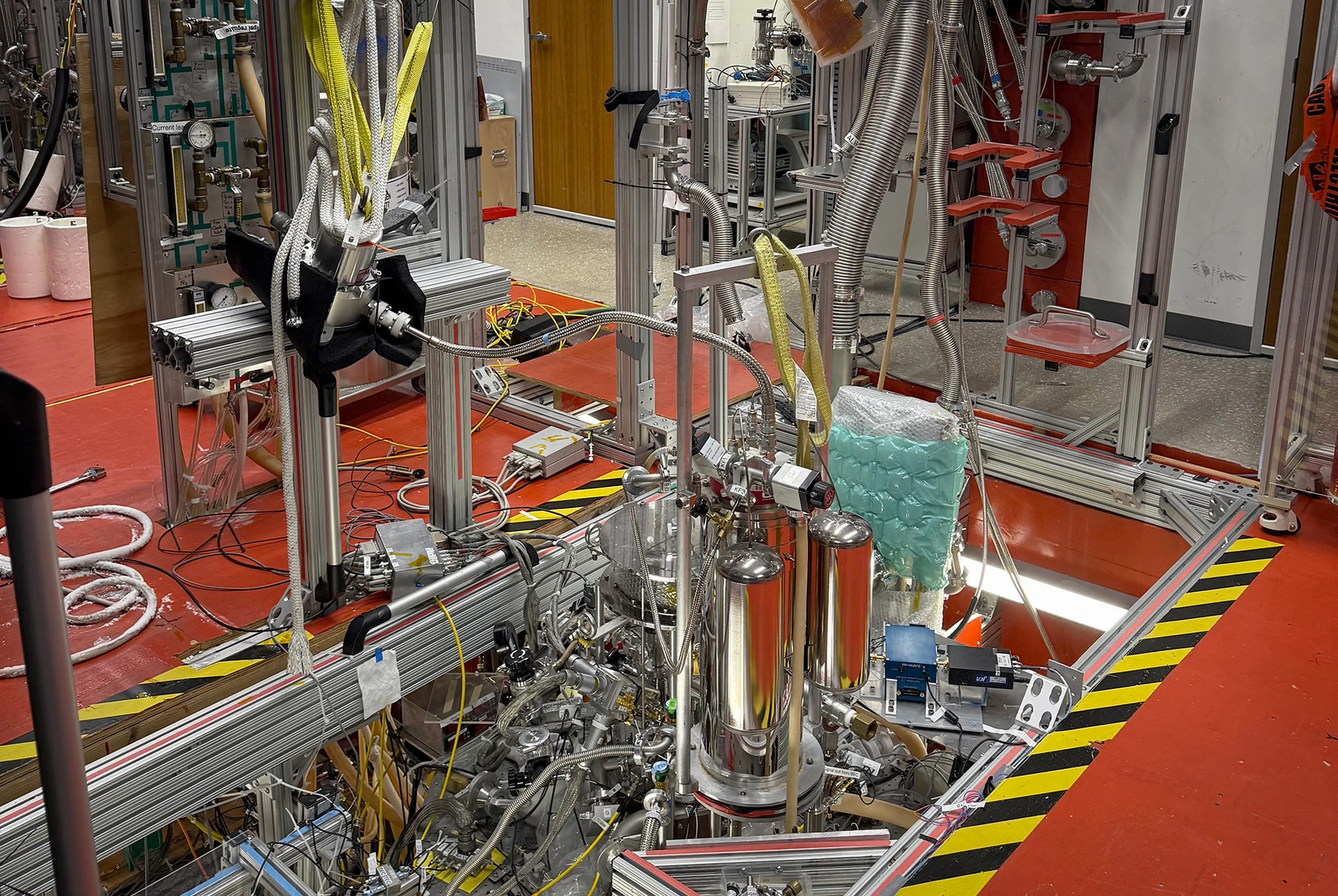
Laboratory apparatus suspended above a floor-level tank at Northwestern University, used to confine a single positron.
The apparatus used by Northwestern researchers to trap and control a single positron. The particle itself is not visible. Photo: Gerald Gabrielse/Northwestern University.Gerald Gabrielse/Northwestern University. Northwestern single-positron apparatus. Northwestern editorial press-photo permission. Source: https://news.northwestern.edu/stories/2026/10/scientists-trap-and-tame-a-single-particle-of-antimatter-for-months?fj=1. Full downloaded frame retained. Orientation normalized, proportionally resized without enlargement and converted to WebP. No crop, retouching or generated content by QubitWire. Exact-subject editorial report under the source journalist-download offer. Preserve credit. No paid advertising, implied endorsement or unrelated reuse. Capture date not supplied; photo accompanied the October 21, 2026 release. Gerald Gabrielse/Northwestern University · Northwestern editorial press-photo permission · Northwestern editorial press-photo permissionFull image credit

The most interesting thing in this laboratory is not the tank, the wiring or the equipment surrounding it. It is one particle that ordinary matter cannot safely touch. Northwestern physicists report a way to keep a positron, the electron’s antimatter counterpart, isolated while controlling its quantum behaviour. The university says the particle can remain trapped for months. Months of confinement does not mean months of coherent quantum superposition.[1][2]

The research, published on October 21 in Physical Review Letters, describes a one-positron quantum cyclotron. A Penning trap uses electromagnetic fields to hold the particle rather than letting it rest against a material container. The key advance is not simply having antimatter nearby: it is resolving and controlling the quantum states needed for a more exact measurement.[1]

That distinction changes the story. A science-fiction reading would ask how much antimatter the laboratory has accumulated. A precision-physics reading asks how clearly one carefully prepared particle can answer a question. More material would not necessarily make this particular experiment better.

The long-term target is the positron’s magnetic moment, a property that can be compared with the corresponding property of the electron. The researchers describe a route to a tighter test of CPT symmetry, a foundational relationship involving charge, spatial reflection and the reversal of time. A future discrepancy, after experimental and theoretical uncertainties were examined, would be consequential.[1]

But the future test is not a result already in hand. This paper does not announce that antimatter violates the Standard Model, explain why the universe contains so much more matter than antimatter, or demonstrate an antimatter power source. The achievement is an enabling instrument. It makes a harder comparison possible; it does not predetermine the answer.[1][2]

The most useful follow-up is therefore a measurement, not a bigger headline. What magnetic moment is ultimately obtained? How much uncertainty remains? Does an electron–positron comparison agree with the expected symmetry? A particle kept out of contact with the world could help make one of physics’ closest comparisons with it.

Keep your reading trail

Your Updates →

Evidence & context

2 linked sources

experiment

How to read the evidence and dates

An announcement records what an organization stated. An experiment reports an observation. A simulation or resource estimate depends on its assumptions. QubitWire’s analysis connects these sources; the labels are not quality scores.

Published is the article’s first QubitWire publication. Updated marks a substantive content change. Sources checked records a review of the underlying evidence. An older paper can support a new explanation, and another press release about the same work is not independent replication.

QubitWire take

A sharper instrument makes a future symmetry comparison possible; the comparison still has to be made.

Sources

  1. Myers et al.: One-Positron Quantum Cyclotron (Physical Review Letters)

    Peer-reviewed experiment published October 21, 2026. An enabling single-positron instrument; no measured CPT violation. Refreshed October 22, 2026 (Pacific time).

  2. Northwestern: Scientists trap and tame a single particle of antimatter for months

    University account dated October 21, 2026. Months refers to confinement, not months of coherent quantum superposition. Refreshed October 22, 2026 (Pacific time).

READ NEXT

Continue exploring

All Research stories
  1. Related reading

    A proposed quantum microscope would show more than where atoms sit

    New measurement protocols aim to reveal motion as well as position. They work within quantum uncertainty, not around it.

    Published · Source report · Sources checked
  2. Related reading

    The edge of a superconductor is giving physicists a different signal

    Newly published transport measurements probe an unusual boundary response. They do not yet establish a working topological qubit.

    Published · Source report · Sources checked
THE QUANTUM BRIEFING

A clearer signal.
Read the latest edition.

A little perspective on a fast-moving field.

Read the on-site briefing →

Read selected quantum coverage in the on-site briefing, or register your interest below.