
Skip to content
RESEARCH · MATERIALS / JOURNAL PUBLICATION

The edge of a superconductor is giving physicists a different signal

Newly published transport measurements probe an unusual boundary response. They do not yet establish a working topological qubit.
Published Source report Sources checked
My reading list
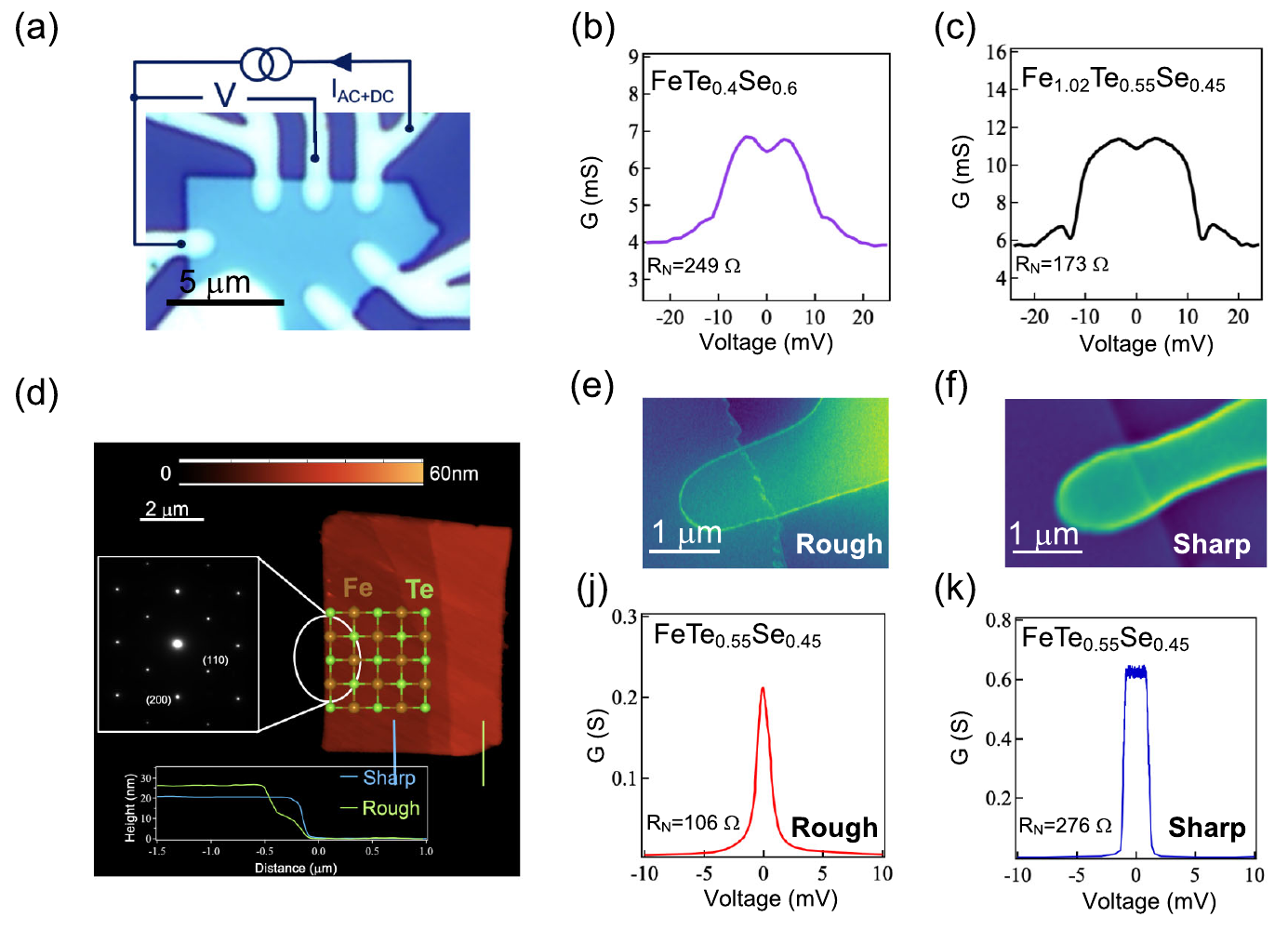
Published scientific figure combining an optical device image, AFM topography, false-colour electron micrographs and conductance plots. Original panel labels, axis labels and scale bars remain visible.
Figure 1 from the boundary-transport study: optical device image (a), AFM topography (d), false-colour scanning electron micrographs (e, f) and conductance data. Original labels, axes and scale bars retained. This is a microscopy and data composite, not a conventional laboratory photograph.Wenyao Liu et al. · CC BY 4.0 · CC BY 4.0Full image credit

For some quantum materials, the edge is not just where the sample ends. It can be where a particularly interesting signal begins. A newly published experiment in an iron-based superconductor examines that possibility through electrical measurements designed to distinguish boundary behaviour from the bulk.[1]

The study, published in Physical Review X on October 22, concerns iron telluride selenide devices. The researchers report an unusual conductance response associated with particular sample compositions, contact arrangements and continuous edges. Moving the electrical contacts changes the response, making geometry part of the evidence rather than a detail of the photograph.[1]

The work also connects the transport observations with measurements of broken time-reversal symmetry. Several kinds of evidence are being assembled around the same question: what carries the unusual response, and how closely is it tied to the material’s boundary?[1]

That is more careful than declaring a topological quantum computer has arrived. An electrical signature is not by itself a demonstration of every property required for a protected . The microscopic interpretation, alternative explanations and further discriminating measurements still matter. The authors frame the result as motivation for additional theoretical and phase-sensitive investigation.[1][2]

There is a useful lesson here for reading spectacular materials headlines. A claim becomes stronger when it survives changes designed to make competing explanations behave differently. Comparing geometries and compositions is valuable precisely because a single striking trace can otherwise support too many stories.

The date also deserves care. An earlier version appeared as a June 19 preprint. October 22 is the journal-publication milestone, not necessarily the first day anyone could read about the result. Readers should be able to see both dates without hunting through a footnote.[2]

The arrangement of the device is part of the evidence. Where contacts touch the sample, whether its edge remains continuous and which composition is measured can help distinguish one explanation from another. That is why the result is worth following even before the microscopic interpretation is settled: it gives researchers more specific questions to test.

Keep your reading trail

Your Updates →

Evidence & context

2 linked sources

experimental journal-publication update; earlier June preprint

How to read the evidence and dates

An announcement records what an organization stated. An experiment reports an observation. A simulation or resource estimate depends on its assumptions. QubitWire’s analysis connects these sources; the labels are not quality scores.

Published is the article’s first QubitWire publication. Updated marks a substantive content change. Sources checked records a review of the underlying evidence. An older paper can support a new explanation, and another press release about the same work is not independent replication.

QubitWire take

Contact geometry helps test an interpretation; a protected topological qubit remains a separate achievement.

Sources

  1. Liu et al.: Nontrivial Boundary-Mediated Superconducting Transport (Physical Review X)

    Journal publication October 22, 2026. Figure 1 includes optical microscopy, AFM, false-colour SEM and data. No protected qubit established. Refreshed October 22, 2026 (Pacific time).

  2. Earlier public preprint of the boundary-transport study

    First preprint June 19, 2026; version 2 posted October 22, 2026. The result was public before its journal publication. Refreshed October 22, 2026 (Pacific time).

READ NEXT

Continue exploring

All Research stories
  1. Related reading

    One particle of antimatter. Months in a trap. A much bigger test ahead.

    A Northwestern experiment brings a positron under quantum control. The next question is whether matter and antimatter match as precisely as physics expects.

    Published · Source report · Sources checked
  2. Related reading

    A proposed quantum microscope would show more than where atoms sit

    New measurement protocols aim to reveal motion as well as position. They work within quantum uncertainty, not around it.

    Published · Source report · Sources checked
THE QUANTUM BRIEFING

A clearer signal.
Read the latest edition.

A little perspective on a fast-moving field.

Read the on-site briefing →

Read selected quantum coverage in the on-site briefing, or register your interest below.