
Britain’s quantum programme is tackling the gap between a login and a useful calculation
An NQCC agreement will give UK organisations access to Phasecraft software. The first cohort is planned for spring 2027; useful results still have to be demonstrated.
Reading tools for text size, copying, printing and your reading list
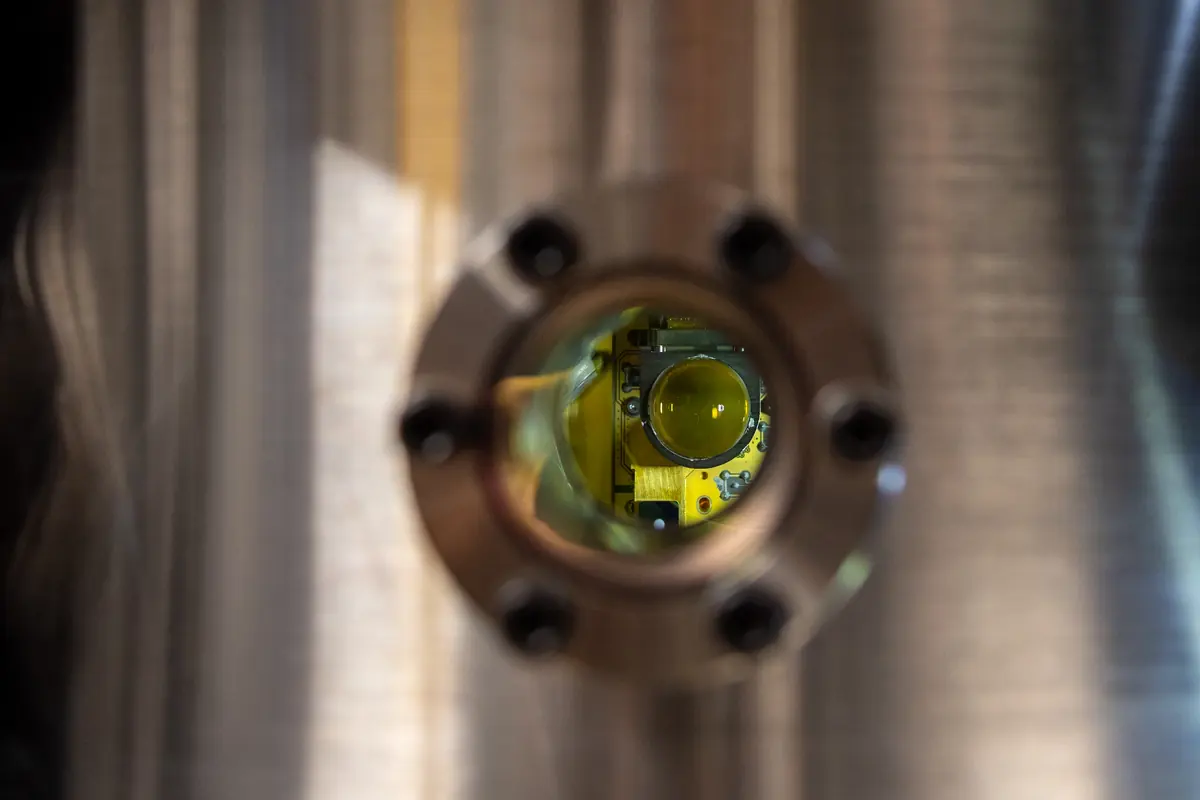

Britain’s National Quantum Computing Centre is adding software to help organisations turn scientific and business questions into work a quantum computer can attempt. The practical gap is simple: access to a machine does not tell a researcher how to use it.[1]
An enterprise licence agreement announced by Phasecraft on November 6 will make its tools available through NQCC’s SparQ programme. Expressions of interest are expected in late November, with the first cohort starting in spring 2027. This is prospective access, not evidence that a participant has already beaten conventional computing on a useful task.[1]
For teams considering a quantum pilot, the interesting question is what happens between an idea and an executable calculation. That preparation can determine whether an experiment is sensible before anyone reserves time on expensive equipment.
Turning a question into instructions
Consider a materials researcher who wants to understand a candidate material’s electronic behaviour. “Study this material” is a research goal, not instructions a quantum processor can execute. Phasecraft’s published methodology describes the intervening work: start with an atomic structure, build a mathematical representation, choose how to encode it in , and construct operations for the target machine. Much of that preparation happens on conventional computers.[2]
A quantum circuit is a sequence of operations. Its depth describes successive layers of operations; reducing depth can matter because present machines cannot perform unlimited operations reliably. A shorter circuit alone, however, does not establish that an answer is accurate, commercially useful or faster to obtain than the best conventional alternative.[2]
A useful trial therefore needs more than a successful login or a circuit that runs. It needs a defined problem, a credible comparison method and a way to assess the answer.
Three tools, different jobs
The agreement covers three different jobs. Magritte supports resource estimation and circuit construction for materials and molecular simulation. Monet concerns quantum-enhanced density-functional modelling, an approach to electronic structure. Mondrian addresses optimization. Phasecraft scientists and engineers will support users, and the announcement says places will be reserved for noncommercial research.[1]
These are not interchangeable promises. Resource estimation asks what a proposed calculation would demand. A materials model describes a physical system. Optimization seeks a good solution among alternatives. The steps can be useful to different teams and require different tests.
Phasecraft describes Mondrian as supplying starting points that conventional optimization software can refine. Its materials work also combines quantum and classical techniques. The relevant picture is a workflow with several components, rather than a quantum machine replacing every existing computer.[3]
For a prospective user, separating those components makes a pilot easier to judge: which step is being tested, what goes into it, what comes out, and which part actually depends on quantum hardware?
What would count as progress?
NQCC deputy director Simon Plant describes the agreement as SparQ’s first quantum-software offering in Phasecraft’s announcement. NQCC’s existing access material frames the wider programme around research, skills and exploring applications, with centrally managed access intended to reduce administrative obstacles.[1][4]
QubitWire’s assessment is that the software programme will be most informative if projects report their starting problem, comparison method and complete workflow, including preparation and checking. An easier route to experimentation and a better computational result can both be valuable, but they answer different questions.
A resource estimate might reveal that a proposed workload needs more hardware than is available. That would not demonstrate commercial advantage. It could still help a team avoid pursuing an unsuitable approach. This is an illustrative possibility, not a reported result from the new programme.
The announcement does not disclose the licence value, participant results or measured customer savings. Company performance claims about individual methods should not be transferred to this agreement as though the programme had already delivered them.[1]
Watch the application call
The immediate milestone is the promised late-November expression-of-interest process, followed by the spring 2027 cohort. NQCC’s existing industry-access webpage says an earlier hardware-access deadline has passed; that is separate from the newly announced software timetable. Applications for this software route should not be assumed open today.[1][4][5]
QubitWire previously examined the evaluation of NQCC’s hardware testbeds. The software agreement addresses another part of the same practical challenge: connecting a researcher’s question to something a machine can test. The next useful evidence will be what participants learn, including which ideas prove unsuitable.