
A new kind of clock can keep its own time
A thorium nucleus now steers a laser through a feedback loop. The advance is a working nuclear time reference, with new questions to test.
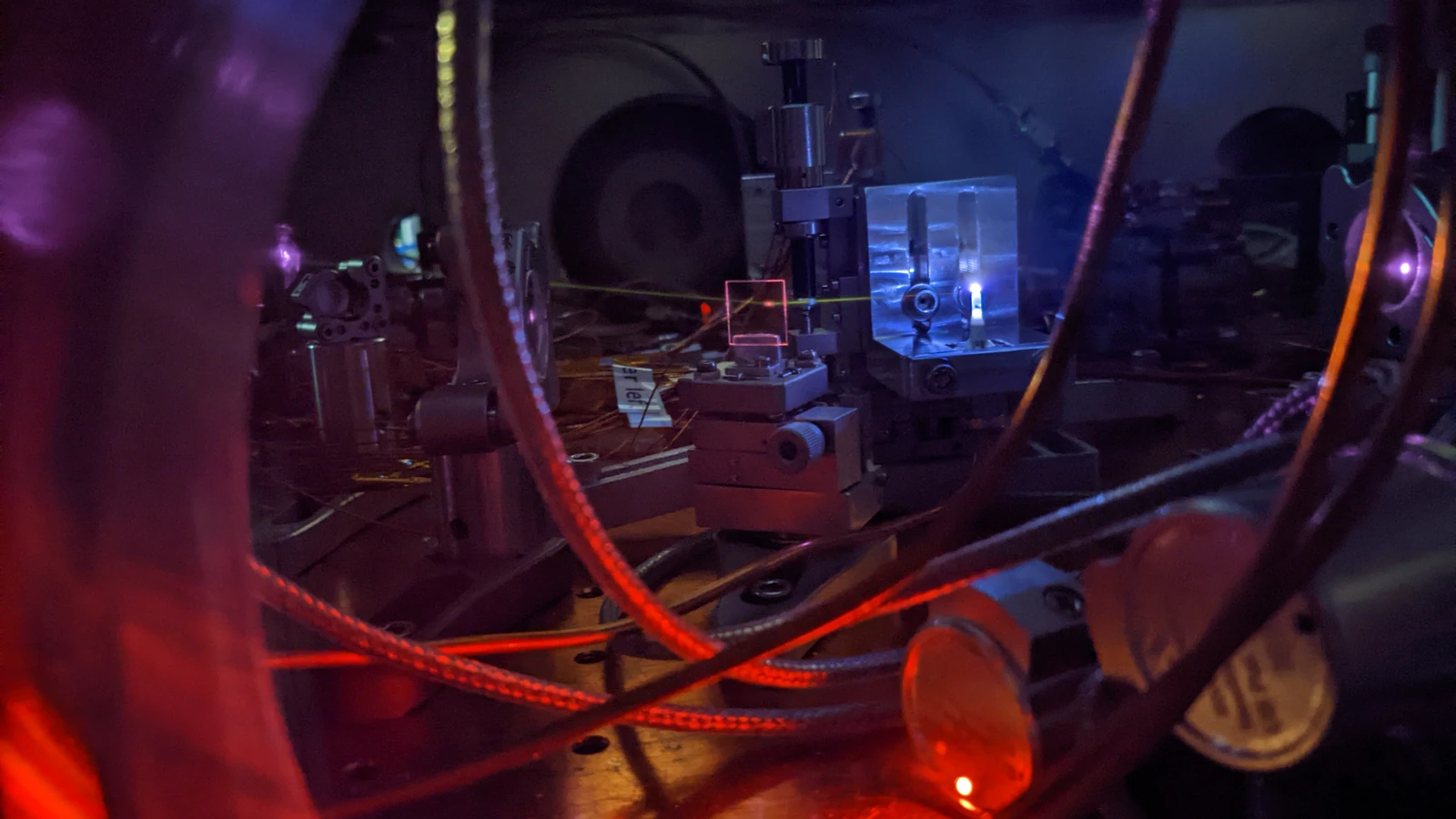
A clock needs more than a rhythm. It needs a way to notice when that rhythm is drifting and pull it back into line. Researchers in Vienna have closed that loop around a transition inside the nucleus of thorium-229. Their laser follows the nucleus, giving physicists a working reference they can keep testing and improving.[1][2]
The result appeared in Nature on October 7, followed by a TU Wien account on October 8. The study had already been shared as a preprint in June. The October development is its journal publication and a new institutional explanation, rather than evidence that the experiment was first performed this week.[1][2][4]
Most familiar atomic clocks use transitions involving electrons. This clock looks deeper, inside an atomic nucleus. Thorium-229 has an unusually low-energy nuclear transition that a laser can reach. That makes it a candidate for precision measurement; the word nuclear here refers to the reference being measured, not a miniature reactor.[2][4]
A rhythm becomes a working reference
The thorium is embedded in a crystal. Researchers shine laser light through it and measure the response. If the laser strays from the right frequency, that response changes. A controller uses the change to adjust the laser. The instrument therefore checks itself against the nuclear transition instead of simply running freely and hoping its frequency stays put.[2][4]
Think of keeping an instrument in tune. Hearing the right note once is different from repeatedly comparing your instrument with it and correcting the drift. A nucleus is not a vibrating string, so the analogy stops at the feedback process. Its useful lesson is that discovering a reference and making an instrument follow it are separate achievements.
This prototype has not beaten the world’s best optical atomic clocks. That does not make the advance small. A different kind of reference can offer another way to compare instruments and investigate physical effects. The next task is to understand how reliably the complete device behaves, including the crystal and the conditions around it.[2][4]
Steady is not the same as accurate
Two words matter when reading the numbers: stability and accuracy. Stability describes how consistently a clock runs. Accuracy requires understanding shifts that move it away from its intended frequency. A dart player can land every throw in a tight cluster while missing the bullseye. Consistency is valuable, but it does not prove the aim is correct.
Collecting data for longer can reduce some kinds of noise, but it does not remove every possible error. The author manuscript discusses limits on reproducibility between runs and effects associated with different positions in the crystal. Those details make an uncertainty budget and comparisons between independently built instruments especially useful next steps.[4]
The researchers also used the clock to search for tiny variations associated with possible dark-matter effects. They report constraints on those possibilities, not a dark-matter detection. Comparing different physical references gives scientists another way to ask whether an apparent change comes from the equipment, its surroundings or a more fundamental cause.[4]
Your phone does not need a thorium clock to arrange dinner. The reason to follow this one is that an unusual nuclear reference now helps control a working instrument. Watch for longer dependable runs, better checks on systematic effects and agreement with another laboratory’s clock. Those results would reveal what the new reference can reliably measure.
Read the deeper explanation · about 6 min
This estimate covers the explanation below, separate from the overview. Optional depth was added in this reading edition. The article keeps one canonical address and its original chronology. Source review: . The relevant source dates and limitations are recorded below.
A remarkably good clock can look almost nothing like a clock. It may have no face, no hands and no audible tick. What matters is a repeatable physical rhythm, a way to count or compare that rhythm, and a way to keep the device following it instead of wandering off. The last part is easy to overlook. A beautiful reference is not much use if the instrument loses it every few minutes.
That is why a result published in Nature on October 7 is worth noticing. Researchers have demonstrated a feedback-controlled optical nuclear clock using thorium-229. A TU Wien account followed on October 8. The clock uses a transition within an atomic nucleus as its reference, rather than the electronic transitions that underpin conventional atomic clocks. This is a different physical route to timekeeping, not a claim that every existing clock has suddenly become inferior.[1][2]
The same study was first shared as an author preprint on June 3, 2026, with a revised version on June 5. The October journal publication and TU Wien account are later milestones. They should not be read as the date when the research first became public.[4]
The part that turns a rhythm into an instrument
Imagine trying to tune a musical instrument to a note that is exceptionally clear but difficult to hear. Recognizing the note once would establish that it exists. Staying in tune while the room and the instrument change would require continuous comparison and small corrections. The analogy is limited: a nuclear transition is not a vibrating string. But it captures the practical difference between observing a reference and maintaining a working lock to it.
The Vienna work makes that distinction tangible. A laser interrogates thorium-229 in a crystal, and the measured response steers the laser back toward the transition. The nuclear resonance supplies the reference; the feedback system supplies the discipline. A clock that can keep doing that is more useful than a single striking measurement, because other experiments need a dependable signal rather than a moment of success.[1][4]
Feedback also changes what can be investigated next. Once a system can run consistently, researchers can ask how its behavior changes with the crystal, the apparatus and the conditions around it. In engineering terms, the project moves from identifying a promising ingredient toward understanding the whole recipe. That is often where the genuinely difficult questions start.
Why look inside the nucleus?
The attraction of a nuclear reference is not the word nuclear. It is the opportunity to exploit a different physical system, with a different pattern of sensitivities, and potentially compare it with clocks based on electrons. Thorium-229 is especially interesting because its unusual low-energy nuclear transition can be addressed optically. The experiment is therefore a clock built around an accessible nuclear transition, not a miniature nuclear reactor.[1][2]
This difference makes the idea accessible without making it ordinary. A clock is also a sensor: if the conditions influencing its reference change, its frequency can change. That is useful when the change is what an experiment intends to measure, and troublesome when the change is an unwanted source of error. Better timekeeping requires distinguishing those two cases carefully rather than declaring the reference perfectly isolated.
A new clock technology is valuable even before it beats the best existing one. It can offer another comparison, another way to test an assumption, or another practical configuration. Two instruments that respond differently to their environment can help expose errors that would remain hidden if everyone used the same instrument in the same way. That is an argument for a diverse measurement toolbox, not a forecast that a specific design will win.
The two numbers that headlines tend to confuse
The accessible author manuscript and journal abstract report fractional frequency instability of about three parts in a trillion divided by the square root of averaging time in seconds, described as approaching the parts-in-a-quadrillion scale over a day. The journal’s detailed performance discussion reports low 10^-14 instability within a continuous run and about 5 × 10^-13 reproducibility between runs on different days. These are different measurement boundaries under the reported conditions. They are not permission to call the system the world's most accurate clock.[1][4]
Stability and accuracy answer different questions. Picture a dart player whose throws form a tight cluster away from the bullseye. The throws are consistent, but they are not centered correctly. Clock comparisons are more sophisticated than darts, yet the distinction is useful: a narrow spread does not by itself show that every systematic shift has been identified and removed.
Averaging also has limits. In a simple noise regime, collecting data for longer improves the estimate. But an instrument may drift, encounter correlated noise or change conditions. A smooth extrapolation is not a substitute for running the device longer and examining the actual data. The best way to read a spectacular stability figure is to ask what was measured, for how long, against which reference, and with which uncertainties.
This is a useful habit far beyond clocks. Quantum technology is full of numbers that look comparable until their definitions are examined. A memory lifetime is not a gate fidelity. A detector efficiency is not an end-to-end computing success probability. Here, the distinctions are unusually intuitive because everyone already understands what it means for a clock to run steadily and still tell the wrong time.
A new way to ask whether nature is changing
Precision clocks can do more than keep appointments. Comparing physically different references creates opportunities to look for tiny variations that would not be visible with a single instrument. The nuclear-clock study includes a search for periodic variations associated with possible dark-matter effects. It does not report a dark-matter discovery. A result that constrains a possible effect is scientifically valuable without being a detection.[1][4]
The interesting idea is comparison. Suppose two instruments are expected to agree in a particular way. A repeatable departure would demand an explanation: ordinary environmental change, an overlooked instrumental effect, or something more fundamental. New physics is not the default explanation. The value lies in constructing a comparison sensitive enough, and controlled enough, to make that question meaningful.
For readers, this provides a better story than the usual race for a record. A clock can become a new window onto nature by being different, not merely by having more impressive decimal places. That window must still be calibrated. Unexpected signals need independent checks. The more extraordinary the interpretation, the more important it becomes to understand every ordinary way the apparatus might mislead its operators.
What would make the next chapter important?
The next milestone should be defined before the next press release arrives. Longer dependable operation would establish one kind of progress. Better characterization of systematic effects would establish another. Agreement between independently built instruments would answer a different question again. Those developments belong on a follow-up timeline with their own dates and evidence, not in a single undifferentiated box marked better clock.
Practicality matters too. How difficult is the apparatus to operate? What happens after an interruption? How reproducible are the materials and settings? What does another laboratory need in order to compare its result? None of those questions detracts from the physics. They are the questions that turn physics into a widely useful instrument.
QubitWire's way into this story is therefore simple: keep the wonder, but make the next test visible. The nuclear reference is the surprising part. The feedback loop is the engineering achievement. The long-term opportunity is an instrument whose distinctive properties can be examined and improved. A reader who understands those three layers can recognize meaningful progress without needing to become a specialist in precision spectroscopy.
Your phone will not need a thorium clock to tell you when dinner starts. That was never the point. The reason to follow this experiment is that a new kind of physical reference has started behaving like a clock, and a working instrument can open questions that an isolated measurement cannot. The first successful loop is a beginning. What researchers can make it reliably measure is the story to return for.
Evidence for this explanation
- A thorium-229 optical nuclear clock with feedback loop — Nature
Journal publication October 7, 2026; publisher-indexed complete article text, identity and date inspected. Direct page retrieval was unavailable. Technical detail also checked against the accessible author manuscript.
- The First Stand-Alone Nuclear Clock is Ticking in Vienna — TU Wien
Institutional account dated October 8, 2026; complete public account inspected. Explicitly says the prototype has not reached the best optical-clock performance.
- Supporting data for the thorium-229 nuclear clock — Zenodo
Dataset v1 published September 8, 2026; record and listed file identities checked. No independent download, reanalysis or replication is claimed.
- A thorium-229 optical nuclear clock with feedback loop — author manuscript v2
First submitted June 3, 2026; v2 June 5. Accessible full author text inspected, including feedback, averaging-time dependence, reproducibility limits and dark-matter constraints. This earlier manuscript is not a separate discovery.