
A telescope caught starlight arriving in tiny bursts
At Palomar Observatory, researchers resolved a fraction-of-a-nanosecond pattern in the light from a star about 360 light-years away.
Reading tools for text size, copying, printing and your reading list
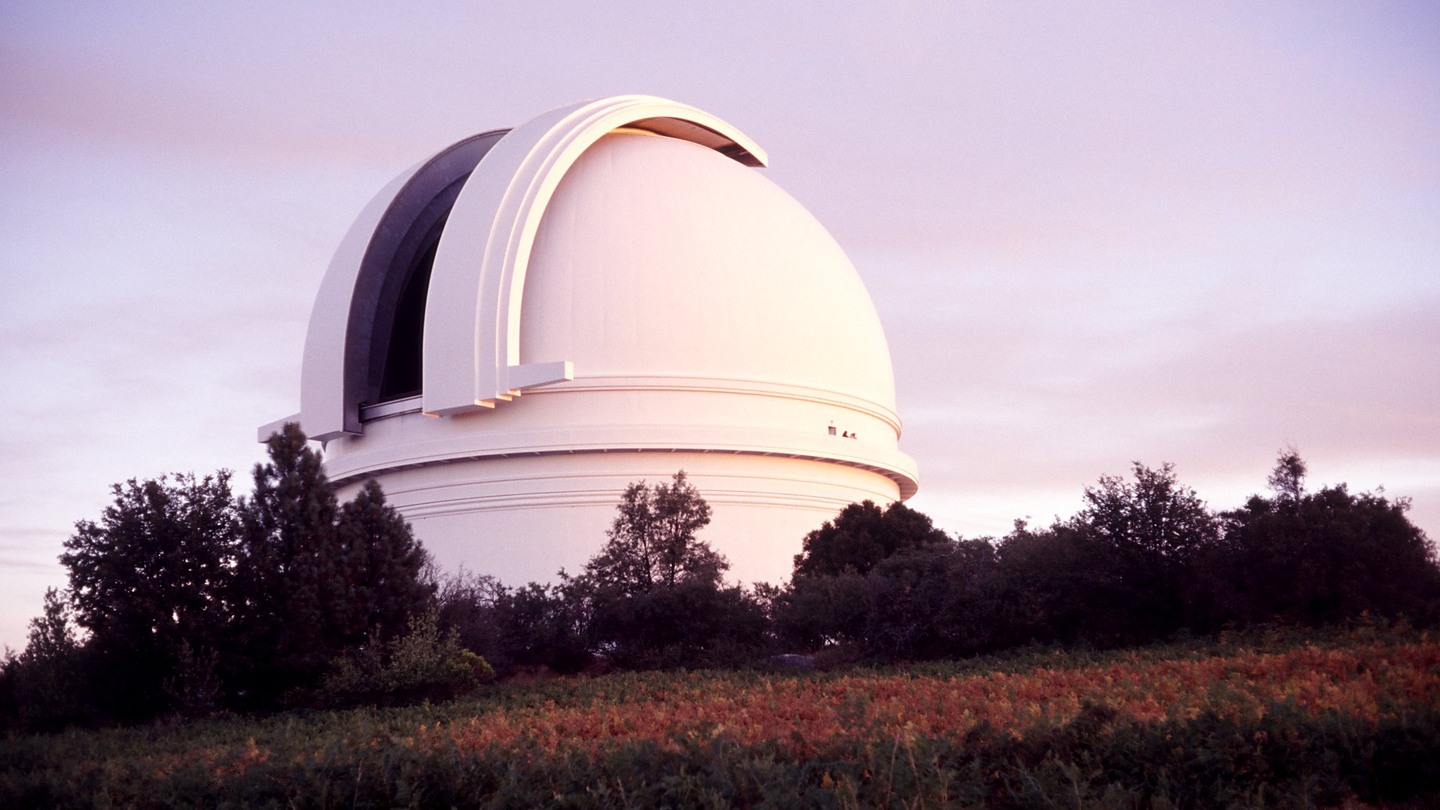
Light from a star 360 light-years away does not reach a telescope in a perfectly random stream. At Palomar Observatory in California, two detectors found that photons from the star system Rasalgethi were more likely to register close together than a random stream would predict. The excess showed up over a fraction of a nanosecond. Astronomers had measured signs of this bunching before; the team reports that it could now resolve its short timescale in light from a star beyond the Sun.[1][2][3]
What it means for starlight to bunch
One way to picture the measurement is to imagine two microphones listening to the same distant rainstorm. If the storm comes in tiny bursts, the recordings will have more near-simultaneous clicks than two unrelated streams with the same average rate. At Palomar, the researchers split filtered starlight between two photon counters and compared the arrival times. They were not finding pairs physically stuck together or seeing the star flash. They were measuring a statistical pattern in the light, one that hot sources such as stars naturally produce.[1][3][5]
The obstacle is timing. Across a wide range of colors, the fluctuations in starlight are generally much faster than the detectors can distinguish. By letting through only a very narrow range of infrared light, the team made the fluctuations in the filtered light last long enough to measure. The Hale Telescope’s adaptive optics helped undo the blurring caused by Earth’s atmosphere, concentrating enough of the light into a single optical fiber. The filtering trades away most of the light, which makes every usable detection count.[1][4]
Seven hours to see a fraction of a nanosecond
The result, reported in a preprint first listed November 24, came from seven hours of usable data on the third night, July 4–5. On the first two nights the star signals were close to the rates at which the detectors registered events in the dark. For the usable data, the team measured a peak of 1.3 ± 0.1 on a scale where 1 is the uncorrelated baseline. That is about a 30 percent excess of near-coincident detections at the peak. The fitted coherence timescale was 0.3 ± 0.1 nanoseconds. A thermal lamp tested in the lab produced a similar measured peak.[1]
Those numbers help explain why this is more than a repeat of an earlier starlight result. In 2017, a team detected bunching in three bright stars, but its timing response broadened the peak beyond the underlying timescale. Its measured contrast was about 0.2 percent rather than 30 percent; the instruments and targets were different, so this is not a comparison of the stars themselves. The 2014 experiment with sunlight had already shown how filtering could make the effect much clearer. The new observation brings that approach to a much fainter target, though it still relied on one usable night. Faster detectors may let future experiments waste fewer photons. That is the next test for a method whose payoff is another way of telling what kind of light a distant object is emitting.[1][2][3]