
A tiny chip uses light to turn light down
A pulse aimed at one of two paths changed how much light came out of a room-temperature crystal circuit.
Reading tools for text size, copying, printing and your reading list
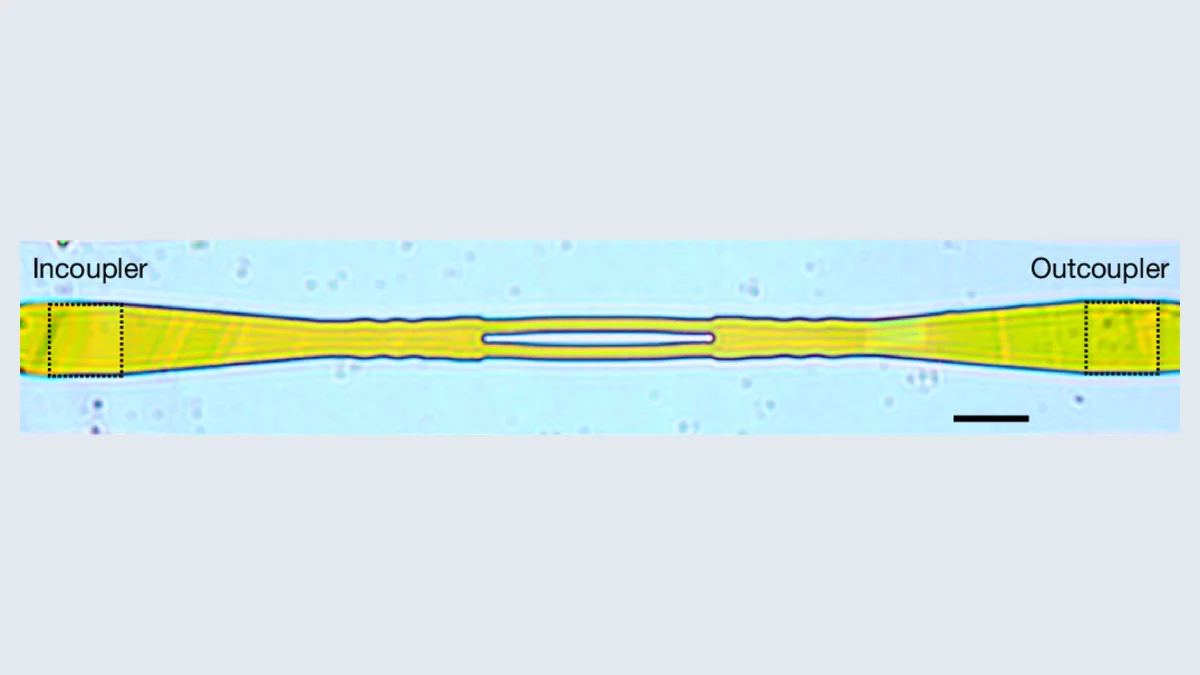
Shine a laser pulse onto one branch of a tiny crystal chip and the light coming out the other end dims sharply. Turn up the control pulse, and the output brightens again. A team led by researchers at Italy’s National Research Council demonstrated that switch on a perovskite circuit at room temperature, in a paper published Nov. 18 in Nature.[1]
The surprise is that the pulse doesn’t have to block a path to dim the output. It changes how the light waves from two paths line up when they meet. In the lab, externally supplied lasers drove the test. The chip did not run a program or store quantum information; it demonstrated one of the basic operations that future optical circuits might use.
Two paths, one output
The input signal splits at a fork, travels along two branches and rejoins at the far end. Think of two sets of ripples crossing in a pond. When their crests meet, they reinforce each other; a crest meeting a trough can cancel some of the motion. In the chip, a second beam moves the crests and troughs in one branch out of step with the other.
Inside the crystal, the light couples to excitations in the material. The hybrid waves, called polaritons, can travel along the chip and respond more strongly to the control pulse than light ordinarily responds to another beam. In a separate forked device, the team measured a relative shift approaching a full wave cycle. The full switch converted this sort of shift into a change in brightness at its single output. With the pulses aligned at the control spot, the detector counted roughly a tenth as much output at the dip as at the low-energy end of the scan. The count rose again for stronger pulses.[1]
What changed since the preprint
The team’s December 2025 preprint already showed guided lasing and amplification, along with signs that the signal could alter its own phase. What the November paper adds is a measurement of how a separate pulse controls the relative phase between two paths, and a split-and-recombine device that uses that control to switch its output.[2][1]
It’s not the first switch made from perovskite. In another 2025 study, members of the team used a different switching mechanism involving light confined in a straight microwire. The newer experiment adds an option for designers: control the way two signals combine instead of only controlling transmission along one path. A different material system demonstrated the split-path idea years earlier; the advance here is implementing it in a grown perovskite waveguide at room temperature.[3][4]
Why a small switch matters
An optical circuit needs more than a material that carries light, just as electronic circuits need more than wires. A way to change one signal with another would let an optical system do something to the information moving through it. That is the piece this experiment tests. It sits alongside separate engineering challenges: building low-loss switches for photonic systems and filtering unwanted light on a chip.
The useful next test is whether one device’s output can drive another with enough signal left over to keep going. That would tell engineers much more about whether these tiny switches can do useful work together.