
Skip to content
RESEARCH · RESEARCH UPDATE

A photon chip brings its noise filters closer to the source

Darmstadt researchers combine photon generation and filtering, while external equipment and unexplained noise still limit the system.

Published Updated Source report Sources checked
Reading tools for text size, copying, printing and your reading list
My reading list
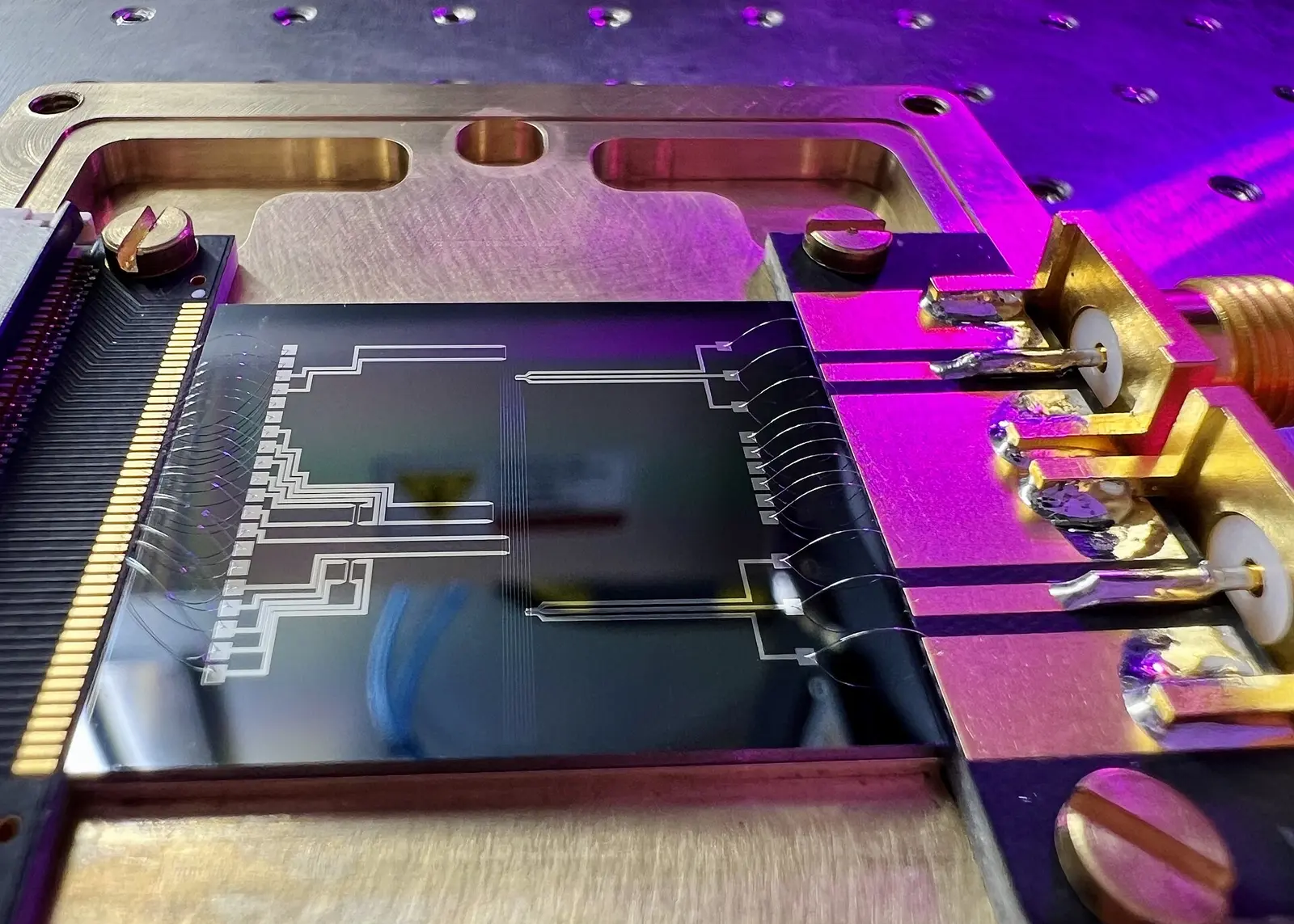
A small photonic chip connected by thin gold wires inside a metal package.
Illustrative photoFMNLab

Researchers at TU Darmstadt have tested a silicon-nitride chip that generates photon pairs and filters unwanted light nearby. Their paper, published November 13 in Physical Review A, examines a practical miniaturization problem: unwanted photons can be generated between optical components.[1]

Filters clean incoming laser light just before photon generation, then remove residual laser light afterward. Less distance between these stages means less opportunity for unwanted photons.[1]

With two receivers connected directly to the source, the experiment produced an average 3.39 secure-key bits per second after correcting bit errors and applying privacy amplification. It ran for more than two hours.[1]

Follow the light through the filter chip

In the authors’ diagram, the green rings clean up the incoming laser light. The blue region generates photon pairs. Filtering on the chip shortens the path where unwanted photons can build up.

Open Figure 2, the team’s chip design · Mengler and colleagues, Physical Review A

Active feedback kept the photon-generating resonator stable. The run eventually ended because temperature drift affected the external interferometers. An unexplained noise process also reduced useful output.[1]

The pump laser and wavelength-splitting equipment remained external. Serving multiple users is a proposed use, not the network demonstrated in this experiment.[1]

The underlying chip, filtering design and noise problem appeared in an April review by the group. The new journal report adds detailed characterization; it should not be read as a newly launched communications service.[1][2]

Keep your reading trail

Evidence & context

2 linked sources

Experiment

How to read the evidence and dates

An announcement records what an organization stated. An experiment reports an observation. A simulation or resource estimate depends on its assumptions. QubitWire’s analysis connects these sources; the labels are not quality scores.

Published is the article’s first QubitWire publication. Updated marks a substantive content change. Sources checked records a review of the underlying evidence. An older paper can support a new explanation, and another press release about the same work is not independent replication.

For material corrections, check the article’s context note and source trail. A routine formatting or link change does not create a new scientific result.

Sources

  1. Mengler et al., integrated photon-pair source (Physical Review A)

    November 13, 2026. Chip characterization and direct two-receiver key-rate tests.

  2. Tippmann et al., practical quantum key distribution networks (mini-review)

    April 25, 2026. Background on network designs, the integrated chip and signal processing.

READ NEXT

Continue exploring

All Research stories
  1. Quantum photonics

    A Photonic Quantum Prototype Put Its Light Sources and Router on One Chip

    A new preprint reports two tunable quantum-dot emitters, cryogenic routing and single-photon tests in one GaAs circuit. The integration matters more than the device count.

    Published · Source report · Sources checked · About 2 min read
  2. Quantum photonics

    An Entangled-Photon Source Made From Off-the-Shelf Parts Faces a Familiar Tradeoff

    An October 6 preprint demonstrates a fiber-connected telecom photon source. More pump power brings more pairs, but their quantum-state quality falls.

    Published · Source report · Sources checked · About 6 min read