
These quantum bits store information in where an atom sits
A peer-reviewed study links 123 position-based qubits in a grid. The researchers demonstrated computing operations on much smaller groups.
Reading tools for text size, copying, printing and your reading list
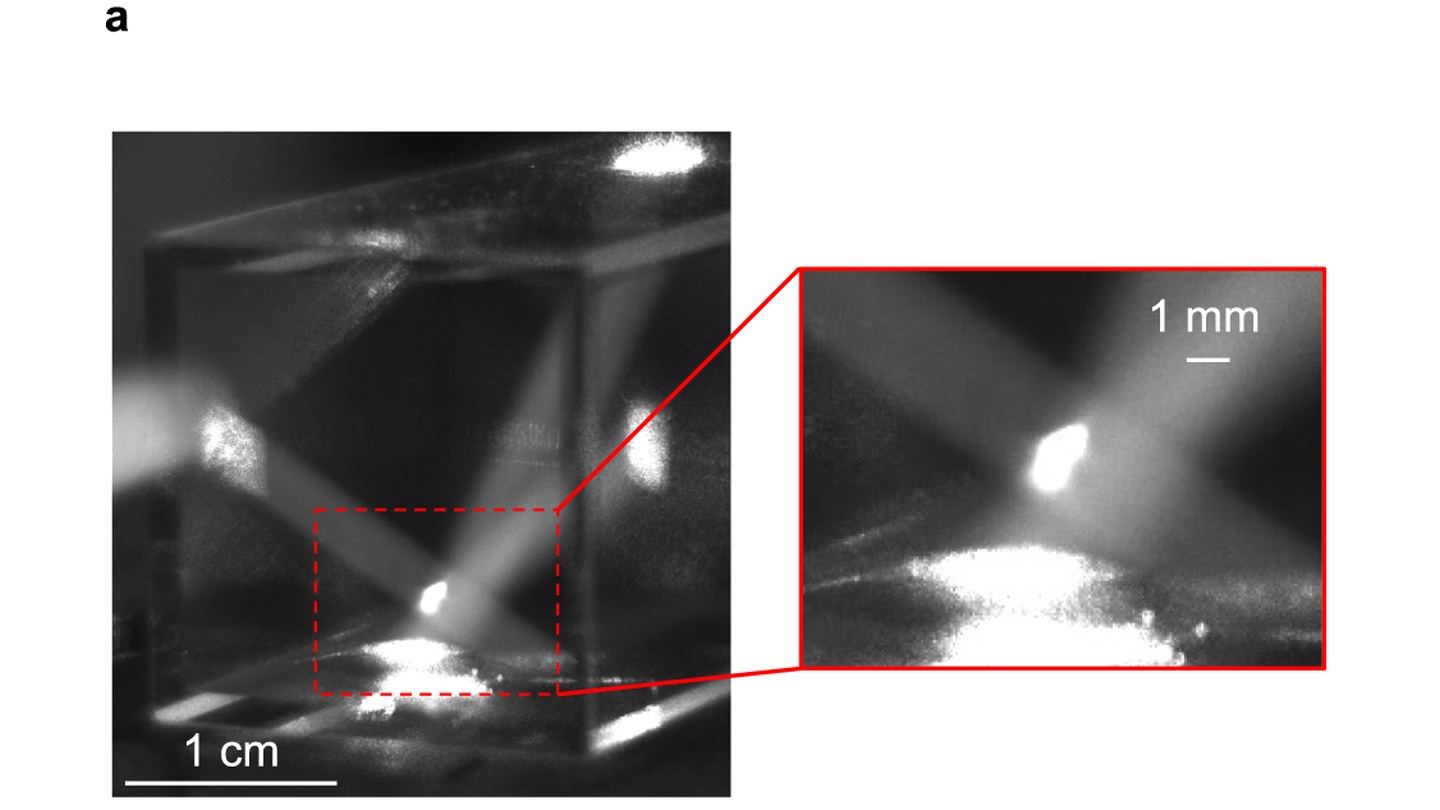
In a quantum experiment at the University of Science and Technology of China, the difference between a zero and a one was which side of a tiny trap an atom occupied. Researchers used that idea to build a grid of ultracold rubidium atoms and test whether quantum extended across 123 of them. The experiment first appeared as a 2025 preprint; Physical Review Letters published the peer-reviewed paper on November 24.[1][2]
Two seats, one atom
Picture an egg carton made of light, with the depressions arranged in pairs. Each pair holds one atom. Finding the atom in the left spot means zero; finding it on the right means one. Before measurement, the atom can be in a superposition of the two locations. The is not an atom circling a nucleus, and it does not need two separate atoms to store the two possible values.[1][2][3]
A laser-made grid is useful because a common operation can act on many atoms in parallel. The challenge is making a more selective operation without affecting the atoms next door. The team used another property of the same rubidium atoms, their internal spin state, to help control which atoms could tunnel between selected sites. In effect, position held the information, while spin helped determine where a particular interaction could take place.[1][2]
What the 123-qubit test measured
The researchers used two successive layers of entangling operations to connect a two-dimensional region. They looked at patterns of results from measurements of neighboring atoms and their surroundings, not simply whether the atoms occupied adjacent spots. Those patterns gave evidence that no fixed division of the 123-qubit region could split it into two unentangled parts. That is a specific statistical result, not proof of a perfect grid. The test did not establish the stronger claim that rules out mixtures involving different divisions, and it was not a 123-qubit calculation.[1][2]
The computing demonstrations were separate. On clusters of three or four qubits, the researchers used a sequence of measurements to carry out simple operations, including one that entangled two logical outputs. This approach prepares a connected state first and uses measurements to do the computing, rather than applying a long series of gates to individual qubits while a calculation is running. For a useful larger calculation, preparing the grid well is only the start. The measurements still have to yield reliable outputs.[1][2][3]
The distinction matters because one number describes scale and the other describes control. The preprint reports an estimated 94.8% average fidelity for a specific physical entangling gate in the tested region, not for the entire cluster or for a completed algorithm. The 123-qubit result shows that the team could build a large connected resource. A harder next test would be to use much more of it in one calculation and verify that the answer stays reliable.[1][2]
Keep your reading trail
Keep up with these topics
Explore the subjects covered in this story.