
Skip to content
RESEARCH · QUANTUM ERROR CORRECTION

A Quantum Chip Works Around Its Weak Spots

An experimental preprint tests a workaround for imperfect quantum hardware.
Published Source report Sources checked
My reading list
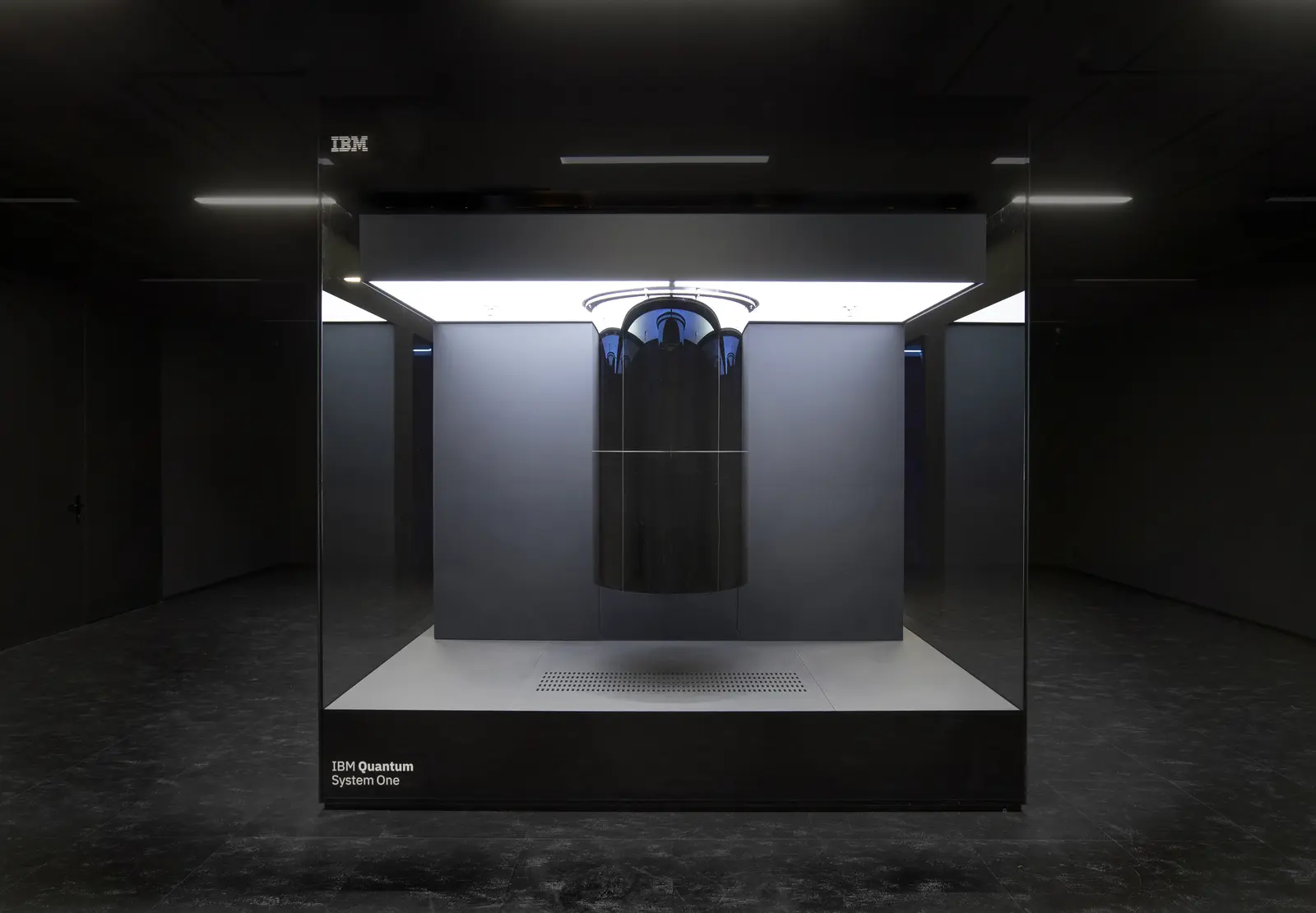
IBM Quantum System One inside its glass enclosure in Ehningen, Germany.
IBM Quantum System One in Ehningen, Germany, photographed in June 2021. Archival hardware context; this is not the Boston processor or the experiment described in the October 8 preprint.Holger Muench / IBM Research, CC BY 2.0 · Creative Commons Attribution 2.0 GenericFull image credit

An October 8 experimental preprint adapts around weak components on IBM’s 156- Boston processor. The question is how much reliability can be recovered from imperfect hardware.[1][2]

Researchers rewrote a dynamic compass code’s measurements to avoid selected qubits and couplers. Its code distance, a measure of error protection, fell from seven to five. Yet memory performance improved with noise-informed decoding and no rejected runs. Average 3×3 patches still performed better.[2]

Separate lattice-surgery tests joined two protected qubits. Their state’s estimated fidelity, or closeness to the target, was bounded at 95.8–97.8% while retaining 4.55% of all attempts. Another setting’s 27% yield counts only attempts already passing an earlier filter.[2]

QubitWire’s analysis: nominal protection and measured reliability need separate scorecards. A design that looks stronger on paper can be the wrong choice for the available machine. The practical target should be a reproducible operating recipe: identify trouble, choose a configuration, then deliver the requested operation at a stated reliability. That is a more demanding test than finding one favorable setting.[2]

For a reader comparing results, write the denominator beside the headline number. Ask whether acceptance is measured from the first attempt or from an already screened subset. Neither convention is inherently wrong; omitting the starting point makes comparisons unreliable. A high-quality accepted output and a productive machine are related goals, but each needs its own measurement.[2]

A useful next test would freeze the rules for choosing which components to exclude before collecting fresh data across multiple devices and days. Report all attempts, accepted outputs and elapsed time for the same target operation. Include an unchanged configuration as the control. This proposed comparison would help distinguish a repeatable engineering improvement from a result that depends on extensive case-by-case tuning.[2]

Keep your reading trail

Your Updates →

Evidence & context

2 linked sources

Experimental preprint. Conditional fidelity is not unconditional performance.

How to read the evidence and dates

An announcement records what an organization stated. An experiment reports an observation. A simulation or resource estimate depends on its assumptions. QubitWire’s analysis connects these sources; the labels are not quality scores.

Published is the article’s first QubitWire publication. Updated marks a substantive content change. Sources checked records a review of the underlying evidence. An older paper can support a new explanation, and another press release about the same work is not independent replication.

QubitWire take

Judge an operating recipe by repeatable results and its complete resource bill. Put the acceptance denominator beside the accuracy number.

Sources

  1. McLauchlan et al. | Preprint record

    October 8, 2026.

  2. Primary full text

    One study; not independent corroboration.

Keep up with these topics

Choose the subjects you want to find again in Your Updates.

READ NEXT

Continue exploring

All Research stories
  1. Related reading

    A QEC Error Map Says Fix the 5% of Components That Hurt Most

    Tsinghua simulations rank each circuit component by its contribution to logical failure, then show targeted improvements beat the same budget spent at random.

    Published · Source report · Sources checked
  2. Related reading

    Quantum Computers Can Make Mistakes While They Wait

    Qubits can accumulate errors while they wait. A surface-code experiment shows why the pauses between operations deserve more attention.

    Published · Sources checked
THE QUANTUM BRIEFING

A clearer signal.
Read the latest edition.

A little perspective on a fast-moving field.

Read the on-site briefing →

Read selected quantum coverage in the on-site briefing, or register your interest below.