
A Quantum-Chip Layout Tool Has a Promising Result—and a Public-Release Catch
An October 6 preprint automates superconducting-chip layouts. Current project documentation says the public release does not yet include the routing stage.

The MQT SCPD research prototype can draw the wiring of a quantum chip before the public software is ready to repeat the job. An October 6 preprint reports automated layouts for planar superconducting processors. But the accompanying project's current benchmark guide makes a crucial distinction: its public release reads, checks, draws and exports chip inputs; it does not route them yet. That gap matters to anyone interpreting the announcement as an immediately available end-to-end design tool.[1][2][3]
The advance is in the layout step
The proposed flow tackles physical layout, not the execution of quantum algorithms. It divides space into manageable regions, assigns component connections and routes the wiring under geometric constraints. A useful route must satisfy requirements such as clearances, bends and specified resonator lengths. In this setting, connecting two points is an engineering problem with physical consequences, not simply drawing the shortest line between them.[1][2]
The paper evaluates layouts spanning four to 69 , while noting that the larger planar instances test algorithmic scalability beyond practical boundary-port limits. These are design benchmarks, not reports of newly operating processors. It also notes differences from competing problem formulations, making its speed comparisons less straightforward than a same-input race. Faster layout generation does not establish better coherence, or manufacturing yield.[1][2]
Published output is different from a repeatable workflow
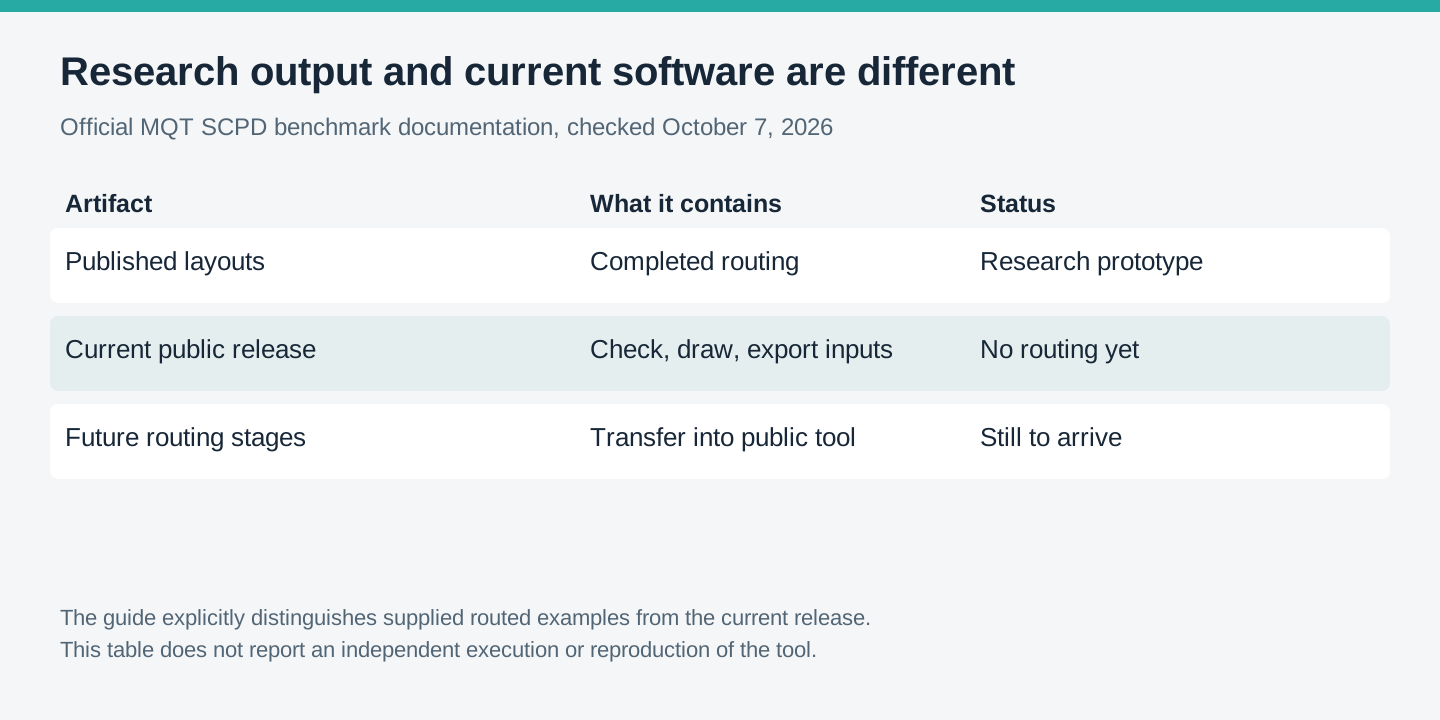
The implementation's benchmark guide provides the operational detail a reader needs. Published routed layouts and quality-of-results data come from the research prototype. The public implementation is being transferred in stages. At the time of this check, its commands inspect inputs and generate drawings or layout files without reproducing the routing stage. An exported chip file can therefore be a valid output of the released software while still lacking the completed wiring shown in the paper.[3]
The MIT-licensed project distributes a Python package, but installation alone does not establish that every research capability is available. Its README says it supports routing, while the more specific benchmark guide explicitly says that stage is not in the current release. QubitWire has not independently executed the package; this availability assessment follows the guide and its documented commands. Users should check which exact release reproduces each promised stage.[3][4]
Why design software still needs several stages
A separate established tool, Quantum Metal, supplies useful context. Its official workflow describes assembling superconducting components such as transmons and resonators, changing parameters and using connection algorithms. Its documentation also separates routing, design-rule checks, layout export and electromagnetic analysis. This is a substantive existing ecosystem rather than a blank field waiting for its first design software. The new research should be judged by the particular automation and constraints it adds.[5][6]
Quantum Metal's analysis examples include capacitance, eigenmode and scattering calculations. Those stages answer questions a geometric drawing alone cannot settle. The distinction also explains why a designer may value a better router without claiming that it replaces simulation or fabrication. A layout can satisfy its stated drawing rules and still require evaluation of how the complete device behaves. Different tools can contribute to that process without being interchangeable implementations of the same benchmark.[5][6]
A useful test for open research tools
QubitWire's interpretation is that quantum-software announcements need two separate forms of evidence: the research output and the current release's reproducible behavior. A paper can establish an interesting method while the packaged implementation remains incomplete. Equally, a convenient package can exist without demonstrating that its outputs meet a user's full engineering requirements. Keeping those claims separate rewards transparent development rather than penalizing teams for honestly documenting what remains unfinished.[2][3][5]
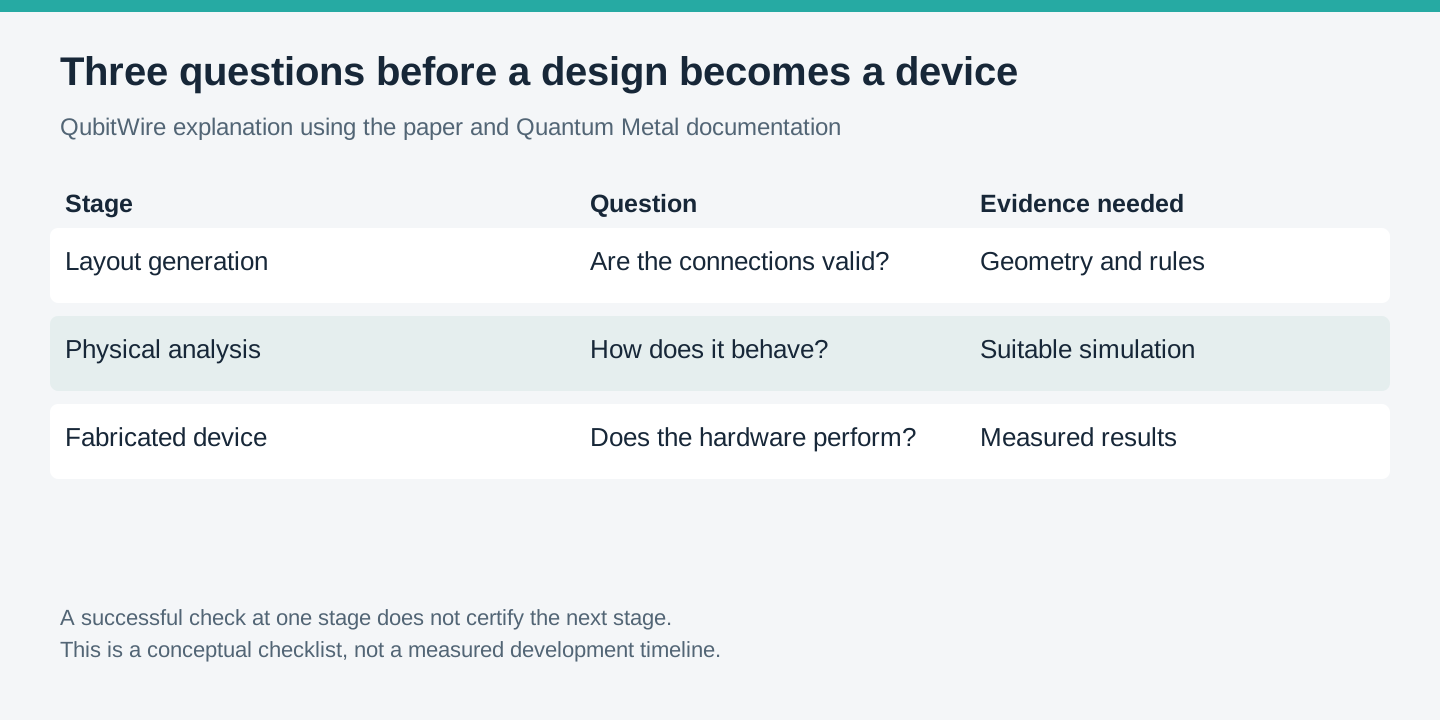
For an engineering team, the practical acceptance test starts with its own representative input. Can the released tool validate that input, generate the requested connections, expose constraint violations and export the result for the next analysis stage? Published examples are valuable references, but they should not silently substitute for those operations. This is QubitWire's proposed evaluation checklist, not a test we ran or a report that the public package failed a user's design.[3][5]
That distinction also keeps the physical claim proportionate. A routing benchmark does not require a working quantum computer to be useful; reducing layout effort can make design iteration easier. Yet the benefit should be measured where it occurs. The evidence here concerns a prototype flow and its design outputs. It does not demonstrate a quantum computational speedup or an automatic route from a qubit diagram to a qualified processor.[1][2][3]
What would close the adoption gap
The next useful milestone is a released routing implementation that reproduces the published examples from their inputs, followed by clearly documented tests on additional designs. Readers should then look for downstream validation appropriate to the fabrication process. For now, the story is a promising automation result with an unusually clear adoption boundary: the research prototype routes chips, while the current public release prepares and exports their inputs.[2][3][5]