
Skip to content
APPLICATIONS · EXPLAINER · QUANTUM CURIOSITIES

A Quantum Computer Made Random Numbers. The Wild Part Was Checking Them.

A 56-qubit machine and several supercomputers tackled a surprisingly tricky question: can you trust someone else’s digital coin toss?
Sources checked Published
My reading list
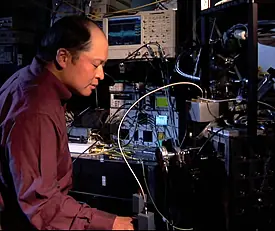
CURBy team members Jasper Palfree, Gautam Kavuri and Krister Shalm in the laboratory that produces publicly verifiable quantum random numbers. Context from a separate NIST/CU Boulder randomness project; this is not the Quantinuum H2-1 experiment.
Photo: NIST

CURBy team members Jasper Palfree, Gautam Kavuri and Krister Shalm in the laboratory that produces publicly verifiable quantum random numbers. Context from a separate NIST/CU Boulder randomness project; this is not the Quantinuum H2-1 experiment. Image credit“CURBy team members Palfree, Kavuri and Shalm” — NIST. NIST public information reuse policy. · https://www.nist.gov/copyrights-disclaimers

Suppose a stranger online offers to flip a coin for you. You receive heads or tails, but how do you know they actually flipped anything? A quantum-computing experiment published in March 2025 tackled a much more sophisticated version of that trust problem: producing remotely generated randomness that could be checked.

The team used Quantinuum’s 56- H2-1 computer as an untrusted server. Researchers sent it carefully chosen quantum circuits, essentially small programs, and required quick responses. The answers carried statistical features associated with those circuits, making the task much harder to fake with a conventional computer under the experiment’s assumptions.
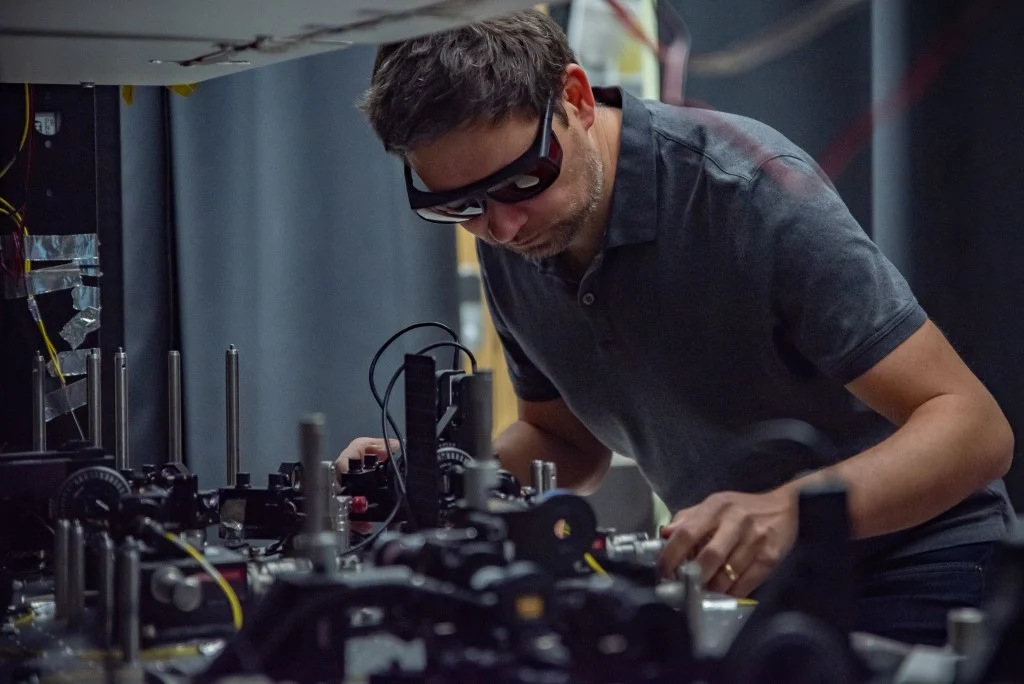
NIST physicist Krister Shalm at an optical setup. The 2023 profile describes his research on entanglement, randomness and quantum networks. Context for optical quantum research; this is not the Quantinuum H2-1 experiment.
NIST physicist Krister Shalm at an optical setup. The 2023 profile describes his research on entanglement, randomness and quantum networks. Context for optical quantum research; this is not the Quantinuum H2-1 experiment. Image credit“NIST Quantum Physicist Krister Shalm” — R. Wilson / NIST. NIST public information reuse policy. · https://www.nist.gov/copyrights-disclaimers

Then came the expensive checking. As JPMorganChase’s research team explains, four supercomputers helped verify the results, including Oak Ridge’s Frontier. The researchers certified 71,313 bits of entropy: a quantified amount of unpredictability in the output. The achievement concerned evidence about the randomness, not merely producing a string that looked jumbled.

The qualification matters. The paper’s guarantee covered a restricted class of potential adversaries and depended on additional assumptions. This was not an unconditional proof against every possible attacker. Ordinary computers also already obtain randomness from physical sources; the experiment explored how to reduce trust in a remote provider.

That makes randomness an intriguing quantum-computing application, with potential uses wherever people need unpredictable choices they can scrutinize. It also shows how demanding a useful demonstration can be: a quantum machine supplied answers, while substantial classical computing did the checking. A digital coin toss became an unusually serious collaboration.

READ NEXT

Continue exploring

All Applications stories
  1. More on hybrid computing

    Allstate and IBM Test a Hybrid Insurance-Portfolio Workflow

    The research combines quantum-generated candidate portfolios with classical repair and compares results against classical methods.

    Source date
  2. More on hybrid computing

    JION Launch Brings Microwave-Controlled Ions to Jülich

    The newly inaugurated quantum computer is operational, with qualification, broader access and supercomputer integration still progressing.

    Source date
THE QUANTUM BRIEFING

A clearer signal.
Straight to your inbox.

A little perspective on a fast-moving field.

Read a briefing preview →

Selected quantum coverage in a weekly briefing. Read the preview or register your interest.