
Quantinuum's 55-Qubit Game Makes Non-Classicality Easier to Check
H2 beat the optimal classical score in an efficiently checked experiment, but this was a device test—not a useful computational speedup.
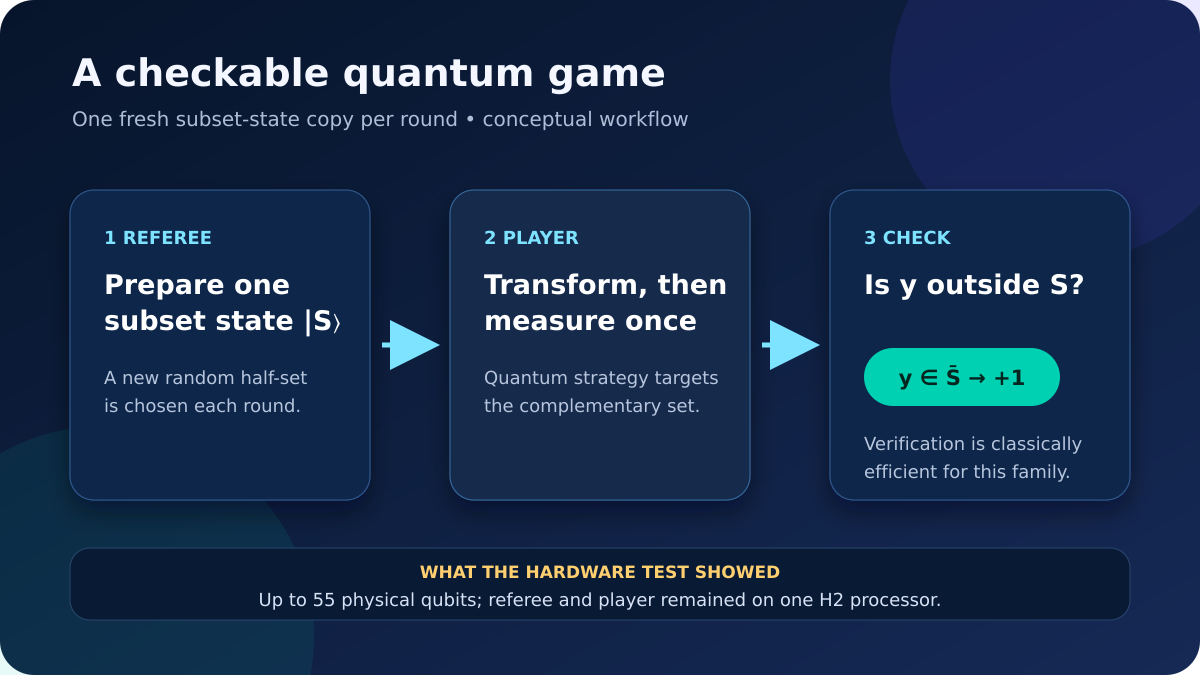
Quantinuum’s H2 trapped-ion processor beat the best classical expected score in a new complement-sampling game, according to a Nature Communications paper published September 5. The test ran 1,200 distinct circuits, taking one sample from each, across settings as large as 55 .
The game asks a quantum player to transform a state representing half of all possible bit strings, then return a string from the missing half. A classical computer given one sample can do only slightly better than guessing, while an ideal quantum strategy succeeds every round—and the referee can check each answer efficiently.
Across every reported size, the experiment’s p-value bound stayed below the authors’ 0.01 threshold for rejecting strategies no better than the optimal classical score. The largest setting used 37-bit strings, 55 physical qubits, 500 rounds and about 227.61 native two-qubit gates per circuit on average.
This is a test of non-classical behavior, not a practical speedup or useful application. The exponential score ratio belongs to the ideal one-copy game; hardware noise pulled measured scores down. The referee’s state preparation had to be trusted, referee and player sat on the same processor, and several confidence intervals overlapped the region where a rerun might not reject the classical benchmark.
A stronger demonstration would separate referee and player across a real quantum link, tighten state-preparation checks and repeat the protocol on independent hardware. More rounds can improve statistical confidence, but they do not close those device-trust or same-machine loopholes.