
Skip to content
APPLICATIONS · QUANTUM SENSING

A quantum shortcut for dark-matter searches has a memory problem

A theory proposal handles a changing signal. Its exact detector design remains impractical.

Published Updated Source report Sources checked
Reading tools for text size, copying, printing and your reading list
My reading list
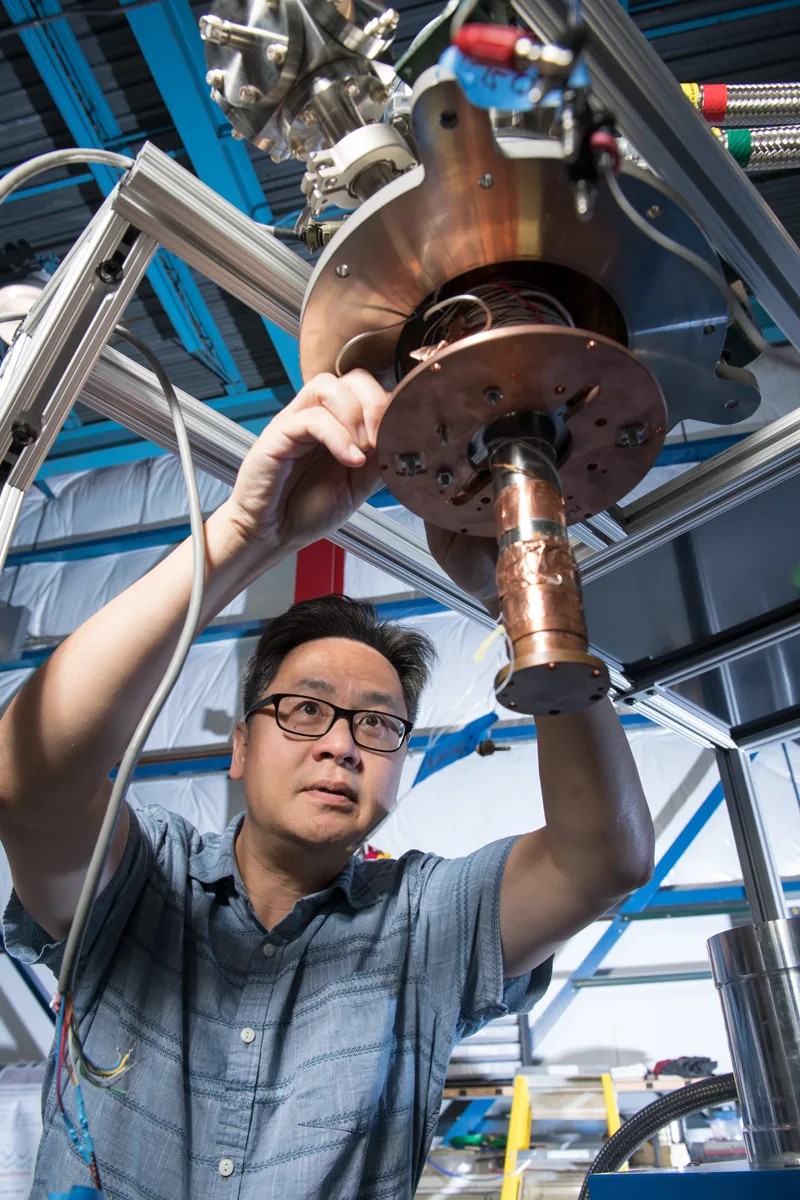
A researcher works beneath copper-colored cylindrical quantum-sensing hardware in a laboratory.
Quantum-sensing hardware at Fermilab.Illustrative photoReidar Hahn / Fermilab

Looking for wave-like dark matter can mean scanning many frequencies without knowing which one might carry a signal. A November 10 theory preprint from Fermilab asks whether a quantum search algorithm could cut that repetition.[1]

Zachary Bogorad and Roni Harnik connect a model sensor to , the information-carrying units of a quantum computer. The qubits represent ranges where a dark-matter signal might oscillate. A signal could shift the phase of the quantum state representing a nearby frequency range, even as the signal’s own phase drifts. Grover’s algorithm uses that mark to make the candidate more likely to appear when the qubits are read.[1]

The readout would still need a follow-up measurement to check whether a real signal is present. The protocol also repeats the search with different settings to cover unknown signal strengths. Under demanding coherence and control assumptions, the search-time advantage over sequential scanning scales with the square root of the number of frequency intervals, apart from constants and logarithmic overheads.[1]

The catch is quantum memory: retaining the relationships between qubits throughout the search. At competitive weak-signal sensitivities, the required coherence can span weeks to years. In this coupling, correcting register phase errors would also erase the signal.[1]

The authors call this exact detector design nonviable. Their contribution is a theoretical route around a fluctuating signal, not a working dark-matter detector or a measured speedup.[1]

Keep your reading trail

Evidence & context

2 linked sources

Theoretical preprint; no dark-matter detection or measured hardware speedup

How to read the evidence and dates

An announcement records what an organization stated. An experiment reports an observation. A simulation or resource estimate depends on its assumptions. QubitWire’s analysis connects these sources; the labels are not quality scores.

Published is the article’s first QubitWire publication. Updated marks a substantive content change. Sources checked records a review of the underlying evidence. An older paper can support a new explanation, and another press release about the same work is not independent replication.

For material corrections, check the article’s context note and source trail. A routine formatting or link change does not create a new scientific result.

QubitWire take

A theoretical speedup can survive a changing signal while still demanding quantum memory that the proposed detector cannot supply.

Sources

  1. Zachary Bogorad and Roni Harnik: A Grover-Accelerated Search for Dark Matter, arXiv:2611.14641v1
  2. arXiv submission history
READ NEXT

Continue exploring

All Applications stories
  1. Explore quantum sensing

    A Quantum Search Algorithm Just Learned to Hunt a Real Signal

    A new preprint brings a famous computing idea into a sensing experiment, with an important difference: the unknown signal helps set the search.

    Published · Source report · Sources checked · About 2 min read
  2. Explore quantum sensing

    Four Entangled Qubits Could Become a New Kind of Dark-Matter Listening Device

    A newly funded Fermilab project will test whether four entangled probes can detect a weak signal more effectively than independent sensors. It is a plan for a controlled experiment, not a dark-matter discovery.

    Published · Source report · Sources checked · About 4 min read