
A laser narrower than a human hair shines steadily at room temperature
The laser is just 5.5 micrometers across. Layers of quantum dots helped it keep shining without deep cooling, though it still needed another laser to power it.
Reading tools for text size, copying, printing and your reading list
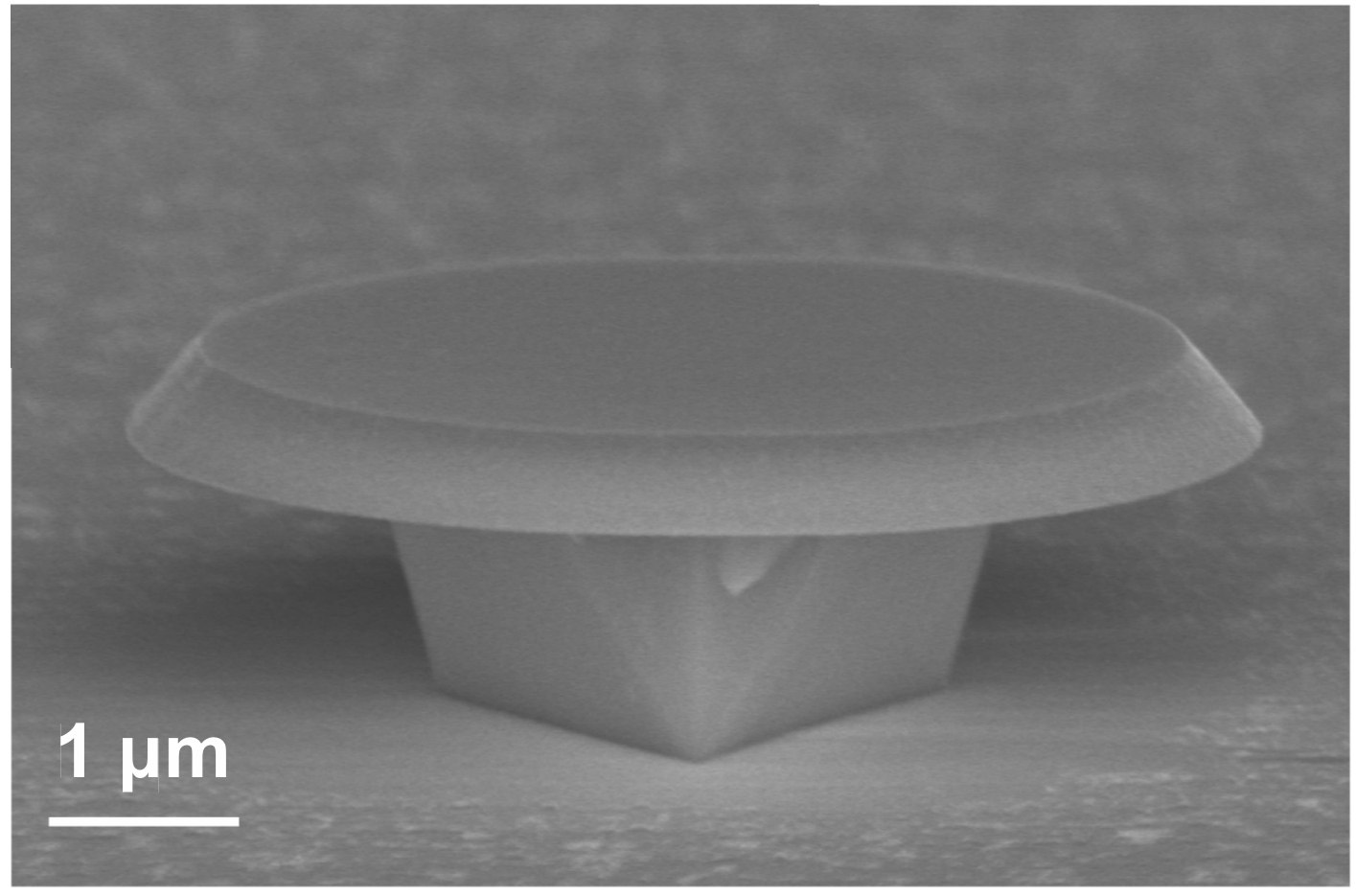
Under an electron microscope, the device looks like a tiny table: a round disk balanced on a short pedestal. The tabletop is only 5.5 micrometers across, a fraction of the width of a human hair. A team led by University College London reported November 27 that the disk produced steady infrared laser light at room temperature. Packing that kind of light source into a small space could matter for chip-scale instruments that identify gases by the wavelengths they absorb.[1][2]
The experiment hit two targets at once. The disk emitted at about 2.064 micrometers, beyond the wavelengths commonly used to carry data along optical fibers, and it could stay on rather than fire in bursts. Microscopic lasers in this part of the infrared have often needed cooling for continuous operation, or have run in pulses near room temperature. The researchers tested one way around that trade-off using a semiconductor platform already familiar to chipmakers: indium phosphide.[1][2]
Why the tiny disk didn’t go dark
The rim of the disk acts like a circular track for light. As the light runs around it, it gets repeated chances to build up at a wavelength that fits. But making the disk smaller puts more of the active material close to the rim. In a more conventional design, the electrons and holes that supply energy to the light can move sideways and meet at defects along that edge, losing their energy without emitting a useful photon.[1][2]
The team built five layers of indium arsenide quantum dots into the disk. These nanoscale regions trap charge carriers in small volumes, making it harder for them to wander to the sidewall. The researchers used a separate laser to supply energy to the disk. At about 22 °C, they saw a clear turn-on at roughly 8.1 milliwatts of incoming pump power, along with the narrowing of the emitted light that distinguishes lasing from a broad glow. That power figure is what the experiment put in at the sample, not what the tiny disk put out.[1][2]
It didn’t do the same thing at 110 °C
The disk kept lasing above 110 °C in a separate test, but the team switched to very short pulses to limit self-heating. At the high end of that test, the laser emitted at about 1.815 micrometers, not the 2.064 micrometers it reached in continuous operation at room temperature. Both results describe the same device, but they are not interchangeable.[1][2]
For a practical instrument, the next test is whether the disk can run on electrical current and send its light into a waveguide on the same chip. The team didn't demonstrate either step. A tiny disk still leaves a bulky system if it needs a separate laser and optics to get going. What it does show is that an infrared source this small can stay on at room temperature, a useful hurdle to clear before engineers try to build the rest of the instrument around it.[1][2]