
A quantum dot tunes a reconstructed quantum signature
A quantum-dot preprint tunes a nonclassical light signature after loss correction. Negativity at the device output remains a hardware goal.

A semiconductor quantum dot produces states with tunable Wigner negativity in a loss-corrected reconstruction back to the emitter, according to an October 26 preprint. The reported purity and fidelity exceed 95% after correction. The authors identify negativity at the device output as a goal for improved hardware.[1]
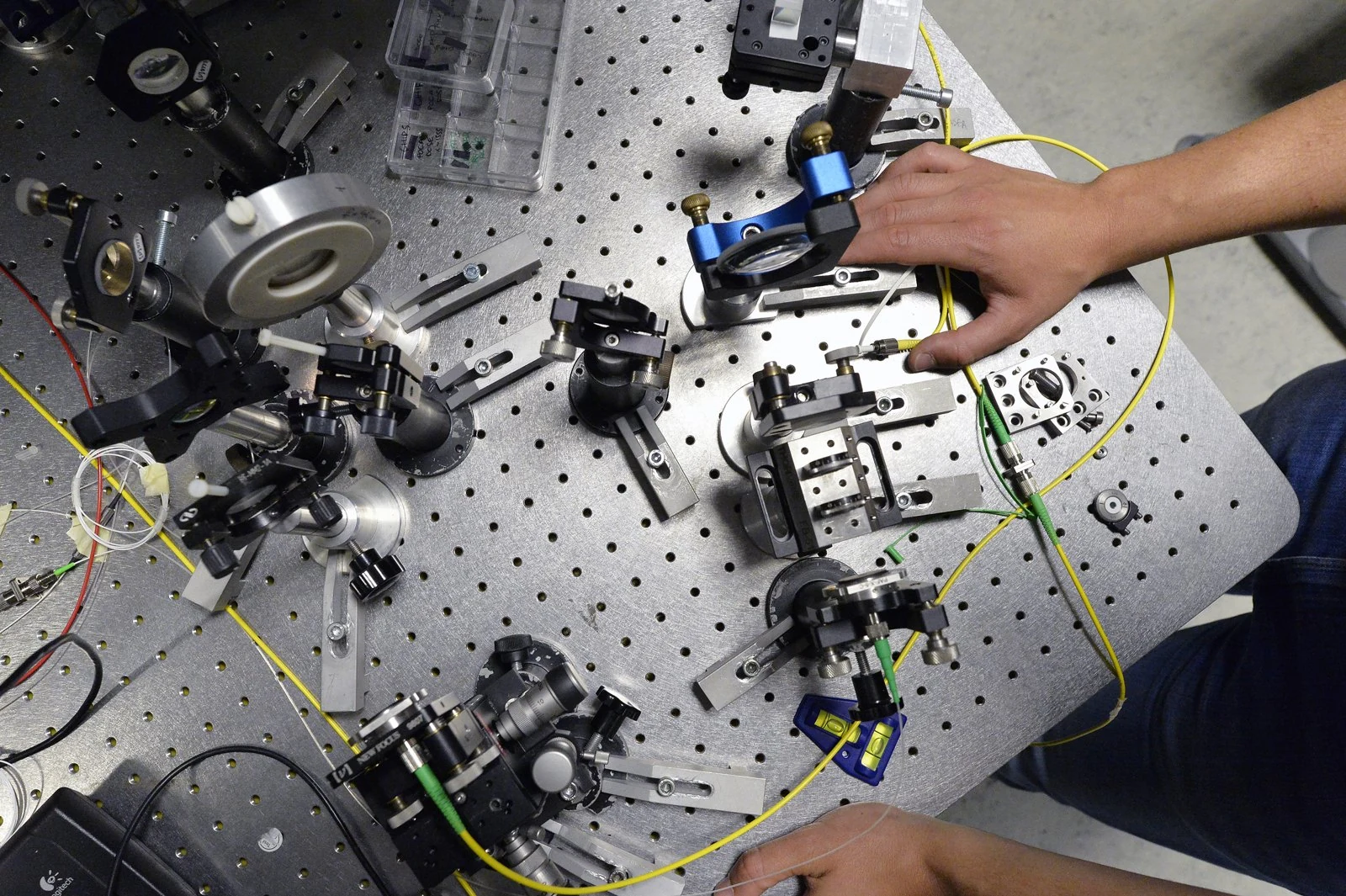
The experiment uses a cavity-coupled quantum dot and homodyne measurements at 5.5 kelvin, driven at 80 megahertz. These operating conditions matter: discussion of faster future sources is not a measurement of this setup at gigahertz repetition rates.[1]
A Wigner function is a way to represent a quantum state in phase space. It resembles a distribution, but its negative regions cannot be interpreted as ordinary negative probabilities. Those regions provide one way of recognizing nonclassical structure in the reconstructed state.
Loss correction answers a specific question: what state is consistent with the observations before the modelled losses? A downstream user has a different question: what state actually reaches the next component? Both questions are legitimate, but their answers should appear under different labels.
This distinction is especially useful when comparing light sources. A high reconstructed-state fidelity does not, on its own, reveal collection efficiency, usable delivery rate or the impact of intervening optics. A comparison table should give each quantity its own column rather than compress them into a single quality score.
The tunability invites a practical research question: can a source provide the particular mixture or superposition required by a later optical operation? The answer must include the state’s arrival conditions as well as its preparation. That is an application question suggested by the result, not an application demonstrated here.
An engineer selecting a source would therefore want both a reconstruction of its preparation and a characterization at the receiving component. Connecting those accounts would show how much of the controllable quantum structure remains usable after delivery. That is where a source result becomes a system-level capability.